If you are vegetarian, lift a few times a week and keep hearing that "plant protein doesn't build muscle like whey", here is the short answer from the research: whey comes out slightly ahead when you pool a lot of studies, but in head-to-head trials where the plant protein is dosed sensibly, the gap mostly disappears. What matters far more is whether you are training properly and eating enough protein across the whole day. Let's look at what the studies actually found, and what that means for a dal-roti-paneer kitchen.
What the newest big analysis found
In August 2026, Frontiers in Nutrition published a network meta-analysis of protein supplements during resistance training. It pulled together 36 randomised trials with 1,552 participants and compared whey, casein, milk, soy, pea, rice and protein blends against placebo.
The headline numbers on lean body mass, compared with placebo:
Whey: about +1.24 kg, and the result was statistically credible.
Soy: about +0.55 kg. Pea: about +0.48 kg. Blends: about +0.62 kg. None of these were credible on their own.
So whey wins? Read the fine print before you throw out your soy chunks. The authors rated the certainty of the evidence as low to very low, and the credible intervals were wide. There were only three pea trials and two rice trials in the whole network, and 72% of all the trials were men only. "Not credible" here mostly means "not enough good studies yet", which is a long way from "doesn't work".
The same paper put a tentative ceiling on whey at around 30 to 35 g a day, beyond which extra supplement added little lean mass. The authors call that estimate exploratory, so treat it as a rough guide.
Head-to-head trials tell a calmer story
Meta-analyses mix studies with different doses, people and programmes. Direct comparisons, where two groups train the same way and only the protein differs, are often more useful for a decision like this one.
Soy vs whey in beginners (12 weeks)
A 2020 randomised trial in the International Journal of Environmental Research and Public Health took untrained men and women aged 18 to 35 and put them through supervised full-body strength training three times a week. One group had 19 g of whey isolate a day, the other 26 g of soy isolate. The doses were set so that both supplements gave about 2 g of leucine, the amino acid that switches on muscle building.
Of the 48 people who finished, the whey group gained roughly 1.5 kg of lean mass and the soy group roughly 1.2 kg. Both got stronger. The difference between the groups was not statistically significant, and the authors concluded that plant protein can support strength and muscle gains comparably to whey when it provides enough leucine.
A soy-pea blend vs whey (12 weeks)
A 2025 trial in the Journal of the International Society of Sports Nutrition gave young men 45 g a day of supplemental protein, either whey or a soy-and-pea blend, alongside leg training three times a week. Total protein intake rose to about 1.7 to 1.8 g per kg of body weight in both groups. Whole-body lean mass went up by about 2.4 kg on the plant blend and 2.5 kg on whey, with no significant difference on any outcome.
One honest caveat: that trial was funded by the company that makes the plant product. The result lines up with the independent soy study above, but it is worth knowing.
Why plant protein needs a bigger scoop
Look again at the soy trial. To match whey on leucine, the soy group needed about 7 g more protein per day. That is the practical lesson. Gram for gram, many plant proteins carry less leucine and a less complete amino acid mix, so you close the gap with a slightly larger serving or by combining sources.
The Indian kitchen has been doing the combining part for centuries. The ICMR-NIN dietary guidelines suggest pairing cereals and pulses in roughly a 3:1 ratio to cover the amino acids your body needs. Rice with dal, roti with rajma, idli with sambar: the pairing is already on your plate.
How much protein you need in the first place
Before choosing a powder, check whether you need one at all. The 2024 ICMR-NIN Dietary Guidelines for Indians set the recommendation at 0.83 g of protein per kg of body weight per day, and note that the average Indian intake is about 0.66 g per kg. Many people really are short.
For people doing resistance training, the same guidelines say that intakes above about 1.6 g per kg per day do not add further muscle gains. They also say protein requirements "are not so high as commonly perceived" and do not recommend protein supplements for healthy people.
A quick worked example for someone who weighs 60 kg:
Baseline need: 60 × 0.83 = about 50 g a day.
Upper useful range if you lift seriously: 60 × 1.6 = about 96 g a day. Eating more than that is unlikely to build extra muscle.
If food gets you into that range, a supplement of any kind is optional. If it doesn't, a scoop is a convenience, not magic.
A simple plan for vegetarian lifters
Here is how I would put the evidence to work, coach to trainee:
Train first. In every trial above, the protein was added to a structured, progressive strength programme. No powder builds muscle on the sofa.
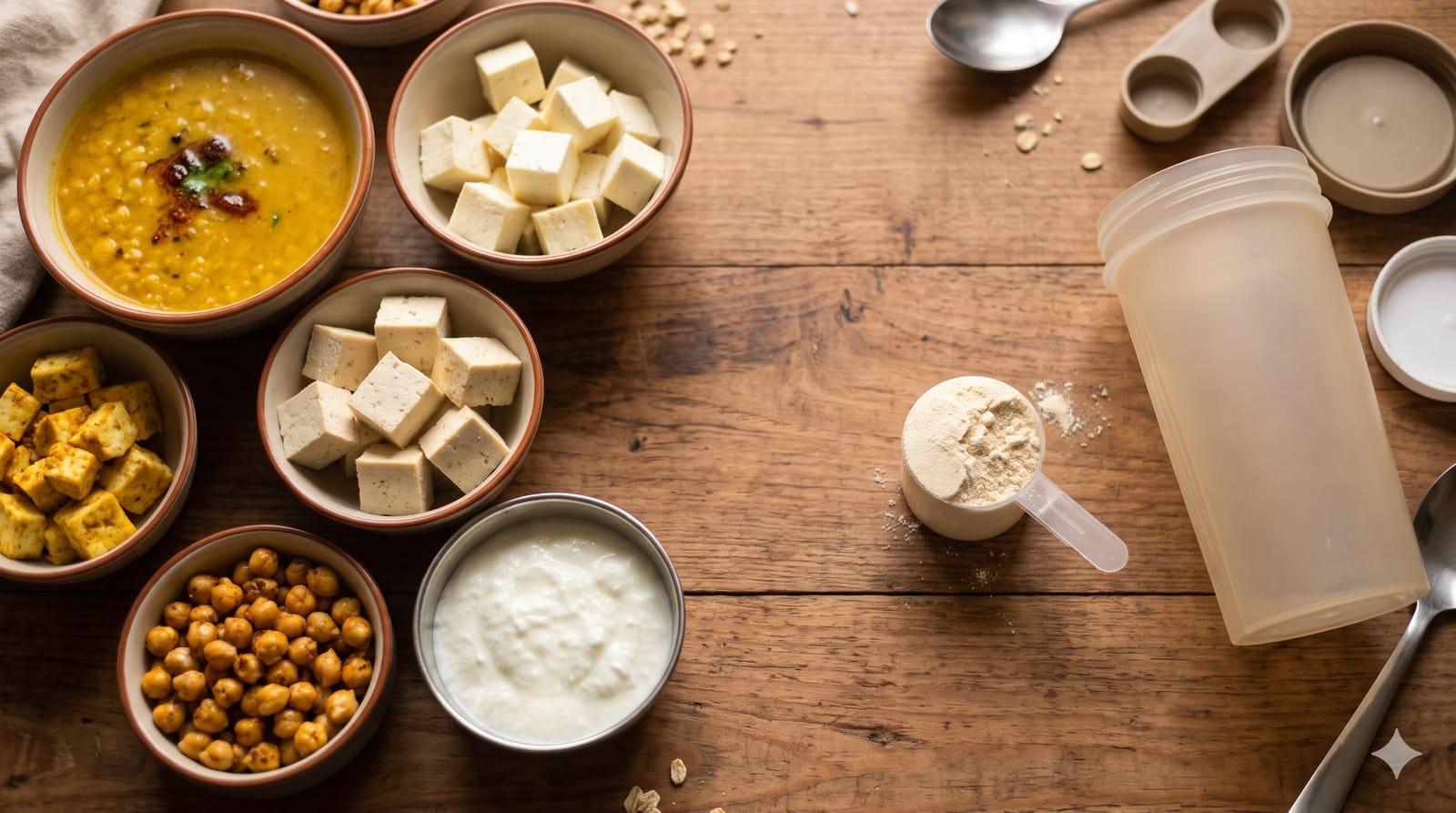
Spread protein across meals. Dal or chana at lunch, paneer or tofu at dinner, curd or eggs (if you eat them) at breakfast. Our earlier look at whether you need protein right after a workout found the total for the day matters more than the exact timing.
Count first, then decide. Tally a normal day for a week. If you sit near your target, skip the supplement.
If you pick a plant powder, go for a soy or soy-pea blend and plan on a slightly bigger serving than you would of whey. Read the pack: our guide to reading food labels under the new FSSAI rules applies to protein tubs too, especially the added sugar line.
If dairy suits you, whey is fine and may give a small edge. The edge is small, and you can match it by eating a bit more plant protein.
Training for an event soon? Our four-week plan before a wedding shows how to fit protein into a busy, sweets-heavy season without crash dieting.
The bottom line
Whey has the strongest evidence, mostly because it has been studied the most. Plant protein, especially soy and blends, performs about as well in direct trials once the dose covers leucine. For most vegetarian Indians the bigger win is simply reaching 0.83 to 1.6 g per kg a day from real food and training consistently. Pick the protein you can afford, digest well and will actually use.
This is general information, not medical advice. If you have kidney disease, diabetes or another health condition, check with your doctor before raising your protein intake or starting a supplement.