
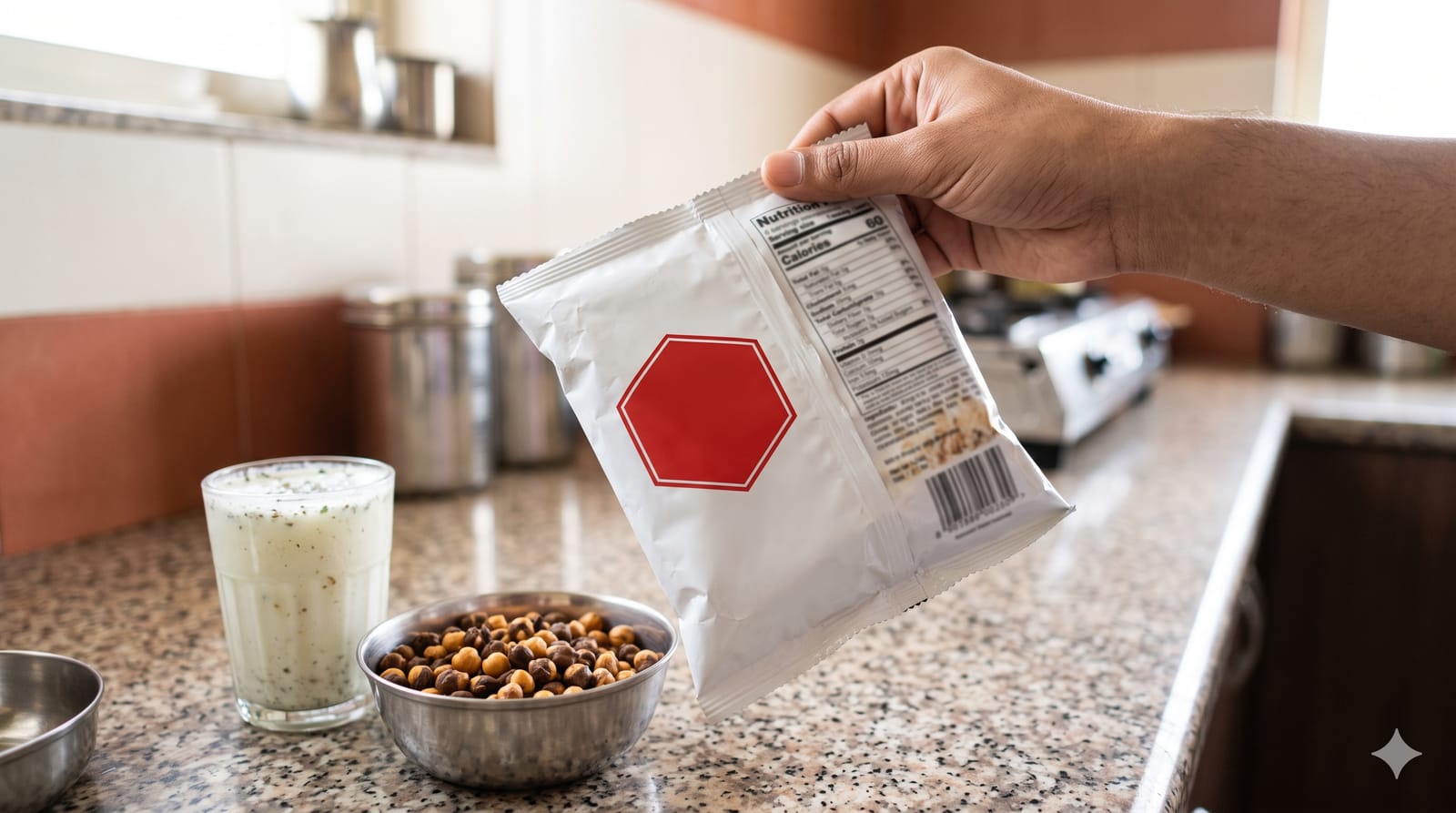
India's packaged foods may soon carry a red hexagon on the front that says "HIGH SUGAR," "HIGH SALT" or "HIGH FAT." The Supreme Court heard the case on 28 September 2026 and reserved its order, and the judgment could land any week now. Until it does, nothing on the shelf has changed. The good news: you do not need to wait for a red label to spot a sugar bomb. You can do it today, in about ten seconds per pack, if you know where to look.
Here is what FSSAI has proposed, where the case stands, and a simple routine for reading labels in the meantime.
What FSSAI's proposed front-of-pack warning looks like
According to FSSAI's submission to the Supreme Court, reported by South First on 31 August 2026, the proposal is:
A red hexagon on the front of the pack.
The words "HIGH FAT," "HIGH SUGAR," "HIGH SALT" and, for drinks, "HIGHLY SWEETENED BEVERAGE."
Warning text one font size larger than the nutrition table on the back.
Exemptions for single-ingredient products like ghee, edible oil, salt, sugar, jaggery and honey.
The thresholds for "high" are meant to come from ICMR-NIN's Dietary Guidelines for Indians, 2024. A separate warning has also been proposed for products with non-caloric sweeteners.
The big unresolved fight has been when the label triggers. FSSAI's first plan was to warn only when a product was high in two or more of these nutrients, and expand to one later. Critics called that a loophole: a sugary drink with no fat would escape. At the 10 September hearing, FSSAI told the court it might switch to warning on any single high nutrient, as Moneylife reported.
Where the Supreme Court case stands
The case is a public interest petition by 3S and Our Health Society, heard by Justices JB Pardiwala and K Vinod Chandran. At the last hearing on 28 September, FSSAI asked for about four months to finalise draft rules, followed by a full year of voluntary compliance. The bench was not impressed. "Why voluntary compliance for a year? Why do you need so much time?" Justice Pardiwala asked, according to FoodOS360's report, noting that the regulator had been studying the issue since 2022.
The court reserved its order after asking for written submissions. Realistically, that means:
No red labels are mandatory yet.
Even with a strict order, rules have to be notified and companies need time to reprint packs.
You are reading the old-style back-of-pack label for a while yet.
So, let's make the old label work for you.
The numbers that matter on a label
The ICMR-NIN guidelines give three daily ceilings, as summarised by ThePrint:
Added sugar: more than 5% of daily energy counts as high, which is about 25 g a day on a 2,000-calorie diet. That is roughly five teaspoons.
Salt: no more than 5 g a day, or 2 g of sodium.
Fat from cooking oils and fats: foods getting more than 15% of their energy from added oils or fats are classed as high in fat.
Those are full-day limits. Keep them in your head as a budget, and every pack becomes a quick bit of maths.
A 10-second routine for reading any pack
Step 1: Find "per serve" and check what a serve is
Nutrition tables usually show values per 100 g and per serving. The serving size is where brands play games. If a serve is "3 biscuits" and you eat 8 with your chai, multiply. Be honest about your real portion.
Step 2: Check added sugar first
Look for "added sugar" if it is listed, otherwise total sugar. Then compare it with the 25 g daily budget. A small flavoured yoghurt or a glass of packaged juice can use up half or more of that budget before breakfast is done.
Step 3: Convert sodium to salt
Many Indian labels list sodium in milligrams, not salt. Multiply sodium by 2.5 to get salt. So 800 mg sodium is 2 g of salt, which is 40% of your 5 g day. Instant noodles, namkeen, papad and pickles are where this adds up fast.
Step 4: Read the ingredient list, not the front
Ingredients are listed in descending order by weight. If sugar, maida or palm oil sits in the first three, that is what you are mostly eating, whatever the front says.
Claims on the front that fool people
The Dietary Guidelines themselves call out several common claims, as Down To Earth reported when they were released:
"Sugar-free" foods, the guidelines warn, "may be loaded with fats, refined cereals (white flour, starch) and even hidden sugars." Sugar-free mithai is the classic Diwali example: check the fat and the calories.
"Real fruit" can be claimed, under FSSAI rules, by a product with 10% or less fruit pulp or juice, often with added sugar on top.
"Good source of protein" needs a check of the actual grams per serve against what you need in a day. A protein biscuit with 4 g per serve is not doing much.
"No cholesterol" or "heart friendly" on a bottle of oil means little, because every oil is 100% fat. Use it in moderation regardless of what the bottle says.
What this means for your week
Here is the honest take. A red hexagon will help, especially for kids' snacks and drinks, and most people will never do label maths. But for someone who is trying to eat better, the label is not the bottleneck. Portions and frequency are.
Practical swaps for the next few weeks, with festive snacking about to ramp up:
Swap one daily packaged drink (juice, iced tea, flavoured milk) for chaas, nimbu pani with less sugar, or plain milk.
Buy namkeen in small packs, not the big festive tin. You will eat less without trying.
Pair mithai with a meal instead of eating it as a standalone snack between meals.
Keep roasted chana, peanuts or makhana at home for the 5 pm hunger.
If you have diabetes, high blood pressure or a heart condition, check with your doctor on targets that are specific to you; the ceilings above are population guidelines, not personal prescriptions.
Pick two products you buy every week and run the routine on them tonight. That alone tells you more than any front-of-pack label will.