
"Eating less protein could slow ageing." That headline has been doing the rounds again this month, and it lands awkwardly in a year when US dietary guidelines told adults to eat 1.2 to 1.6 grams of protein per kilo of body weight and half the gym is carrying a shaker. So which is it: more protein or less? The honest answer is that the two messages are mostly about different people. The review behind the headline leans heavily on flies and mice, its own author says protein clearly helps active people build muscle, and his real worry is sedentary people eating more than they need. Here's what the research found, what it didn't, and how much protein actually makes sense for you.
What the review actually looked at
The paper, "The hallmarks of protein and amino acid restriction in aging and longevity" by Bailey Knopf and Dudley Lamming at the University of Wisconsin-Madison, was published in Cell Press Blue in July and resurfaced on ScienceDaily on 10 November. It pulls together more than 350 papers. The main findings:
In flies and rodents, limiting protein extended lifespan, even when total calories stayed the same.
In humans, several recent clinical trials found that cutting protein reduced weight and body fat and improved fasting blood sugar, even though people on lower protein tended to eat more calories.
Specific amino acids seem to matter: methionine, isoleucine and valine. Too much of these may switch on growth pathways linked to obesity and inflammation.
A hormone called FGF21 rises when protein is low and affects blood sugar and inflammation. Mice with more of it lived longer; whether that carries over to people is unknown.
What it didn't show
This is where the myth-busting starts. Experts asked by the UK's Science Media Centre were blunt. Prof Paul Greenhaff, a muscle metabolism researcher at the University of Nottingham, pointed out that the longevity effect "has not been addressed in humans," and that "rodents and insects are not representative models of human ageing." Prof Kevin McConway, a statistician at the Open University, objected to the press release calling it a systematic review: "It simply isn't." It's a narrative review, without a stated method for choosing papers or combining results.
So: nobody has shown that eating less protein makes humans live longer. And the review doesn't recommend a specific lower intake for anyone.
The part the headlines skip: it depends on how much you move
Read the original release and Lamming himself sounds nothing like the headline. "It's absolutely crystal clear that there are benefits of protein to muscle growth and exercise response of active individuals," he said. He notes that athletes eat a lot of protein without developing metabolic disease, and suspects that regular exercise, which uses protein to build muscle, protects against the downsides. His concern is narrower: "the amount of protein sedentary people are eating today may have negative health consequences." And his conclusion: "We probably need to personalize protein recommendations based not just on age," but also on activity.
The review also notes that higher protein combined with exercise helped older adults hold on to muscle. That fits with what we know about how fitness declines with age: muscle is easier to keep than to rebuild.
So how much protein do you actually need?
Three reference points, all per kilo of body weight per day:
ICMR-NIN (India, 2020): the recommended allowance is 0.83 g/kg, which works out to 54 g a day for a 65 kg man and about 46 g for a 55 kg woman. For people whose diet is mostly cereal with low-quality protein, NIN puts the figure at 1 g/kg.
US Dietary Guidelines 2025-2030: 1.2 to 1.6 g/kg. Harvard's Nutrition Source notes that's 50 to 100% above the previous minimum, warns about "protein hype," and points out that excess protein can be converted to fat.
For a 65 kg person, that's roughly 54 g (ICMR), 78 g (1.2 g/kg) or 104 g (1.6 g/kg) a day.
Here's the coach's translation:
Mostly sitting, not training
Aim for the ICMR range, around 0.8 to 1 g/kg, from regular food. There's no reason to chase 1.6 g/kg with powders and bars, and this is exactly the group Lamming is worried about.
Lifting or doing serious training two to four times a week
Somewhere in the 1.2 to 1.6 g/kg range is reasonable, especially if you're trying to build muscle or keep it while losing fat. The training is what makes the extra protein useful.
Over 50, or losing weight
Don't cut protein because of this headline. Pair adequate protein with strength training; that combination is what protects muscle.
What that looks like on an Indian plate
Good news: you don't need much engineering. ICMR-NIN's model "My Plate for the Day" for 2,000 kcal, built from cereals, dal, milk or curd, vegetables, fruit and nuts, gets about 15% of its energy from protein, which is roughly 75 g a day. The pulses alone (85 g raw) bring about 20 g and 300 ml of milk or curd about 10 g. That's comfortably above the ICMR allowance for most adults with zero supplements.
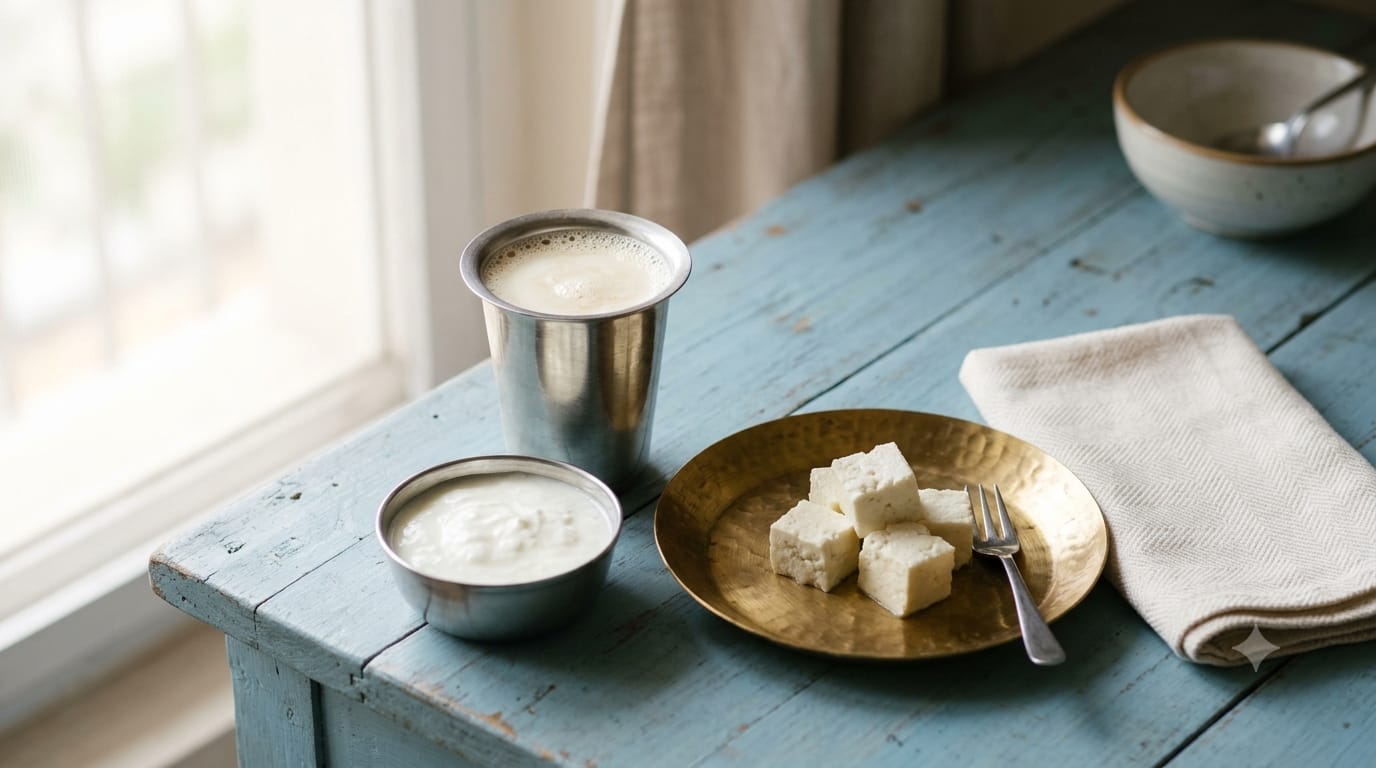
If you train and want to move up towards 1.2 to 1.6 g/kg, add one or two extra protein servings rather than a tub of powder: an extra katori of dal or rajma, paneer or tofu at dinner, eggs at breakfast, or a bowl of curd after training. If you're vegetarian and wondering whether you need whey at all, our look at plant protein vs whey for vegetarians covers it, and whether protein timing after a workout matters saves you from one more thing to worry about.
The bottom line
The "less protein slows ageing" story is interesting science in animals and a reasonable warning for people who sit all day and eat like bodybuilders. It's not a reason for active people, older adults or pregnant women to cut back; the release itself says some of those groups need more. Match your protein to how much you move: around ICMR's figure if you're mostly sedentary, higher if you're training, and from real food first.
General information, not medical advice. If you have kidney disease, diabetes or another health condition, or you're pregnant, check with your doctor or a registered dietitian before changing your protein intake.