A new review of exercise trials for people with high blood pressure and diabetes has been doing the rounds with a simple headline: aerobic exercise works, weights don't. That's not what it found. It found aerobic exercise had the clearest evidence, partly because far more trials tested it. A much bigger 2023 analysis of blood pressure trials shows strength work helps too, and the single best performer was something most people never try: wall sits. Here's what each study actually says, and a simple week that uses both.
The new review: what it found
The study is a meta-analysis by Zhang and colleagues in Scientific Reports, reported by News-Medical on 11 November 2026. It pooled 48 controlled intervention studies with 93 effect estimates, in people with hypertension, diabetes or cardiovascular disease.
Aerobic exercise (70 effect estimates) was "the only modality with a significant pooled effect in the primary analysis."
Resistance training (7 estimates) and combined training (16 estimates) had confidence intervals that included no effect.
There were no significant differences between the types, so none was shown to be superior.
Exercise improved systolic and diastolic blood pressure, resting heart rate and VO2max (aerobic fitness). It didn't significantly change BMI or physical and mental health scores.
Look at those numbers again: 70 estimates for aerobic, 7 for resistance. With seven data points, a real effect can easily look like "not significant." That's a statement about missing evidence, not proof that weights don't work.
The authors are cautious themselves. Heterogeneity was "substantial", the search covered English and Chinese only, 517 of 587 reports they wanted to read in full couldn't be retrieved, and in a sensitivity analysis the differences between modalities stopped being significant. Their own summary: "Because heterogeneity was substantial, the findings require cautious interpretation."
The bigger picture: 270 trials on blood pressure
For blood pressure specifically, there's a far larger body of evidence. A 2023 network meta-analysis by Edwards and colleagues in the British Journal of Sports Medicine pooled 270 randomised trials with 15,827 participants (abstract on PubMed). Average reductions in resting blood pressure, systolic over diastolic:
Aerobic training: 4.49 / 2.53 mmHg
Dynamic resistance training (regular weights): 4.55 / 3.04 mmHg
Combined aerobic and resistance: 6.04 / 2.54 mmHg
HIIT: 4.08 / 2.50 mmHg
Isometric training: 8.24 / 4.00 mmHg
Weights did about as well as cardio. Isometric training, where you hold a position under tension, came out on top for systolic pressure, and the isometric wall squat ranked as the single best sub-type. Running ranked best for diastolic. The authors concluded: "Various exercise training modes improve resting blood pressure, particularly isometric exercise."
Be honest about the size: a few millimetres of mercury, on average. Exercise works alongside the treatment your doctor has prescribed, not instead of it.
So, cardio or weights?
Both. The World Health Organization's physical activity fact sheet sets "at least 150 minutes of moderate-intensity physical activity per week" for adults, says "muscle strengthening benefits everyone", and adds that "any amount of physical activity is better than none." It also notes regular activity is linked with a lower risk of developing hypertension and type 2 diabetes.
The new review doesn't overturn that. It says aerobic exercise has the most evidence in people who already have these conditions. The 2023 analysis says strength and isometric work pull their weight for blood pressure. Put together, the sensible plan is walking as the base, with strength and a little isometric work on top.
A simple week for busy people
A sample for an adult with high BP or type 2 diabetes who has their doctor's go-ahead. Adjust to your level.
Monday: 30-minute brisk walk. Add 10 minutes after dinner if you can.
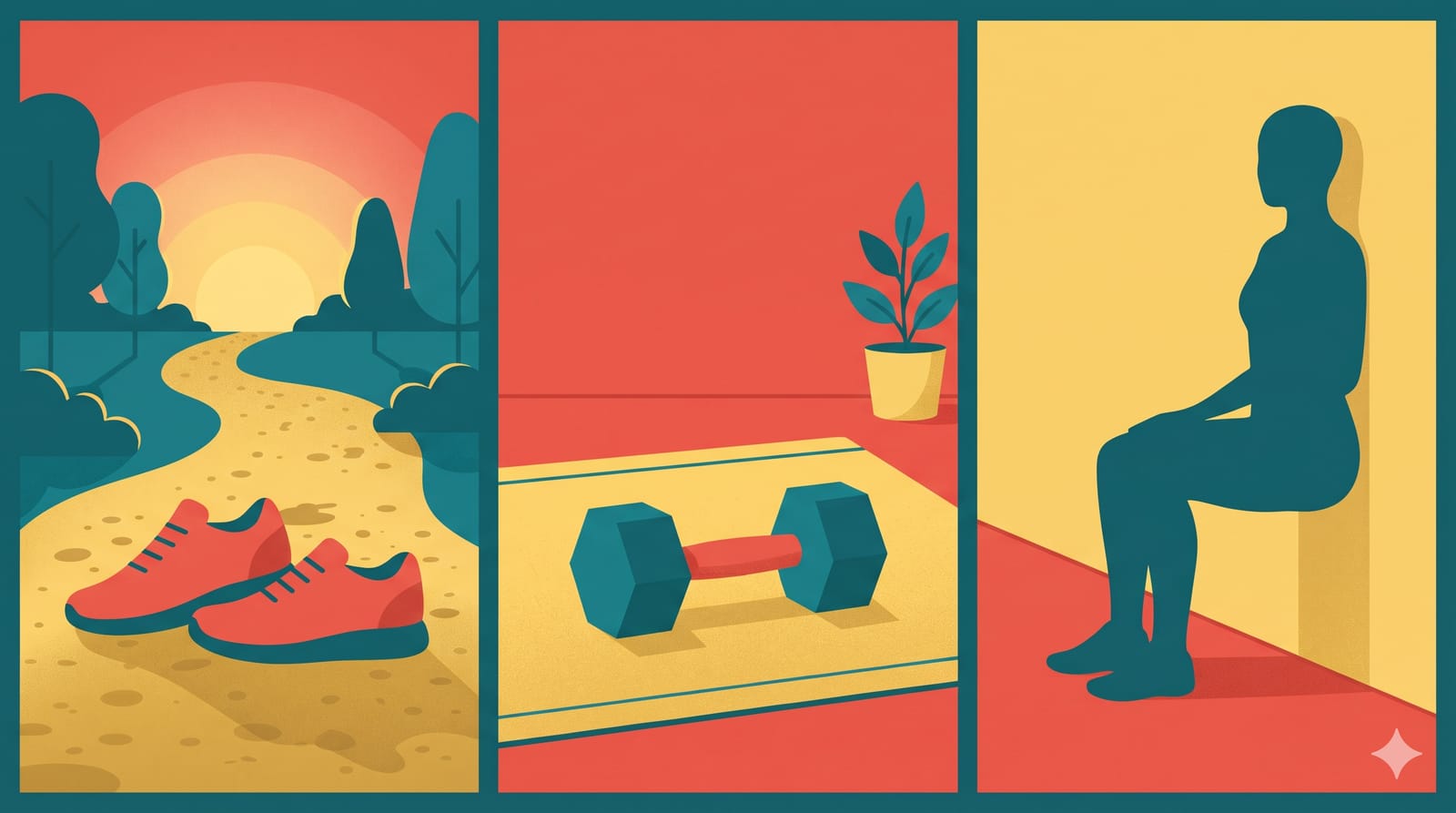
Tuesday: 20 minutes of strength: squats to a chair, wall push-ups, step-ups on a stair, a light backpack row. Two rounds of 10-12.
Wednesday: 30-minute walk, plus wall sits: hold 30-60 seconds, rest a minute, repeat 3-4 times.
Thursday: 30-minute walk.
Friday: strength session again.
Saturday: a longer walk of 45-60 minutes, or a game of badminton, a swim, a cycle.
Sunday: rest, or an easy stroll and wall sits.
That's roughly 150-180 minutes of walking plus two strength days, which lines up with the WHO guidance.
How to do a wall sit
Stand with your back flat against a wall, feet about shoulder-width apart and a step or two forward.
Slide down until your knees are bent, but not lower than a comfortable angle. Higher is fine when you start.
Keep your knees over your ankles, not past your toes, and your weight in your heels.
Hold, breathing normally, then slide back up. If your knees hurt, come up higher or stop.
Don't hold your breath during wall sits. Breathe steadily throughout. If you're on blood pressure or diabetes medication, ask your doctor before adding isometric holds and about watching for low sugars around exercise.
Where food fits in
Exercise doesn't cancel a heavy plate. Whether a short walk after your biggest meal helps blood sugar is covered in this look at walking after eating, and the guide to exercise and food changes for prediabetes covers the food side in more detail.
If you're past 35 and worried it's too late to start, this look at a 47-year fitness study is worth a read before you decide.
The takeaway
Ignore the "cardio beats weights" framing. The new review shows aerobic exercise has the strongest evidence in people with chronic conditions; the larger blood pressure analysis shows weights and isometric holds work too. Walk most days, lift twice a week, add a few wall sits, and keep taking the treatment your doctor prescribed.
This is general fitness information, not medical advice. If you have high blood pressure, diabetes or heart disease, check with your doctor before starting a new exercise routine.