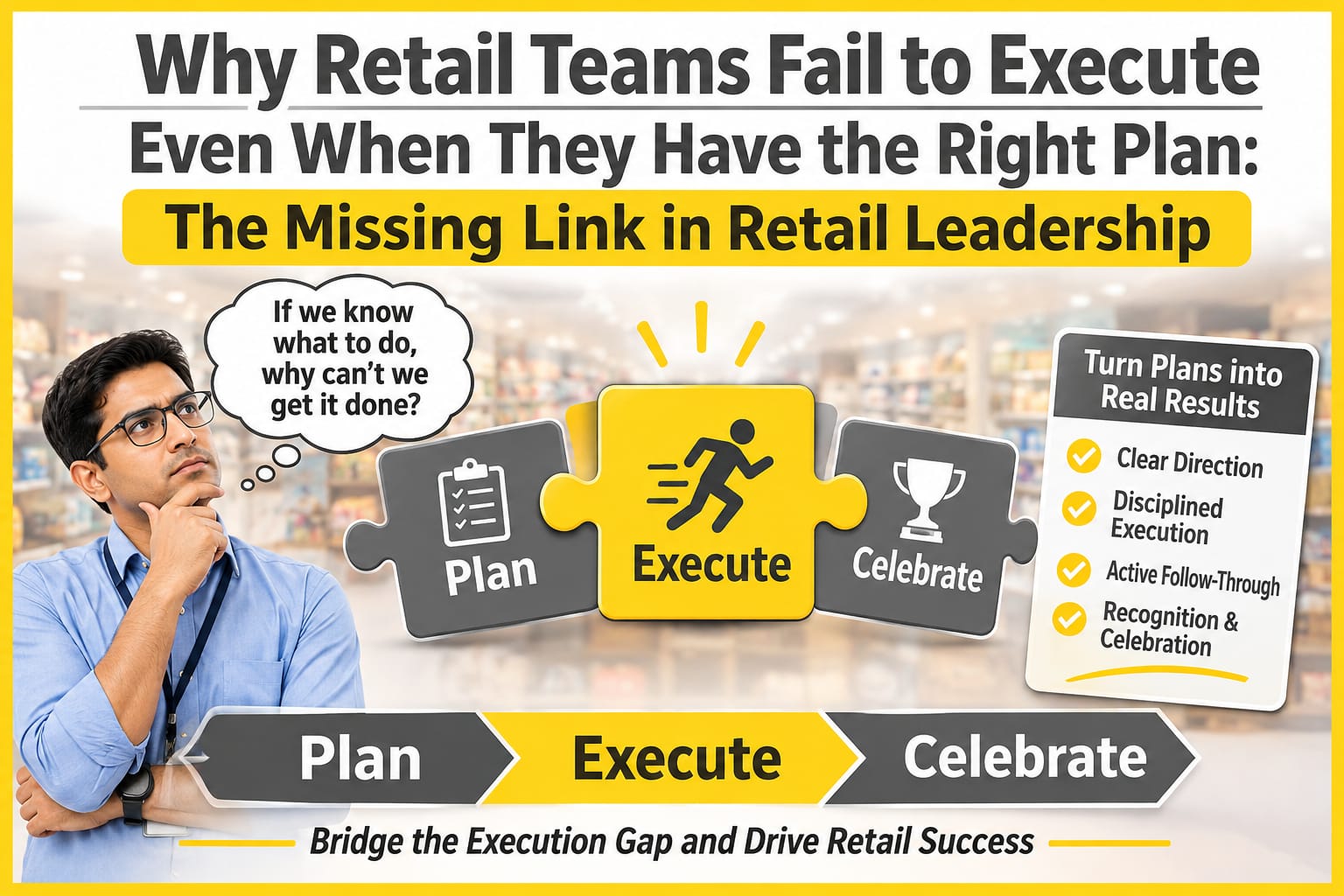
Why Retail Teams Fail to Execute Even When They Have the Right Plan: The Missing Link in Retail Leadership
By Vishal Sawakhande
Creator of Retail PEC Method | Retail Consultant | Retail Problem Solver | Author
Every retail organisation has plans.
There are sales targets, operational guidelines, customer service standards, inventory plans, employee training programmes and business improvement initiatives.
Management teams spend considerable time preparing strategies and communicating expectations.
Yet, one question continues to challenge the retail industry:
If we know what needs to be done, why do we still struggle to get it done consistently?
Walk into many retail stores and you may observe an interesting situation.
The store manager knows the monthly target. The sales team knows its responsibilities. The operations team understands the processes. The company has established guidelines.
But when the day ends, the expected results are not always achieved.
Some activities remain incomplete. Some employees wait for instructions. Some problems are repeated. Some opportunities are missed.
This is not always a problem of knowledge or intention.
Sometimes, the missing link is effective execution.
Through my experience and thinking about retail management, I have come to believe that the biggest opportunity for retail improvement lies in connecting planning with disciplined execution and meaningful recognition.
This is one of the central ideas behind my Retail PEC Method – Plan, Execute, Celebrate.
1. The Planning Trap: Having a Plan Does Not Mean Being Ready
Many retail businesses confuse planning with preparation.
A manager prepares a monthly sales target and communicates it to the team.
But does every employee understand how they will contribute to achieving that target?
For example, a store has a monthly sales target of ₹50 lakh.
The manager communicates the target during a meeting.
Everyone knows the number.
But important questions remain unanswered:
· What is the daily business requirement?
· Which categories need additional attention?
· What customer engagement improvements are required?
· Which employees need coaching?
· What operational challenges could affect performance?
· Who is responsible for monitoring progress?
A target without an action plan can become a number that employees simply hear rather than a responsibility they understand.
Effective planning requires breaking larger objectives into smaller, understandable actions.
A good plan should answer three questions:
1. What do we want to achieve?
2. What actions will help us achieve it?
3. Who will take responsibility?
When these questions are answered, employees gain clarity.
Planning is not about creating more documents. It is about creating direction.
2. The Execution Gap: Why Good Plans Remain on Paper
The biggest challenge often begins after the planning meeting.
Everyone agrees with the plan. Employees return to their respective responsibilities. Customers start entering the store. Operational activities begin.
Gradually, the original priorities may disappear behind daily pressures.
A manager becomes occupied with administrative work.
Employees become busy handling customers.
Inventory issues appear.
Customer complaints require attention.
Unexpected situations disturb the planned activities.
By the end of the day, some important priorities may remain incomplete.
This is the execution gap.
Retail leaders must understand that execution does not happen automatically after a meeting.
It requires regular attention, ownership and follow-through.
Consider these simple practices:
Start with clear priorities.
Every employee should understand the most important activities for the day.
Assign responsibility.
Avoid situations where everyone assumes someone else will complete the task.
Monitor progress.
Review important activities during the day instead of waiting until the closing meeting.
Address obstacles quickly.
When an employee faces a problem, the manager should help remove the obstacle rather than simply repeat the instruction.
Review the outcome.
At the end of the day, compare planned activities with actual execution.
The objective is not to control every movement of employees.
It is to create an environment where people understand their responsibilities and deliver consistently.
3. The Missing Leadership Skill: Follow-Through
A retail manager may communicate ten instructions in the morning.
But how many of those instructions are actually followed through?
This is where leadership effectiveness becomes visible.
Giving instructions is easy.
Ensuring understanding is more important.
Checking progress is necessary.
Helping employees overcome challenges is valuable.
And ensuring that commitments are completed is essential.
For example, suppose a store identifies poor product availability as a major concern.
The manager instructs the team to improve shelf replenishment.
However, after two days, the problem continues.
What should the manager do?
Instead of repeating the same instruction, investigate:
· Is the replenishment responsibility clearly assigned?
· Is the stock available in the backroom?
· Does the employee understand the process?
· Is the replenishment frequency appropriate?
· Is there a system-related issue?
This approach shifts leadership from instruction-giving to problem-solving.
A leader's responsibility does not end when an instruction is communicated. It ends when the intended outcome is achieved or the obstacle is properly addressed.
4. Why Employee Ownership Matters More Than Constant Supervision
Imagine two retail employees.
The first employee completes tasks only when the manager reminds them.
The second employee understands the importance of the task and takes responsibility without waiting for repeated instructions.
Both may have similar job descriptions.
But their approach to responsibility is different.
The difference is ownership.
Retail businesses should develop employees who understand the connection between their daily activities and business performance.
A sales associate should understand that customer engagement influences the buying experience.
An inventory employee should understand that stock accuracy affects product availability.
A cashier should understand that billing efficiency contributes to customer satisfaction.
A store manager should understand that team development influences the entire store's performance.
When employees understand the larger purpose behind their responsibilities, work becomes more meaningful.
Ownership cannot be developed through instructions alone.
It requires communication, coaching, trust, clarity and consistent leadership.
5. The Often-Ignored Power of Celebration
There is another important part of retail management that sometimes receives less attention than planning and execution.
Celebration.
Most retail organisations regularly discuss targets, performance gaps, mistakes and corrective actions.
But how often do they stop and recognise progress?
Consider a store team that improves its conversion rate from 18% to 21%.
That improvement represents additional effort, better customer engagement and possibly stronger teamwork.
Should the achievement go unnoticed simply because the team has not yet reached its ultimate target?
I believe the answer is no.
Celebration should become a meaningful part of retail leadership.
It can include:
· Appreciating employees who demonstrate improvement.
· Recognising teams that achieve important milestones.
· Sharing successful practices across stores.
· Acknowledging employees who take ownership.
· Celebrating learning from difficult situations.
Celebration does not always require financial rewards or large events.
Sometimes, a genuine appreciation message from a manager can make a difference.
However, recognition should be authentic and connected to meaningful contributions.
When leaders recognise progress, they encourage the behaviours that support future performance.
6. The Retail PEC Method: Connecting the Missing Links
These challenges bring us to an important management philosophy.
Retail PEC Method – Plan, Execute, Celebrate.
As its creator, I developed this framework around three connected elements that encourage a more structured approach to everyday performance.
P – PLAN
Start with clarity.
Define objectives, identify priorities, understand challenges and assign responsibilities.
Every team member should know what needs to be achieved and how their contribution matters.
E – EXECUTE
Convert the plan into action.
Maintain discipline, monitor progress, encourage ownership, support employees and address obstacles.
Execution should not be limited to completing tasks. It should focus on achieving the intended outcome.
C – CELEBRATE
Recognise achievements, appreciate contributions and learn from progress.
Celebration should strengthen motivation and encourage continuous improvement.
These three elements work together.
Planning without execution creates expectations without results.
Execution without proper planning creates activity without direction.
Planning and execution without celebration may miss an important opportunity to reinforce positive behaviours.
The PEC philosophy encourages retail leaders to bring all three elements into their everyday management practices.
7. A Practical Example: Applying PEC in a Retail Store
Consider a store that wants to improve its customer experience.
PLAN
The store manager identifies customer waiting time and inconsistent employee engagement as improvement priorities.
The team discusses the challenges, agrees on responsibilities and establishes measurable improvement objectives.
EXECUTE
Employees follow the agreed customer engagement practices.
The manager observes customer interactions, provides coaching and reviews progress during the day.
When operational obstacles appear, the team works together to resolve them.
CELEBRATE
At the end of the improvement period, the manager reviews the results.
Employees who demonstrate improvement are appreciated.
Successful practices are shared with the entire team.
The next improvement opportunity is then identified.
This creates a practical cycle of planning, action, review and recognition.
The same thinking can be applied to sales performance, inventory management, store standards, employee development and operational efficiency.
8. The Future of Retail Leadership Must Focus on Execution
Retail is becoming increasingly competitive.
Customers expect convenience, personal attention and consistent service.
Businesses must manage costs, improve productivity and respond quickly to changing market conditions.
Technology can provide information, reports and automation.
But people still play a critical role in translating business objectives into actual performance.
Retail leaders must therefore develop three important capabilities:
Think clearly.
Understand business priorities and identify what matters most.
Execute consistently.
Convert plans into actions and ensure responsibilities are fulfilled.
Recognise meaningfully.
Appreciate people, celebrate progress and encourage continuous improvement.
The future of retail leadership will not be determined only by who creates the best strategy.
It will also depend on who can bring people together to execute that strategy consistently.
My Final Thought
Throughout my retail journey, I have developed a strong belief that business improvement does not always require complicated solutions.
Sometimes, the biggest improvement begins by changing how we approach everyday responsibilities.
Instead of conducting meetings without clear outcomes, create meaningful plans.
Instead of repeatedly giving instructions, build ownership.
Instead of discussing only mistakes, recognise progress.
Instead of treating every day as a separate activity, create a continuous improvement mindset.
This is the philosophy I want to encourage through the Retail PEC Method.
PLAN with clarity.
EXECUTE with discipline.
CELEBRATE progress.
Because a retail business does not become excellent simply because it has ambitious targets.
It becomes stronger when people understand the plan, take ownership of execution and feel valued for their contributions.
And that is where better retail leadership begins.
About the Author
Vishal Sawakhande is the Creator of Retail PEC Method (Plan, Execute, and Celebrate), Retail Consultant, Retail Problem Solver and Author.
With a strong interest in retail leadership, business performance, store operations, employee development and practical problem-solving, he shares ideas to encourage retail professionals to think differently and improve everyday business practices.
His philosophy is centred on three principles:
Plan with clarity. Execute with discipline. Celebrate progress.
Created from 19 years of Retail Experience by Vishal Sawakhande