Starting a packaged drinking water brand in India can be a promising business opportunity, especially for entrepreneurs targeting hotels, restaurants, corporate offices, events, and retail customers.
However, the biggest question before launching is: How much does it cost to start a private label water brand in India?
The investment depends on packaging type, minimum order quantity (MOQ), manufacturing arrangements, branding, and distribution.
Unlike establishing a water manufacturing plant, private label manufacturing allows businesses to sell packaged drinking water under their own brand while outsourcing production.
Understanding the private label water business cost helps entrepreneurs plan investment, manage risks, and build a profitable business model.
What Is a Private Label Water Business?
A private label water business sells packaged drinking water under its own brand name while an established manufacturer handles production.
Depending on the agreement, the manufacturer may manage water treatment, filling, packaging, labeling, and quality testing.
The brand owner focuses on marketing, customer acquisition, sales, and distribution.
For example, an entrepreneur can launch a premium water brand using customized cartons or bottles without investing in manufacturing machinery.
Businesses exploring white label water manufacturing services can evaluate available production and customization options before launching.
How Much Investment Is Required?
There is no fixed minimum investment for starting a private label water business.
Costs vary according to production quantity, packaging specifications, supplier pricing, and marketing requirements.
For preliminary budgeting, entrepreneurs might consider these illustrative scenarios:
₹1–3 lakh: Small-scale market testing with limited inventory and basic branding.
₹3–8 lakh: A local launch involving customized packaging, inventory, and initial marketing.
₹8–15 lakh or more: Larger production commitments, expanded distribution, and additional marketing activities.
These are hypothetical planning ranges, not verified supplier quotations. Actual feasibility depends on MOQ, product specifications, compliance obligations, and distribution costs.
Businesses should obtain detailed manufacturing quotations before committing capital.
1. Manufacturing and Production Costs
Manufacturing is one of the main expenses in a private label drinking water business.
Production costs depend on water treatment, filling, packaging, quality testing, and order quantities.
Some manufacturers quote a finished-product price, while others charge separately for packaging and additional services.
Before selecting a supplier, clarify whether the quotation includes filling, sealing, labeling, testing, and transportation.
Comparing complete quotations helps businesses understand their actual procurement costs.
2. Packaging and Branding Expenses
Packaging influences both product cost and customer perception.
Businesses can choose from different packaging formats depending on their target market.
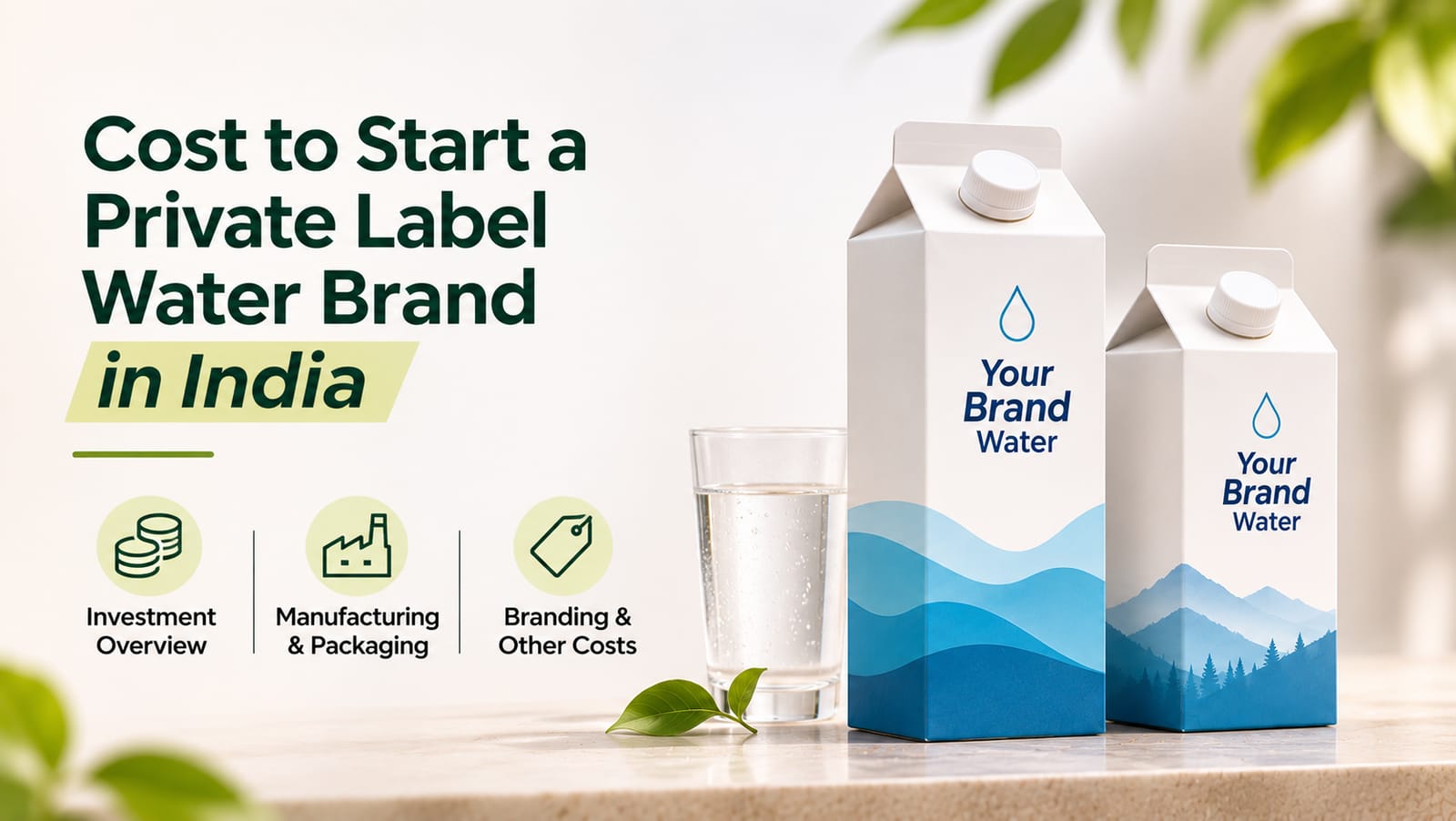
Conventional plastic bottles are common in mass-market distribution, while gable top cartons can support distinctive branding and premium positioning.
Custom packaging may involve printing charges, artwork development, and minimum order requirements.
For example, hotels may prefer branded water cartons that complement their visual identity, while retail businesses may prioritize affordability.
Packaging decisions should balance appearance, product suitability, and commercial viability.
3. Minimum Order Quantity and Inventory
MOQ directly affects the initial investment required.
Manufacturers establish minimum quantities based on production efficiency, packaging procurement, and customization requirements.
Larger orders may reduce unit manufacturing costs but increase upfront inventory expenditure.
For a new business, ordering excessive stock before validating demand can create financial pressure.
Entrepreneurs should compare quotations at different quantities and estimate how quickly they can sell the products.
A manageable initial order is often more practical than pursuing the lowest possible unit price.
4. Licensing and Regulatory Expenses
Packaged drinking water businesses must comply with applicable Indian food safety regulations.
Manufacturers require relevant FSSAI licensing and must follow applicable product safety, testing, and labeling requirements.
Brand owners should also determine which regulatory obligations apply to their operations.
Potential expenses include documentation, trademark registration, professional consultation, and compliance-related activities.
Requirements depend on the business model and current regulations.
Businesses should verify applicable obligations before launching rather than assuming the manufacturing partner handles everything.
5. Transportation and Storage Costs
Packaged drinking water is relatively heavy, making transportation an important operating expense.
Freight costs depend on order quantity, delivery distance, shipment arrangements, and distribution locations.
Businesses selling through wholesalers may require warehouse storage, while direct B2B suppliers may deliver products to hotels, offices, or events.
Proper storage is also necessary to protect packaging and product quality.
When comparing suppliers, calculate the delivered cost per unit rather than relying only on manufacturing prices.
6. Marketing and Customer Acquisition Costs
Manufacturing a product does not guarantee sales.
A private label water brand requires a clear customer acquisition strategy.
Marketing expenses may include website development, product photography, digital advertising, sampling, sales materials, and distributor outreach.
For startups, targeting a specific commercial segment can help control acquisition costs.
For example, supplying branded water to hotels or corporate offices may generate repeat bulk orders.
Businesses should prioritize customers with sustainable order volumes rather than spending heavily on broad advertising before validating demand.
7. Private Label Manufacturing vs Owning a Factory
Establishing a manufacturing facility involves investment in water treatment equipment, filling machinery, infrastructure, utilities, employees, and compliance systems.
Private label manufacturing reduces the need for these capital investments by outsourcing production.
Businesses considering contract manufacturing for packaged drinking water can evaluate whether outsourced production suits their budget and business objectives.
However, contract manufacturing introduces supplier dependency, MOQ requirements, and production scheduling considerations.
The right choice depends on available capital, expected sales volumes, and long-term growth plans.
8. How to Calculate Profit Margins
Profitability depends on the difference between selling price and total costs.
Consider a hypothetical example where a branded water product sells for ₹30.
Illustrative expenses per unit might include:
Manufacturing and packaging: ₹15
Transportation: ₹3
Distribution: ₹4
Marketing allocation: ₹2
Total variable cost: ₹24.
Contribution per unit: ₹6, before fixed expenses, taxes, and other obligations.
These numbers are examples, not verified market prices.
Businesses should use actual supplier quotations and realistic sales projections to calculate margins.
9. How to Reduce Startup Investment
Entrepreneurs can manage initial costs by focusing on a specific customer segment and limiting unnecessary product variations.
Start with one or two packaging sizes instead of launching multiple formats simultaneously.
Compare supplier quotations, negotiate practical order quantities, and avoid excessive inventory.
Validate customer demand through direct B2B outreach before committing to large advertising budgets.
Businesses should also monitor repeat orders, customer acquisition costs, and contribution margins.
The objective is to establish predictable sales before expanding operations.
10. Choosing the Right Manufacturing Partner
A reliable manufacturing partner can influence product quality, profitability, and delivery performance.
Before selecting a supplier, evaluate manufacturing capabilities, applicable licences, quality testing, packaging customization, MOQ, and production timelines.
Request samples and written quotations.
Businesses exploring customized drinking water packaging can review Gable Top Pak's water packaging solutions.
Gable Top Pak supports businesses exploring branded water products and customized gable top carton packaging.
Before placing an order, confirm manufacturing responsibilities, packaging specifications, and delivery arrangements.
Conclusion
The cost of starting a private label water brand in India depends on manufacturing, packaging, branding, inventory, compliance, transportation, and marketing.
Outsourcing production can reduce infrastructure investment compared with establishing a manufacturing plant.
However, entrepreneurs must carefully evaluate total costs and expected profit margins.
Starting with a defined target market, manageable inventory, reliable manufacturing support, and a practical distribution strategy can reduce financial risk.
A successful private label water business depends not only on controlling startup expenses but also on building consistent product quality, customer demand, and repeat sales.