Plastic packaging has been widely used for liquid products because of its affordability, durability, and convenience. From drinking water and dairy products to liquid soaps and personal care products, plastic bottles and containers remain common across industries.
However, changing consumer preferences, sustainability goals, and increasing demand for distinctive product packaging are encouraging businesses to explore alternatives to conventional plastic containers.
For manufacturers and FMCG brands, choosing the right packaging is no longer just about protecting the product. Packaging also influences brand perception, transportation costs, product presentation, and purchasing decisions.
This article explores some of the best alternatives to plastic packaging for liquid soap, drinking water, and dairy products, along with the factors businesses should consider before switching.
Why Are Businesses Looking for Alternatives to Plastic Packaging?
Plastic packaging offers several practical advantages, but businesses are increasingly evaluating its environmental impact and long-term suitability.
Traditional plastic containers can contribute to waste when collection and recycling systems are inadequate. At the same time, customers are becoming more aware of packaging materials and how brands communicate their environmental commitments.
Businesses are exploring alternative packaging for several reasons:
Reducing dependence on conventional plastic packaging
Improving brand differentiation in competitive markets
Supporting corporate sustainability objectives
Exploring renewable and responsibly sourced packaging materials
Creating distinctive packaging for premium products
Responding to changing consumer and retailer expectations
However, switching packaging materials requires careful evaluation. The alternative must protect the product, meet applicable regulations, and remain commercially practical.
1. Gable Top Cartons for Liquid Products
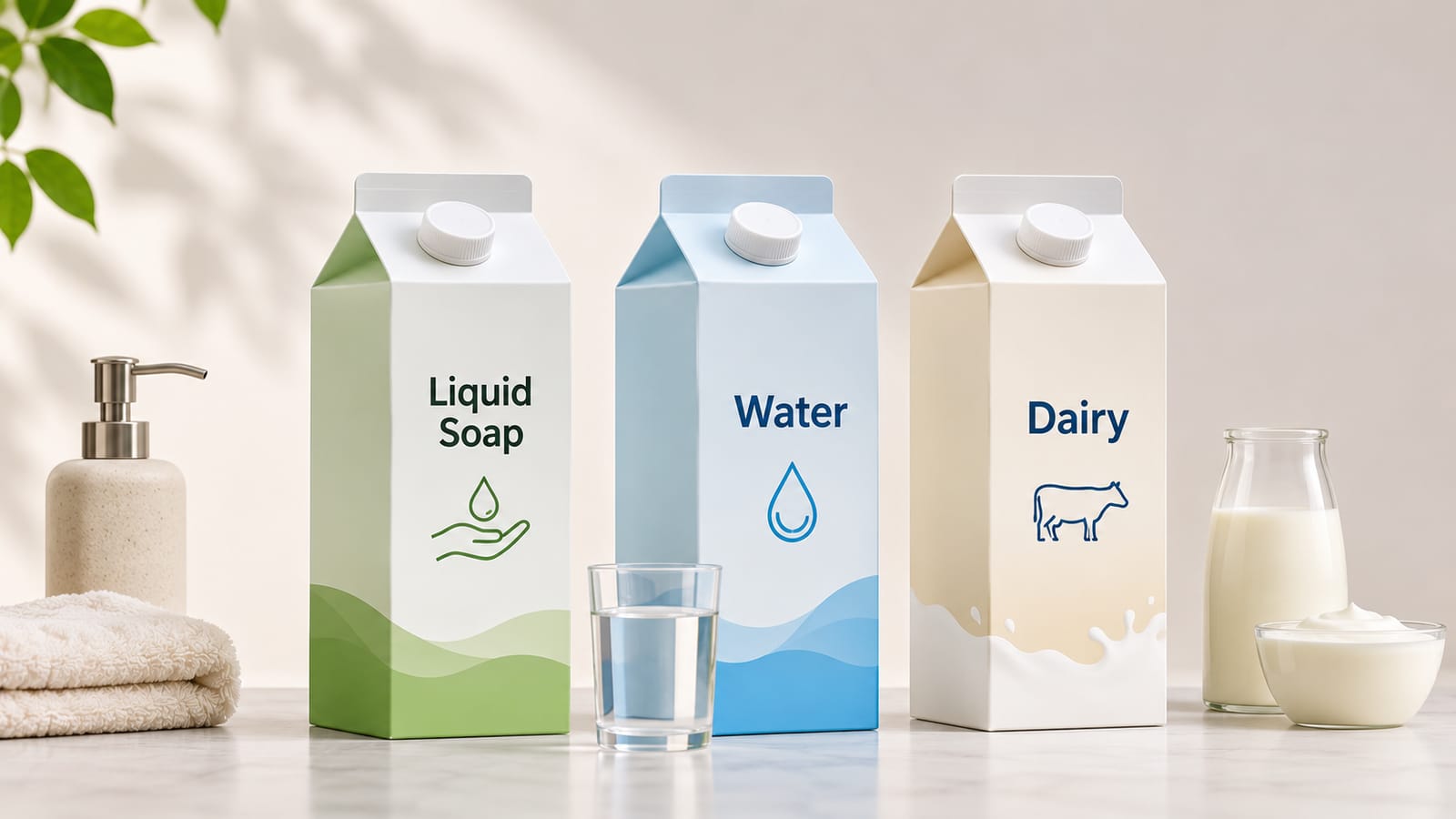
Gable top cartons are an increasingly relevant packaging option for businesses looking beyond conventional plastic bottles.
These cartons are generally manufactured using paperboard combined with functional barrier and sealing layers. Their distinctive folded-top design provides a recognizable appearance and supports efficient filling and pouring.
Gable top cartons are commonly associated with dairy products and beverages, but appropriately engineered carton structures can also accommodate certain non-food liquid products.
Benefits of Gable Top Carton Packaging
Brand differentiation: Cartons offer large printable surfaces that allow businesses to display product information, branding, and promotional designs.
Material composition: Paperboard-based structures can reduce reliance on conventional plastic compared with some plastic container formats, depending on the carton design.
Shelf presentation: Their rectangular structure creates a distinctive appearance that can support premium product positioning.
Storage efficiency: Cartons can offer practical advantages for secondary packaging, stacking, and transportation, depending on their dimensions and specifications.
Customization: Manufacturers can develop different carton sizes, branding designs, and functional specifications based on product requirements.
Businesses should remember that most liquid cartons are not entirely plastic-free. Barrier coatings and sealing layers are important for maintaining product safety and packaging performance.
2. Alternative Packaging for Liquid Soap and Personal Care Products
Liquid soap packaging must meet different requirements from drinking water and dairy packaging.
Handwash, liquid soap, shampoo, and other personal care formulations may contain surfactants, fragrances, preservatives, and additional ingredients that interact differently with packaging materials.
For this reason, packaging selection should consider chemical compatibility, sealing performance, leakage prevention, and dispensing convenience.
Gable Top Cartons for Liquid Soap
Gable top cartons can provide an alternative packaging format for suitable liquid soap formulations.
Their printable surfaces allow personal care brands to develop distinctive packaging that communicates product benefits and brand identity.
For example, a premium handwash manufacturer may consider carton packaging to distinguish its products from competitors using conventional plastic bottles.
Businesses exploring liquid soap packaging solutions can evaluate customized carton formats designed around product compatibility, filling requirements, and branding needs.
Before commercial production, manufacturers should conduct appropriate compatibility, shelf-life, sealing, and transportation tests.
Other Liquid Soap Packaging Alternatives
Refill pouches: Flexible refill packaging can reduce material consumption compared with some rigid containers, although recyclability depends on the material structure and local infrastructure.
Aluminium containers: Aluminium provides a durable packaging option and can be recycled through established collection systems where available.
Reusable dispensing systems: Refillable containers can support businesses operating in hospitality, commercial washrooms, and institutional environments.
The most suitable solution depends on whether the product is intended for retail sale, commercial use, or refill distribution.
3. Alternatives to Plastic Water Bottles
Packaged drinking water is one of the most visible categories where businesses are exploring alternatives to conventional plastic bottles.
Hotels, restaurants, corporate offices, events, and premium beverage brands increasingly consider packaging as part of their customer experience.
For these businesses, water packaging can also function as a branding opportunity.
Gable Top Cartons for Packaged Drinking Water
Gable top cartons provide an alternative format for packaged drinking water.
Their exterior surfaces allow businesses to incorporate custom branding, product information, and distinctive visual designs.
For example, a hospitality business can introduce branded drinking water cartons featuring its own identity rather than relying entirely on standard third-party bottle labels.
Businesses evaluating water in gable top cartons can explore packaging options for private-label water brands, hospitality distribution, corporate events, and other commercial applications.
Carton specifications must be suitable for drinking-water contact, filling conditions, storage, and the intended distribution environment.
Other Alternatives for Drinking Water
Glass bottles: Glass offers a premium appearance and is suitable for reusable bottle systems where washing and return logistics are available.
Aluminium bottles and cans: Aluminium packaging provides a distinctive format and can be recycled where appropriate collection infrastructure exists.
Reusable water containers: Refillable dispensers and reusable bottles can help reduce single-use packaging requirements in controlled environments such as offices.
Each option involves different considerations relating to cost, weight, convenience, infrastructure, and customer expectations.
4. Sustainable Packaging Alternatives for Dairy Products
Dairy packaging requires particular attention because milk and other dairy products are sensitive to temperature, microbial contamination, oxygen exposure, and storage conditions.
Packaging must help maintain product quality throughout the intended shelf life.
Traditional dairy packaging includes plastic pouches, rigid plastic bottles, and different carton formats.
Gable Top Cartons for Dairy Packaging
Gable top cartons are widely recognized in the dairy industry, particularly for refrigerated milk and related products.
Their shape supports convenient handling, pouring, and product presentation.
Dairy businesses exploring dairy carton packaging can assess suitable solutions for refrigerated milk and other compatible dairy applications.
However, non-aseptic gable top cartons should not be confused with aseptic packaging.
Non-aseptic cartons generally require appropriate refrigerated handling and do not independently make milk shelf-stable at room temperature.
Other Dairy Packaging Options
Glass milk bottles: Glass can support returnable packaging systems, particularly for local dairy distribution.
Flexible milk pouches: These remain widely used because of their relatively low packaging cost and efficient distribution characteristics.
Aseptic cartons: These use specialized processing and packaging systems that can support extended unopened shelf life for appropriately processed dairy products.
Dairy manufacturers must choose packaging based on product treatment, distribution conditions, shelf-life expectations, and applicable food safety requirements.
5. How to Choose the Right Alternative to Plastic Packaging
Not every packaging material is suitable for every liquid product.
Before selecting an alternative, manufacturers should evaluate the following factors.
Product Compatibility
Packaging must be compatible with the product's ingredients and physical characteristics.
Liquid soap requires chemical compatibility testing, while drinking water and dairy products require appropriate food-contact materials and safety controls.
Packaging Cost
Businesses should calculate more than the cost of an empty container.
The total packaging cost may include filling equipment, minimum order quantities, transportation, storage, printing, product losses, and distribution requirements.
Branding and Customization
Packaging should support the intended market positioning.
A premium product may benefit from customized printing and distinctive structural design, while a high-volume product may prioritize operational efficiency.
Storage and Transportation
Packaging performance must be evaluated under realistic distribution conditions.
Leak resistance, stacking strength, temperature exposure, and handling requirements can influence product losses and overall operating costs.
Environmental Performance
Businesses should examine the complete packaging structure rather than relying only on claims such as recyclable, biodegradable, or eco-friendly.
Material sourcing, production, transportation, reuse potential, and local waste-management infrastructure all influence environmental outcomes.
6. Can Alternative Packaging Improve Brand Positioning?
Packaging influences how customers perceive a product before they use it.
In competitive FMCG categories, similar products often compete for attention through packaging design, convenience, and brand communication.
A liquid soap manufacturer using distinctive carton packaging may create a different visual identity from conventional bottled products.
Similarly, a hotel introducing privately branded drinking water cartons can make packaged water part of its overall guest experience.
Dairy businesses can also use customized packaging to communicate product details, freshness requirements, and brand identity.
However, packaging differentiation must be supported by consistent product quality and reliable distribution.
An attractive container alone does not guarantee higher sales or customer loyalty.
7. What Should Businesses Look for in a Liquid Packaging Supplier?
Choosing a packaging supplier is an important commercial decision, particularly when introducing a new packaging format.
Businesses should evaluate the supplier's ability to support product-specific packaging requirements, customization, production consistency, and commercial scaling.
Important considerations include:
Availability of suitable carton structures and sizes
Compatibility with the intended liquid product
Custom printing and branding capabilities
Filling and sealing requirements
Minimum order quantities and production timelines
Quality testing and regulatory documentation
Transportation and storage performance
Ability to support future production growth
Businesses should also request samples and conduct packaging trials before committing to large production quantities.
For companies considering carton packaging across different product categories, working with an experienced packaging solutions provider can simplify technical evaluation and customization.
Conclusion
The demand for alternatives to plastic packaging is creating new opportunities for manufacturers across liquid soap, packaged drinking water, and dairy product categories.
Glass, aluminium, refill systems, flexible packaging, and paperboard-based cartons each offer different advantages depending on the product and distribution model.
Among these alternatives, gable top cartons provide a distinctive packaging format with opportunities for customized branding, structured product presentation, and reduced dependence on conventional rigid plastic containers.
For businesses exploring carton-based liquid packaging, Gable Top Pak offers solutions across drinking water, dairy, and compatible liquid soap applications.
Companies planning to introduce new packaging formats should prioritize product compatibility, operational feasibility, brand positioning, and long-term commercial performance before making a final decision.