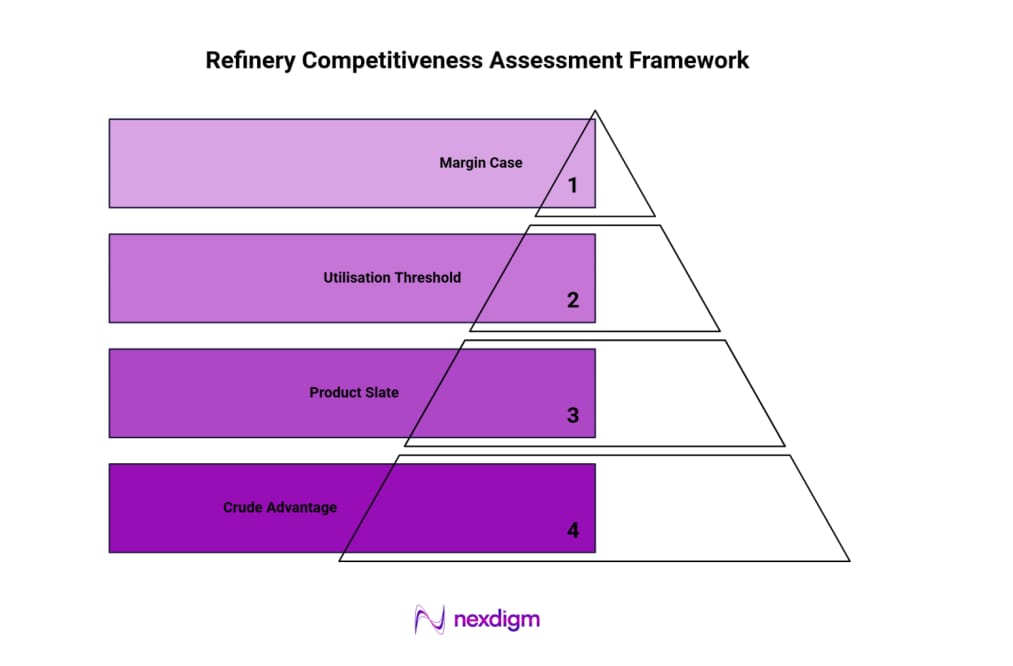
A Refinery Must Win on Both Inputs and Outputs
A refinery can be well designed and still lose money if its crude is expensive, its product slate misses local demand, or its utilisation falls below the level needed to recover fixed costs. A feasibility test must begin with a specific configuration and crude slate, then model the cost of bringing feedstock to the site and selling each product into a real market. Nameplate capacity is not a proxy for competitive supply.
The IEA’s 2025 medium-term assessment expected substantial refinery additions and closures through 2030, with regional patterns differing sharply. That matters because mature markets with declining road-fuel consumption may be exposed to closures and import dependence, while new complex plants in growing economies may capture domestic demand and export markets. Yet a global capacity forecast cannot substitute for a site-level product balance. Competitive position depends on the plant’s conversion units, energy use, carbon intensity, labour, logistics and access to crude grades.
Crude Economics Set the Starting Position
Crude evaluation should compare API gravity, sulfur and contaminants with the refinery’s design, availability and landed cost. A discount on a heavy or sour grade has value only if the plant can process it without losing uptime or requiring additional treatment. Model product yields and quality for several crude blends, then apply market prices net of transport,
storage, blending, taxes and export costs.
This also determines how much flexibility the refinery has when market conditions change. A plant dependent on one crude grade may achieve attractive economics under its base assumption but become exposed when differentials narrow or supply is disrupted. Multiple crude options can provide resilience, provided the configuration can process them without significant yield or operating penalties.
Demand Determines Whether the Product Slate Works
Refining margin is not a stable spread between a benchmark crude and a basket of products. It varies with crude slate, complexity, location, product prices and by-product credits. Forecast demand separately for gasoline, diesel, jet fuel, LPG, naphtha and other outputs, accounting for electrification, efficiency, biofuel blending and petrochemical feedstock requirements.
To gain more information, refer to: Nexdigm Insights
The supply side needs equal attention. Existing and committed capacity, announced closures, imports and seasonal inventories determine whether additional barrels can actually find a market. A refinery producing more diesel than the local market can absorb may depend on exports, exposing the project to freight costs and exchange-rate movements. Conversely, strong domestic jet-fuel demand can support a particular configuration even when overall petroleum demand growth is modest.Utilisation Is the Commercial Pressure Point. The refinery must be tested at the utilisation level required to cover cash operating costs, service debt and meet the investor’s return threshold. That threshold depends on the plant’s fixed-cost base, energy consumption, maintenance requirements and configuration. A project that looks attractive at 90% utilisation may be materially weaker at 75%, particularly during ramp-up or periods of weak margins. A proper refinery market feasibility study should therefore run the economics through multiple downside conditions: weaker crude differentials, lower product cracks, slower demand, delayed commissioning and temporary outages. Benchmark the project against imports, brownfield expansion and alternative supply routes rather than treating a greenfield refinery as the default answer.
Nexdigm Case Study
Nexdigm evaluated a proposed 180,000-barrel-per-day refinery across three crude slates and two conversion configurations, modelling local fuel demand and export netbacks. The assessment found that the simpler configuration fell below the return hurdle at 82% utilisation under weaker cracks, while the complex option required long-term crude supply and product offtake agreements.
To take the next step, simply visit our Request a Consultation page and share your requirements with us.
Harsh Mittal
+91-8422857704
enquiry@nexdigm.com