The demand for customized liquid packaging is creating new opportunities for businesses across India's food, beverage, dairy, and personal care industries. Manufacturers are increasingly evaluating packaging options that combine product protection, attractive branding, and practical distribution requirements.
Among these options, gable top cartons have become an important consideration for businesses exploring paperboard-based liquid packaging.
However, finding reliable gable top carton manufacturers in India requires more than comparing prices. Packaging quality, material compatibility, customization capabilities, production capacity, and delivery reliability can directly influence business operations.
Whether you manufacture packaged drinking water, dairy products, juice, or liquid soap, selecting the right supplier can help prevent packaging failures, reduce operational disruptions, and support long-term brand growth.
This guide explains what businesses should evaluate before choosing a gable top carton packaging manufacturer in India.
What Are Gable Top Cartons?
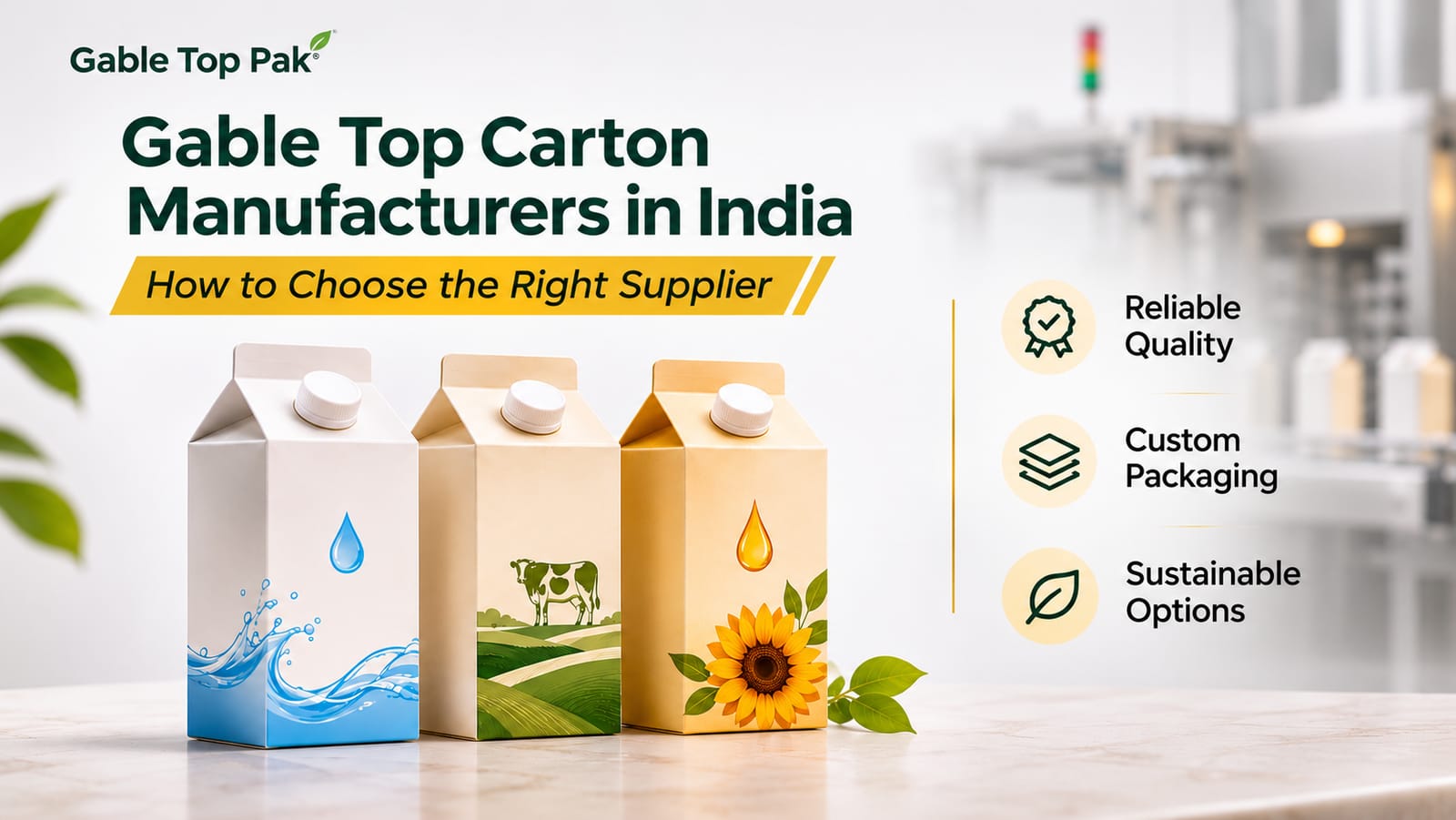
Gable top cartons are paperboard-based containers recognized by their distinctive folded, roof-shaped tops. They are commonly used for packaging liquid products, particularly milk and other refrigerated beverages.
These cartons generally contain multiple material layers. Paperboard provides structural support, while polymer coatings or specialized barriers help maintain liquid resistance and sealing performance.
Depending on the product and packaging design, cartons may include pouring openings, screw caps, or other closure systems.
Gable top cartons are available in different capacities and can be customized with printed branding, product information, and packaging designs.
For businesses seeking alternatives to conventional plastic containers, these cartons provide a recognizable packaging format with opportunities for product differentiation.
However, their suitability depends on the packaged product, barrier requirements, filling process, and storage conditions.
Why Are Indian Businesses Exploring Gable Top Carton Packaging?
Packaging decisions are becoming increasingly important for FMCG manufacturers and emerging consumer brands.
Businesses are evaluating gable top cartons for several commercial reasons.
Brand Differentiation
In crowded retail categories, packaging influences how customers recognize products.
The printable surfaces of gable top cartons allow businesses to display logos, colors, product information, and distinctive designs.
This can be particularly useful for private-label brands competing against established manufacturers.
Alternatives to Conventional Plastic Packaging
Gable top cartons use paperboard as a major structural component, potentially reducing dependence on conventional rigid plastic containers.
However, most liquid cartons contain polymer coatings and other functional layers. Their environmental performance depends on material composition and end-of-life infrastructure.
Packaging Customization
Businesses can explore different carton capacities, printed designs, and closure options according to product requirements.
This flexibility supports companies launching new product lines or developing packaging for specific customer segments.
Commercial Applications
Gable top cartons can serve different industries when the carton structure is engineered for the intended product.
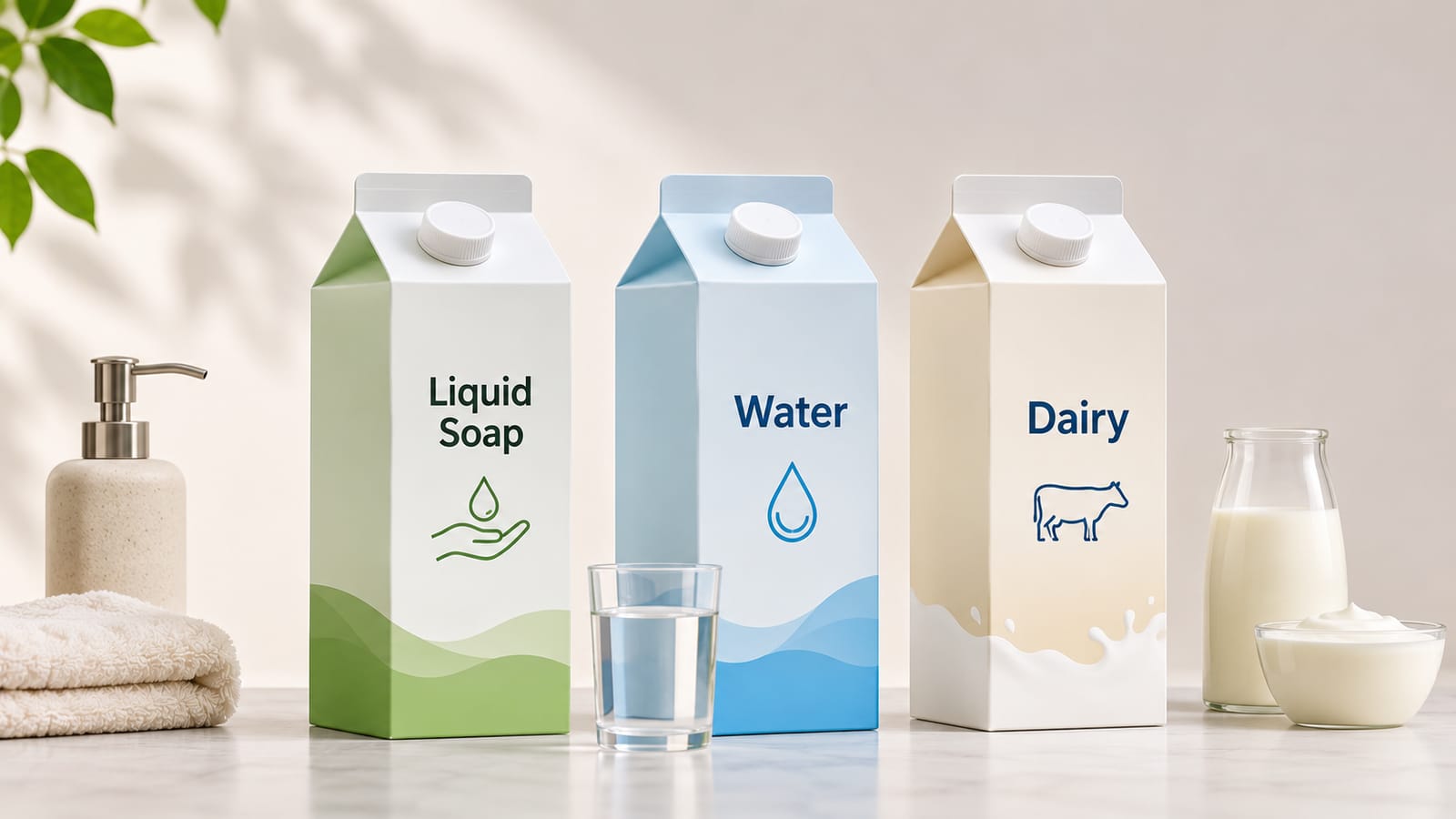
Common applications include drinking water, refrigerated dairy beverages, and certain compatible non-food liquids.
1. Check the Manufacturer's Product Expertise
The first step in choosing a gable top carton manufacturer is determining whether the supplier understands your product category.
Different liquids have different packaging requirements.
For example, packaged drinking water requires appropriate food-contact materials, reliable sealing, and compliance with applicable regulations.
Dairy products may require refrigeration, suitable barrier properties, and compatibility with hygienic filling processes.
Liquid soap formulations can contain surfactants, fragrances, and other ingredients that interact differently with packaging materials.
A supplier should be able to explain which carton structures are suitable for your product and what testing is necessary.
Avoid selecting a manufacturer solely because it offers the required carton size.
Product compatibility should always come first.
2. Evaluate Packaging Material Quality
Material quality is one of the most important factors affecting carton performance.
Poor-quality materials may contribute to leakage, deformation, sealing problems, or reduced product protection.
When evaluating suppliers, ask about the paperboard structure, barrier layers, sealing properties, and intended storage conditions.
For food and beverage applications, request relevant food-contact documentation and material specifications.
Businesses should also determine whether the carton is designed for refrigerated, ambient, or specialized storage conditions.
Not every gable top carton provides the same level of protection.
A carton suitable for refrigerated milk should not automatically be considered appropriate for shelf-stable dairy products.
3. Understand Custom Printing and Branding Capabilities
For private-label businesses, packaging design is a significant commercial consideration.
A manufacturer should be able to support consistent printing, accurate brand colors, readable product information, and suitable artwork specifications.
Before approving production, businesses should request packaging samples or printed proofs.
Important details include:
Logo placement and print quality
Available printing methods
Carton dimensions and printable areas
Labeling requirements
Artwork approval procedures
Minimum quantities for custom designs
Customized cartons can help brands create distinctive products without relying on standard packaging formats.
For example, a hospitality company launching its own packaged drinking water may use custom-printed cartons to create a consistent brand experience.
Similarly, beverage startups can use distinctive carton designs to support premium positioning.
4. Compare Minimum Order Quantities and Pricing
One of the most common questions businesses ask carton packaging suppliers concerns minimum order quantities.
MOQ requirements vary depending on the manufacturer, carton specifications, printing requirements, and production arrangements.
Custom printing may involve additional setup costs, particularly for smaller production runs.
When requesting quotations, businesses should ask suppliers to clarify the complete commercial terms.
These may include packaging cost per unit, printing charges, minimum quantities, tooling expenses, transportation, taxes, and payment conditions.
Comparing only the quoted unit price can be misleading.
A lower-cost carton may become more expensive if it creates filling difficulties, leakage, excessive wastage, or transportation problems.
The objective should be to identify a supplier offering reliable packaging at a commercially sustainable total cost.
5. Check Manufacturing Capacity and Delivery Reliability
A packaging supplier should be capable of supporting your current demand and potential business growth.
Before finalizing a manufacturer, evaluate its production capacity, standard lead times, and ability to handle repeat orders.
Businesses should also ask how the supplier manages unexpected production delays or changes in demand.
Reliable packaging availability is particularly important for manufacturers operating continuous filling lines.
A delayed carton shipment can interrupt production schedules and affect customer deliveries.
For growing brands, consistency often matters as much as price.
Suppliers should provide realistic delivery commitments rather than promising timelines they cannot reliably maintain.
6. Evaluate Packaging Solutions for Drinking Water
Packaged drinking water represents an important commercial opportunity for customized carton packaging.
Businesses operating in hospitality, corporate gifting, events, and private-label water distribution may consider gable top cartons as an alternative to conventional plastic bottles.
The carton exterior provides space for brand identity, promotional designs, and product information.
Companies evaluating gable top carton packaging suppliers in India can explore supplier-selection considerations for water and dairy packaging applications.
For drinking water, buyers should verify carton suitability, sealing performance, filling compatibility, and applicable regulatory requirements.
Businesses planning private-label products should also clarify whether the supplier provides empty cartons, filled products, or additional manufacturing services.
These are different service models and can significantly affect startup investment.
7. Consider Dairy Packaging Requirements
Dairy manufacturers have specific requirements relating to product freshness, storage temperatures, hygiene, and shelf life.
Gable top cartons are commonly associated with refrigerated milk packaging because they offer convenient handling and pouring.
However, businesses must distinguish between non-aseptic and aseptic packaging systems.
Non-aseptic gable top cartons generally require appropriate refrigerated distribution for perishable dairy products.
Aseptic packaging involves specialized processing and packaging conditions that can support longer unopened shelf life for appropriately processed products.
Businesses evaluating paper carton manufacturers in India for dairy products should examine product compatibility, filling requirements, refrigeration needs, and packaging performance.
Before placing a bulk order, dairy manufacturers should conduct appropriate filling and shelf-life validation.
8. Ask About Quality Testing and Certifications
Reliable manufacturers should be able to explain their quality-control procedures and provide documentation relevant to the intended packaging application.
Quality evaluation may involve material inspection, dimensional consistency, sealing performance, leakage resistance, and transportation testing.
For food packaging, businesses should request applicable food-contact compliance information.
It is also useful to ask whether the supplier maintains documented production procedures and traceability systems.
Certifications should be verified rather than assumed.
A supplier's general sustainability claims do not automatically establish compliance with food safety or packaging regulations.
Businesses should request evidence appropriate to their product and intended market.
9. Assess Private-Label and White-Label Support
Some businesses require more than empty packaging cartons.
Entrepreneurs launching a new drinking water brand may need assistance with packaging customization, filling arrangements, production planning, and branding.
In such cases, working with a provider that supports additional manufacturing or private-label services can simplify coordination.
For example, Gable Top Pak's white-labeling services provide a relevant starting point for businesses exploring customized branded water solutions.
Before selecting a partner, businesses should confirm the exact scope of services, production responsibilities, compliance documentation, and order requirements.
A supplier offering customized packaging is not necessarily responsible for filling, labeling approvals, or finished-product distribution.
Clarifying these responsibilities early can prevent operational misunderstandings.
10. Questions to Ask Before Finalizing a Gable Top Carton Manufacturer
Before signing a supply agreement, businesses should prepare a practical supplier evaluation checklist.
Important questions include:
Which liquid products are your cartons designed to package?
What carton sizes and closure options are available?
What is the minimum order quantity for custom printing?
Can you provide material specifications and relevant compliance documents?
Are your cartons compatible with our existing filling equipment?
What quality testing is performed before dispatch?
What are your standard production and delivery timelines?
Can you support larger orders as our business grows?
What happens if cartons fail agreed quality specifications?
Do you offer packaging only or additional private-label services?
These questions can help businesses compare suppliers on technical suitability and operational reliability rather than price alone.
Common Mistakes Businesses Should Avoid
One common mistake is selecting cartons based only on appearance without confirming product compatibility.
Another is assuming that all paperboard cartons are completely plastic-free or suitable for every liquid formulation.
Businesses may also overlook filling-equipment requirements, which can create unexpected capital expenditure.
For startups, ordering large quantities of custom packaging before validating product demand can increase financial risk.
Finally, businesses should avoid depending on unverified claims about recyclability, shelf life, or packaging performance.
Supplier decisions should be supported by specifications, samples, testing, and clear commercial agreements.
Conclusion
Choosing among gable top carton manufacturers in India requires a careful assessment of product compatibility, material quality, customization capabilities, pricing, and supply reliability.
For businesses manufacturing packaged drinking water, dairy products, or other compatible liquids, the right packaging supplier can contribute to consistent production, recognizable branding, and improved operational planning.
Rather than choosing the lowest quotation, manufacturers should evaluate the complete packaging solution, including technical suitability, production requirements, quality assurance, and long-term commercial costs.
Gable Top Pak offers businesses a starting point for exploring customized gable top carton packaging and white-label water solutions.
By selecting a supplier that understands both packaging requirements and commercial objectives, businesses can make more informed decisions when introducing new products or expanding existing brands.