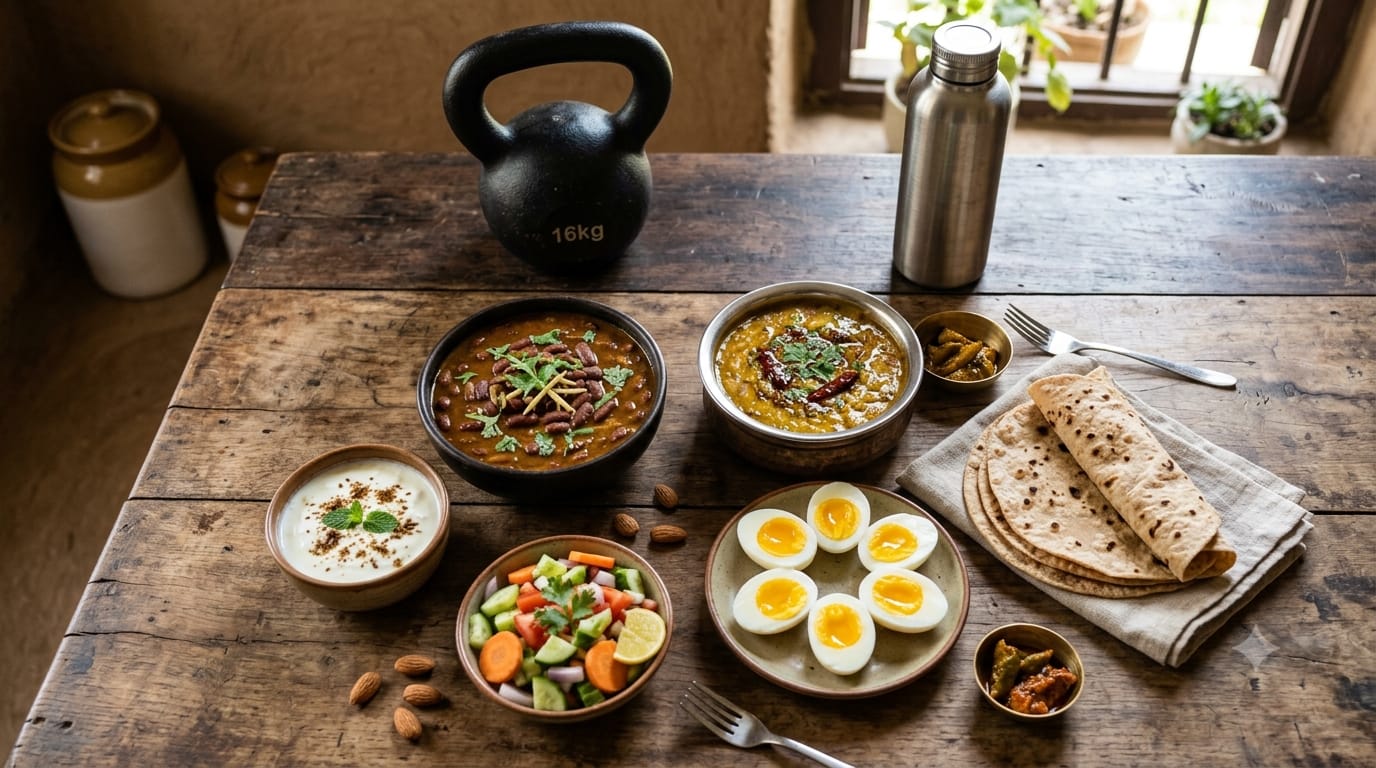

Navratri starts on Sunday 11 October and runs to Dussehra on Tuesday 20 October, with Ashtami and Navami both on Monday 19 October. If you lift, run or do home workouts, the question is simple: skip nine days, or keep going? Short answer: most healthy adults can keep training, but trim the volume, protect your protein and stop the moment you feel off. One catch first. Almost no research studies Navratri fasting itself.
What the studies actually cover
The closest research is on intermittent fasting, which is a different thing from a vrat. It usually means a tight eating window or a couple of low-calorie days a week. Navratri varies: some people skip meals, others eat several vrat meals a day. So treat the evidence below as a rough guide, not a rule.
One useful trial, published in the European Journal of Nutrition in 2022, put 34 untrained adults through 12 weeks. One group followed a 5:2 pattern (roughly 70% less energy on two days a week). The other cut energy by about 20% every day. Both did three sessions a week, two of them resistance training, and both were given at least 1.4 g of protein per kg of body weight a day.
The result: both groups lost fat, gained lean mass and got stronger, with no real difference between the two approaches. The authors' conclusion was that resistance training plus moderate protein produced similar improvements either way. They also admit the study may have been too small to catch smaller differences.
Look at the protein number. For a 60 kg person, 1.4 g per kg is 84 g a day. On a vrat menu that can be hard to reach, and that is where Navratri training usually goes wrong.
What experts say about muscle and fasting
In a 2022 piece from the University of Toronto, Eric Williamson said resistance exercise is "so potent" that it can help maintain muscle even during fasting periods. He also warned that fasting creates missed chances for protein feedings through the day, which matter for keeping muscle.
Another expert in the same piece, Matthew Lees, said intermittent fasting is "not ideal for an older person", because ageing bodies need regular protein. The experts also noted that people chasing peak performance or maximum muscle gain may get worse results when they restrict when they eat.
What a vrat plate gives you
According to Medanta's Navratri guide, permitted foods include kuttu (buckwheat), rajgira (amaranth), sama rice, dairy, fruits, nuts, potatoes and makhana, with rock salt instead of table salt. Regular grains, legumes, onion and garlic are restricted.
That list tells you the real issue for gym-goers: no dal, chana or rajma. Your protein has to come mainly from dairy and nuts. Medanta suggests smaller, balanced meals through the day that combine carbohydrates, protein and healthy fats, and fluids such as water, coconut water and buttermilk.
Practical swaps, in coach terms:
Build each meal around a protein anchor first: curd, milk or paneer-style dairy, then add kuttu, fruit or potato on the side.
Keep a handful of nuts or makhana within reach for the gaps.
Sip fluids through the day, not only at meals.
A sensible training week for Navratri
This is a coaching starting point, not a research finding. Adjust it to how you feel.
Keep two or three strength sessions, but cut volume: for example, three sets of each lift instead of four or five, and stop a couple of reps before failure.
Train within an hour or two of a meal that has some protein, not at the end of a long gap.
Swap hard cardio for walking or easy cycling on days when you are travelling, doing long pujas or eating very little.
Skip the sessions on Ashtami and Navami if the day is packed. Missing one workout changes almost nothing.
Stop, sit down and eat or drink if you feel dizzy, shaky, get a pounding headache or notice your heart racing. That is not discipline; it is a signal.
A sample day on a vrat plate
This is an illustration built only from the foods Medanta lists as permitted. It is not a prescription, and quantities depend on your size and appetite. The pattern to copy is that dairy or nuts show up at every meal.
Morning: a glass of milk, a banana and a handful of nuts.
Lunch: kuttu roti or sama rice with curd and a potato sabzi made with rock salt.
Before training (an hour or two ahead): curd with makhana, or fruit and nuts.
After training: a bowl of curd, or milk with fruit.
Dinner: rajgira or kuttu roti with a vegetable and a dairy side.
Add water, coconut water or buttermilk through the day. If you finish the day well short of what you would normally eat, lighten the next session rather than pushing through.
Who should check with a doctor first
Medanta says people with diabetes, high blood pressure, heart conditions or unstable angina need medical approval before fasting. Pregnant and nursing women, young children and older people should avoid strict fasting. The University of Toronto experts also urge consulting professionals before any weight-loss plan, because of the risk to a healthy relationship with food.
After Dussehra
Do not try to "make up" for lost sessions with a punishing week. Go back to your normal volume gradually over a few days. The studies above were not designed to test a nine-day dip in training, so nobody can promise it makes no difference. Still, nothing in them suggests that a short, lighter stretch undoes months of work.
This is general information, not medical advice. If you have a health condition or take medication, check with your doctor before you fast or change your training.