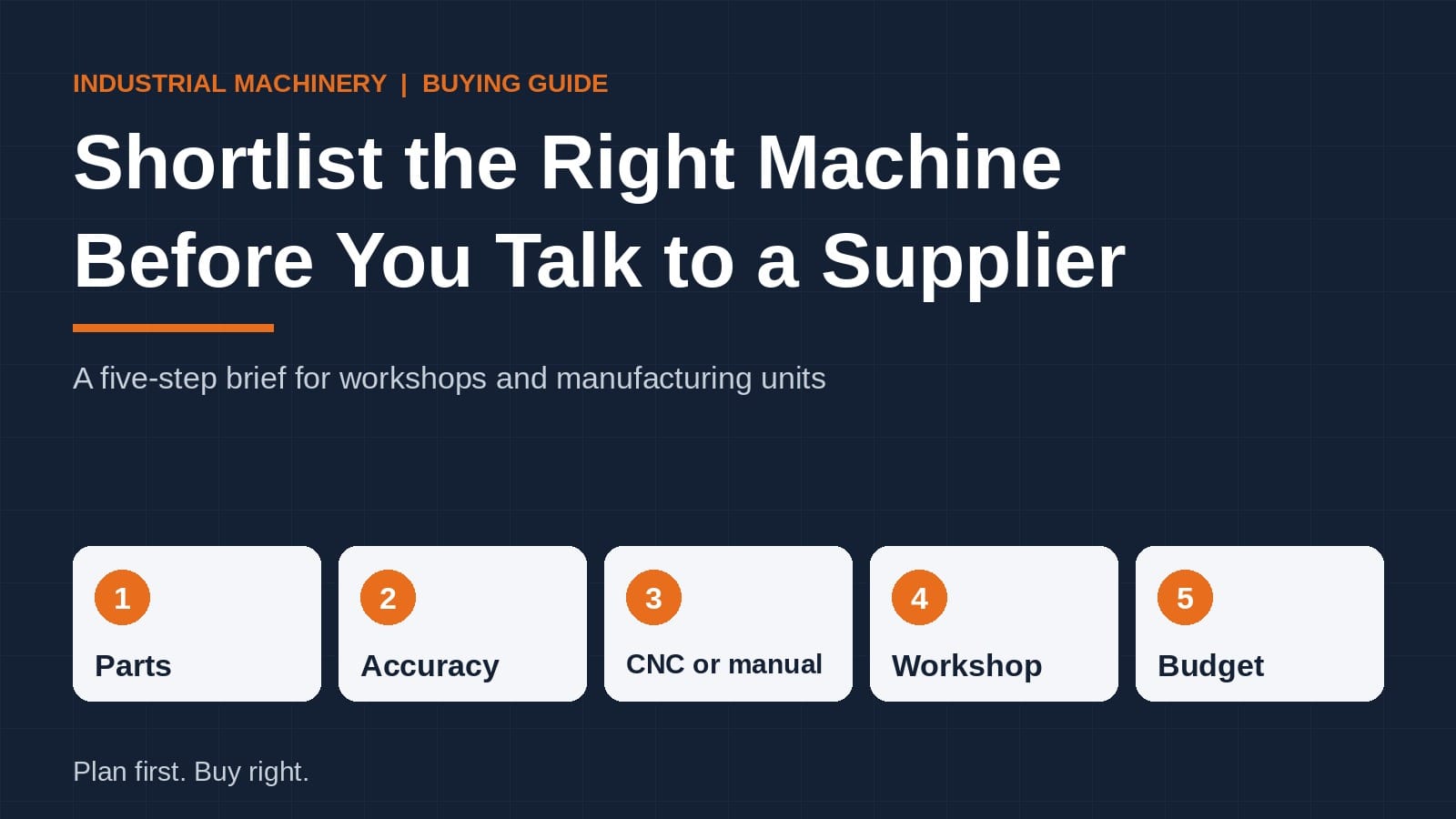
Most machinery purchases go wrong before the first phone call. A buyer walks in with “I need a CNC machine” and walks out with whatever is available. The result is often a machine that is too big, too small or simply wrong for the work.
Spending an hour on preparation changes the whole conversation. Here is a five-step way to define what you need, so that any industrial machinery supplier in India can give you a useful, specific answer.
Step 1: Describe the parts you make, not the machine you want
Write down what actually comes off your machines today.
The material: mild steel, stainless, cast iron, aluminium
The largest and smallest part dimensions
Whether the work is mainly turning, milling, grinding, drilling or gear cutting
How many pieces you make per month, and how often the job changes
A workshop making a few large castings needs very different equipment from one making thousands of small turned pins.
Step 2: Note the accuracy you really need
Tolerance drives cost. Ask yourself:
What is the tightest tolerance on your current jobs?
Which surface finish do customers demand?
Do you expect tighter requirements from new customers in the next year or two?
Buying far more accuracy than your jobs need wastes money. Buying less than you need costs you rejected parts.
Step 3: Decide where CNC makes sense and where it does not
CNC is not automatically the answer.
CNC fits repeat jobs, complex profiles and work where consistency matters across many pieces.
Conventional machines fit one-off jobs, repairs, simple operations and low-volume work where setup time would outweigh the benefit.
A mix often works best, with CNC for repeat production and conventional machines for support work.
Also think about your people. A CNC machine is only as productive as the operator and programmer behind it.
Step 4: Check your workshop before you check prices
A machine has to fit your space and your power supply. Measure and confirm:
Floor area, including room to load and unload parts
Door width and the path the machine will take to its spot
Power supply and phase requirements
Crane or forklift access
Coolant, chip handling and compressed air needs
It is much cheaper to find a mismatch on paper than after delivery.
Step 5: Set a budget that includes everything
The listed price is one part of the spend. Build your budget around:
Machine price
Transport and unloading
Installation and levelling
Tooling, fixtures and cutters
Operator training
A small reserve for early repairs or adjustments, especially on used machines
Turn the answers into a one-page brief
Put your answers on a single page: part sizes, material, tolerance, volume, available space, power supply and total budget. Share it with each supplier you contact.
This does two useful things. It lets the supplier recommend machines that genuinely fit, and it makes quotes easier to compare, because everyone is answering the same question.
If you are also weighing up what to look for in a dealer, this overview of an industrial machines supplier in India explains how to evaluate suppliers, compare new and used machines and avoid common buying mistakes.
What a good supplier does with your brief
Watch how suppliers respond:
They ask follow-up questions about your parts and volumes.
They suggest options within your budget, and sometimes tell you a cheaper machine will do.
They show proof, such as photos, videos or a trial, rather than just promises.
They are open about condition and costs instead of hiding them until later.
A supplier who works from your brief is far more likely to sell you the right machine than one who simply pushes available stock.
Final thought
The best machinery purchases start with a clear picture of the work, the workshop and the budget. Get that on paper first, and the rest of the process, from shortlisting to negotiation, becomes much easier.
Title: How to Shortlist the Right Machine for Your Workshop Before You Talk to a Supplier
Summary (editor ke liye, ≈180 characters):
A five-step guide to defining your parts, accuracy, workshop space and budget before contacting a machinery supplier, so you buy the right machine the first time.
Focus keyword: industrial machinery supplier in India
Tags / topic: industrial machinery, CNC machines, workshop equipment, machinery buying guide, manufacturing
Dhyan rakhna
Link: sirf 1, target page
https://rudramachinery.com/industrial-machines-supplier-in-india/ka. Anchor: industrial machines supplier in India (URL slug wala variation, pehle is conversation mein use nahi hua).Focus keyword: Publisha ke editor mein “industrial machinery supplier in India” daalna. Article mein ye exact phrase sirf “supplier” ke context mein natural tareeke se aata hai, aur link anchor alag rakha hai, taaki exact keyword repeat na lage. Agar editor ka checklist keyword ko body mein maange, to ek line mein “industrial machinery supplier in India” jod sakte ho.
Pichle live.journal.live wale blog se angle, title, structure aur wording alag hain.
Maine Rudra ki kisi service (inspection, warranty, delivery) ka claim nahi kiya.
Publisha par free plan mein stories ki limit hai, to ye bhi dhyan rakhna.
kis contetn mekeyword hai ?