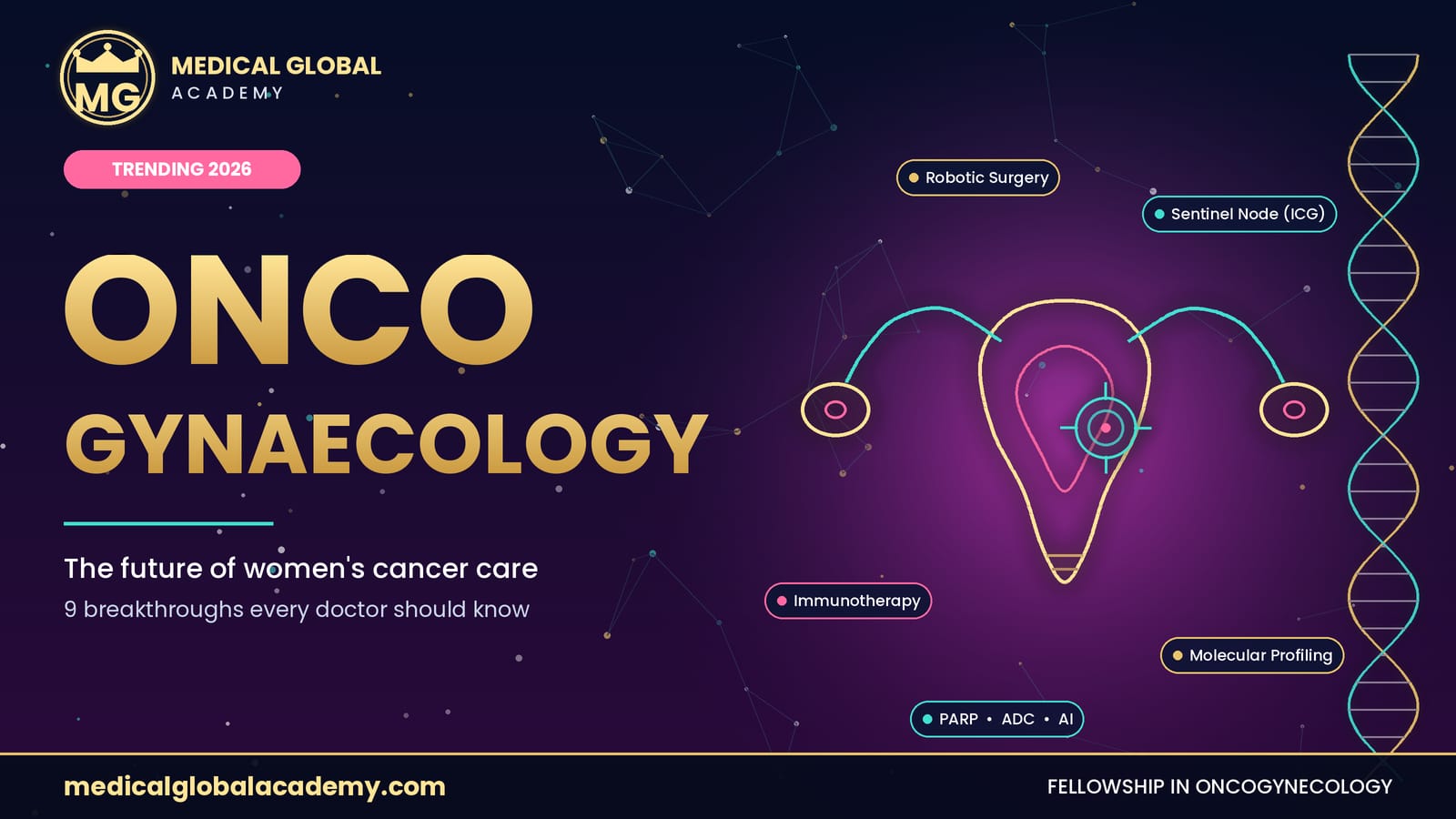
From molecular classification to antibody-drug conjugates, AI pathology and sentinel node mapping: how gynaecological oncology has changed in just five years, and what it means for your practice.
A decade ago, a patient with endometrial cancer was treated largely by histology and stage. Today, the same patient may be treated according to her tumour's POLE, mismatch repair, p53 and NSMP status. A recurrent cervical cancer patient who once had very limited options can now be offered an antibody-drug conjugate. Ovarian cancer maintenance therapy is guided by HRD and BRCA testing.
Onco-gynaecology is no longer just a surgical sub-speciality. It is now a fusion of surgery, molecular pathology, immunology, genomics and digital technology. If you are an OB-GYN, a surgical oncologist or a resident planning your next career step, here are the nine developments that are reshaping the field right now.
1. Molecular classification has rewritten endometrial cancer
The TCGA-derived four-group classification (POLE-mutated, mismatch repair deficient, NSMP and p53-abnormal) is now built into the FIGO 2023 endometrial cancer staging system. Practical tools such as ProMisE allow the same stratification using routine IHC and POLE sequencing.
Why it matters clinically:
POLE-mutated tumours have an excellent prognosis, which raises the question of adjuvant de-escalation.
p53-abnormal tumours behave aggressively and usually need chemotherapy-based treatment.
MMR-deficient tumours identify patients who may benefit from immunotherapy and who need evaluation for Lynch syndrome.
The takeaway: a pathology report without molecular information is now an incomplete report.
2. Immunotherapy has moved into frontline treatment
Phase III trials such as RUBY (dostarlimab) and NRG-GY018 (pembrolizumab) showed that adding a checkpoint inhibitor to carboplatin-paclitaxel improves progression-free survival in advanced or recurrent endometrial cancer, with the largest benefit in the dMMR subgroup.
In cervical cancer, KEYNOTE-A18 established pembrolizumab plus chemoradiotherapy as a new standard for high-risk locally advanced disease. Immunotherapy is no longer reserved for late-line rescue. It is entering curative-intent treatment.
3. Antibody-drug conjugates (ADCs): "smart chemotherapy"
ADCs deliver a cytotoxic payload directly to cells expressing a specific surface target. The gynaecological oncology toolkit now includes:
Tisotumab vedotin (tissue factor target) for recurrent or metastatic cervical cancer after first-line therapy.
Mirvetuximab soravtansine (folate receptor alpha target) for platinum-resistant, FRα-high ovarian cancer.
Trastuzumab deruxtecan, approved tumour-agnostically for HER2-positive (IHC 3+) solid tumours, which has made HER2 testing relevant across gynaecological cancers.
This brings a new skill requirement: knowing which biomarker to order, when, and how to interpret it.
4. PARP inhibitors and HRD testing in ovarian cancer
Trials such as SOLO-1, PRIMA and PAOLA-1 established maintenance PARP inhibition as part of first-line care for many patients. BRCA and homologous recombination deficiency (HRD) status now guide who benefits most. Germline and somatic testing should ideally be offered at diagnosis, not at recurrence.
5. Sentinel lymph node mapping replaces routine lymphadenectomy
Using indocyanine green (ICG) fluorescence with near-infrared imaging, surgeons can map and remove sentinel nodes in endometrial and early cervical cancer, with pathological ultrastaging to detect low-volume disease. The aim is accurate staging with less lymphoedema and lower surgical morbidity.
The broader trend is de-escalation: trials like SHAPE supported simple hysterectomy over radical hysterectomy in carefully selected low-risk early cervical cancer.
6. Surgical technology: robotics, but with caution
Robotic and laparoscopic approaches are well established for endometrial cancer. Cervical cancer is the important exception: the LACC trial showed worse survival with minimally invasive radical hysterectomy compared with open surgery in early-stage disease, which changed global practice. Modern onco-gynaecology means choosing the technology the evidence supports, not the technology that looks most advanced.
Other surgical themes include ERAS protocols, prehabilitation, and the role of HIPEC at interval cytoreduction in selected ovarian cancer patients, where evidence continues to evolve.
7. Artificial intelligence and digital pathology
AI is starting to enter the gynaecological oncology workflow through:
Digital pathology models that assist with tumour grading and molecular subtype prediction.
Radiomics and MRI/CT analysis for risk stratification and response prediction.
Decision-support tools that combine clinical, imaging and genomic data.
Most of these tools are still being validated and are decision support, not decision makers. Clinicians who understand their strengths and limits will be the ones who use them well.
8. Prevention: the road to cervical cancer elimination
The WHO strategy aims for 90% HPV vaccination of girls by age 15, 70% screening with a high-performance test, and 90% treatment of pre-cancer and invasive cancer by 2030. HPV DNA testing, self-sampling and single-dose vaccination schedules are practical tools for countries with large populations to reach, including India. Gynaecologists are central to making this happen.
9. Fertility-sparing and quality-of-life oncology
For selected young women, options such as radical trachelectomy in early cervical cancer and progestin-based therapy, including the levonorgestrel IUD, in well-selected early endometrial cancer allow cancer control while preserving fertility. Molecular profiling is increasingly used to refine who is a suitable candidate. Survivorship, sexual health and menopause management are now recognised parts of cancer care, not afterthoughts.
What this means for your career
The common thread across all nine developments is that onco-gynaecology now rewards clinicians who can think across disciplines: surgical technique, molecular reports, immunotherapy decisions, genetics counselling and multidisciplinary team leadership.
If you want to move from reading about these changes to practising them, structured, case-based training is the fastest route. A dedicated programme such as the Fellowship in Onco-Gynaecology from Medical Global Academy is designed for clinicians who want to build depth in this fast-moving field.
Frequently asked questions
What is onco-gynaecology? Onco-gynaecology (gynaecological oncology) is the branch of medicine that deals with the diagnosis, surgical and medical management, and follow-up of cancers of the female genital tract: cervix, uterus, ovary, fallopian tube, vulva and vagina.
Why is molecular testing important in endometrial cancer? Because POLE, MMR, p53 and NSMP status predict prognosis and guide adjuvant therapy and immunotherapy eligibility, and are now part of FIGO 2023 staging.
What are antibody-drug conjugates in gynaecological cancers? They are targeted agents that link an antibody to a cytotoxic drug, delivering chemotherapy more selectively to cancer cells expressing a specific target.
Is sentinel node biopsy safe in endometrial cancer? In appropriately selected patients and with experienced surgeons, sentinel node mapping with ICG is an accepted alternative to systematic lymphadenectomy for staging, with lower morbidity.
Who should consider a fellowship in onco-gynaecology? Obstetrician-gynaecologists and surgical oncology trainees who want structured exposure to modern cancer surgery, molecular oncology and multidisciplinary decision-making.