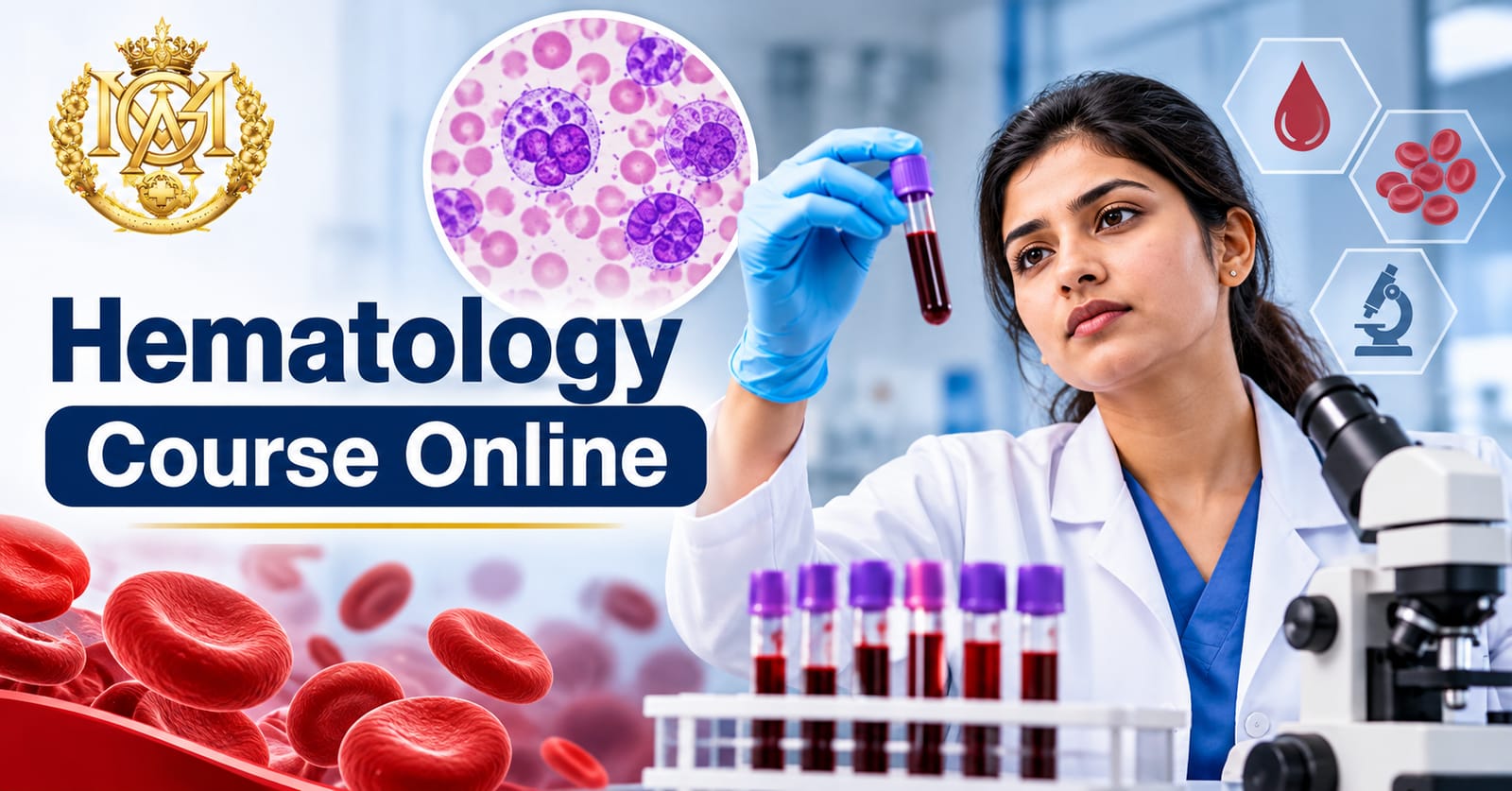
Hematology rests on cell biology. Every red cell, white cell, and platelet in the circulation comes from a small population of stem cells in the bone marrow, and every bleeding or clotting problem depends on a precise sequence of biochemical events. A clinician who understands that biology can reason about a blood count rather than memorize it. This article explains the science behind blood production and blood disease, and it describes what a hematology course online should teach about it. Doctors who want to see how one structured program presents this material can review the Fellowship in Hematology at Medical Global Academy.
How Blood Cells Are Made
Blood production, or hematopoiesis, begins with hematopoietic stem cells in the bone marrow. These cells can renew themselves and give rise to every blood lineage. They divide and mature along distinct branches. The erythroid branch produces red cells, which carry oxygen through hemoglobin. The myeloid branch produces granulocytes and monocytes, which defend against infection and clear debris. The lymphoid branch produces B cells, T cells, and natural killer cells, which handle adaptive and innate immunity. Megakaryocytes, large marrow cells, shed fragments that become platelets.
This branching structure matters clinically. A disorder that affects the stem cell itself can change several lines at once, while a problem confined to one branch produces a narrower pattern. Reading a blood count well means asking which branch is under strain, and that question depends on understanding how the lineages relate to one another.
The Marrow Environment and Its Regulation
Stem cells do not work in isolation. They depend on the bone marrow microenvironment, a network of supporting cells, signaling molecules, and physical structures that controls when cells divide and when they mature. Red cell production responds to oxygen levels, which is why chronic kidney disease and high altitude both affect hemoglobin. Growth factors coordinate production across lineages, and disruption of these signals contributes to several blood disorders.
Understanding this regulation helps explain why some anemias reflect poor marrow output and others reflect loss or destruction of cells outside the marrow. The distinction shapes every subsequent investigation.
Hemostasis: How Bleeding Is Controlled
Hemostasis is the system that stops bleeding and, when needed, maintains a clot. It works in two overlapping phases. Primary hemostasis begins when platelets adhere to exposed tissue at a site of injury and aggregate into a temporary plug. Secondary hemostasis follows, as a cascade of clotting factors converts fibrinogen into fibrin, which reinforces the plug into a stable clot. Regulatory proteins then limit clot formation to the site of injury.
Disorders can disrupt any part of this sequence. Platelet number or function, clotting factor deficiency, and abnormal regulation each produce different patterns on testing. A course that explains the cascade conceptually, rather than as a list of factors, gives you the framework to interpret those patterns.
When Cell Biology Goes Wrong
Many blood cancers arise when a single cell acquires somatic mutations that give it a growth advantage. The abnormal clone expands and crowds out normal cells, which is why leukemias often present with cytopenias alongside abnormal circulating cells. Lymphomas arise from lymphocytes at different stages of maturation, and the stage of origin helps determine how the disease is classified.
Benign disorders follow different logic. Inherited hemoglobin disorders such as thalassemia and sickle cell disease alter the structure or production of hemoglobin, and their effects are felt across the whole red cell population. These differences explain why the same symptom, such as fatigue or pallor, can arise from very different mechanisms.
Connecting Biology to Diagnosis
Biology becomes useful in practice when it connects to testing. Flow cytometry identifies cells by the proteins on their surface, which reflects their lineage and stage of maturation. Molecular and cytogenetic testing reveal the genetic changes that drive clonal disease. The Fellowship in Molecular Hematology covers how these genetic findings are interpreted in a structured format.
Pediatric blood disorders follow the same biology but show different patterns, because the developing marrow and the child's immune system behave differently from adult systems. A hematology pathology course online should show how these findings are read in real reports. Doctors who work with children can look at the Fellowship in Pediatric Hematology for its structure.
What a Hematology Course Should Teach About Biology
A strong hematology course online builds from this foundation. It should explain lineage relationships and marrow regulation before the diseases, teach the coagulation system as a sequence rather than a list, and connect each disorder to the biological mechanism that produces its findings. Courses that begin with disease lists and skip the biology tend to produce clinicians who can recite criteria but struggle with unfamiliar presentations.
Doctors looking for a blood disorders fellowship India program should check whether it teaches this biology explicitly rather than assuming it. Biology alone is not enough for practice. Interpreting smears, marrow reports, and flow results requires supervised experience in the laboratory and at the bedside, and a responsible online program will say so plainly.
Training Routes for Blood Science
Doctors who want formal training in clinical hematology in India can look at DM or DrNB Clinical Hematology, which are three-year super-specialty programs entered after an MD or DNB through NEET-SS. Eligibility and seat numbers change, so verify current requirements with the NMC and NBEMS.
For doctors who cannot take that route, structured programs can build the same biological reasoning. Those interested in blood products may also search for a transfusion medicine course India, which is a separate field with its own training. The PG Diploma in Hematology at MGA is one option. It is a longer, assessed program than a certificate, and it is not a super-specialty degree.
Frequently Asked Questions
Do I need to understand cell biology to take a hematology course online?
Yes. For a hematology course for medical students India, the biology is the foundation, because it explains why a blood count changes and why one finding points in a different direction from another. Courses that teach biology first generally build stronger reasoning.
What is hematopoiesis?
Hematopoiesis is the process by which stem cells in the bone marrow produce red cells, white cells, and platelets through distinct maturation pathways.
Is hematopathology the same as the biology of blood?
A hematopathology course India program applies that biology to laboratory diagnosis. It uses morphology, flow cytometry, and genetic testing to classify blood and marrow disease.
Can an online course teach the laboratory side of hematology?
It can teach interpretation and reasoning. Laboratory technique needs supervised, in-person practice.
Summary
Hematology is built on the biology of stem cells, blood lineages, and the coagulation system. Understanding that science makes blood counts, smears, and clotting tests easier to interpret. A hematology course online is worth considering when it teaches this foundation clearly and is honest about what requires in-person training. For more information on postgraduate programs available through Medical Global Academy, visit the homepage.