Patients who have been told they may have cholesteatoma ear leave the consultation with questions they did not think to ask in the room. What is it, exactly? Does it always need an operation? Could it affect the face? Could it run in the family? This article addresses those questions directly, using plain language and accurate clinical information. It is written for patients and their families, and it is not a substitute for advice from the doctor who has examined and imaged the ear. Doctors who want to develop expertise in managing this condition may find the Fellowship in Otology at Medical Global Academy worth reviewing.
What Is Cholesteatoma Ear, in Plain Terms?
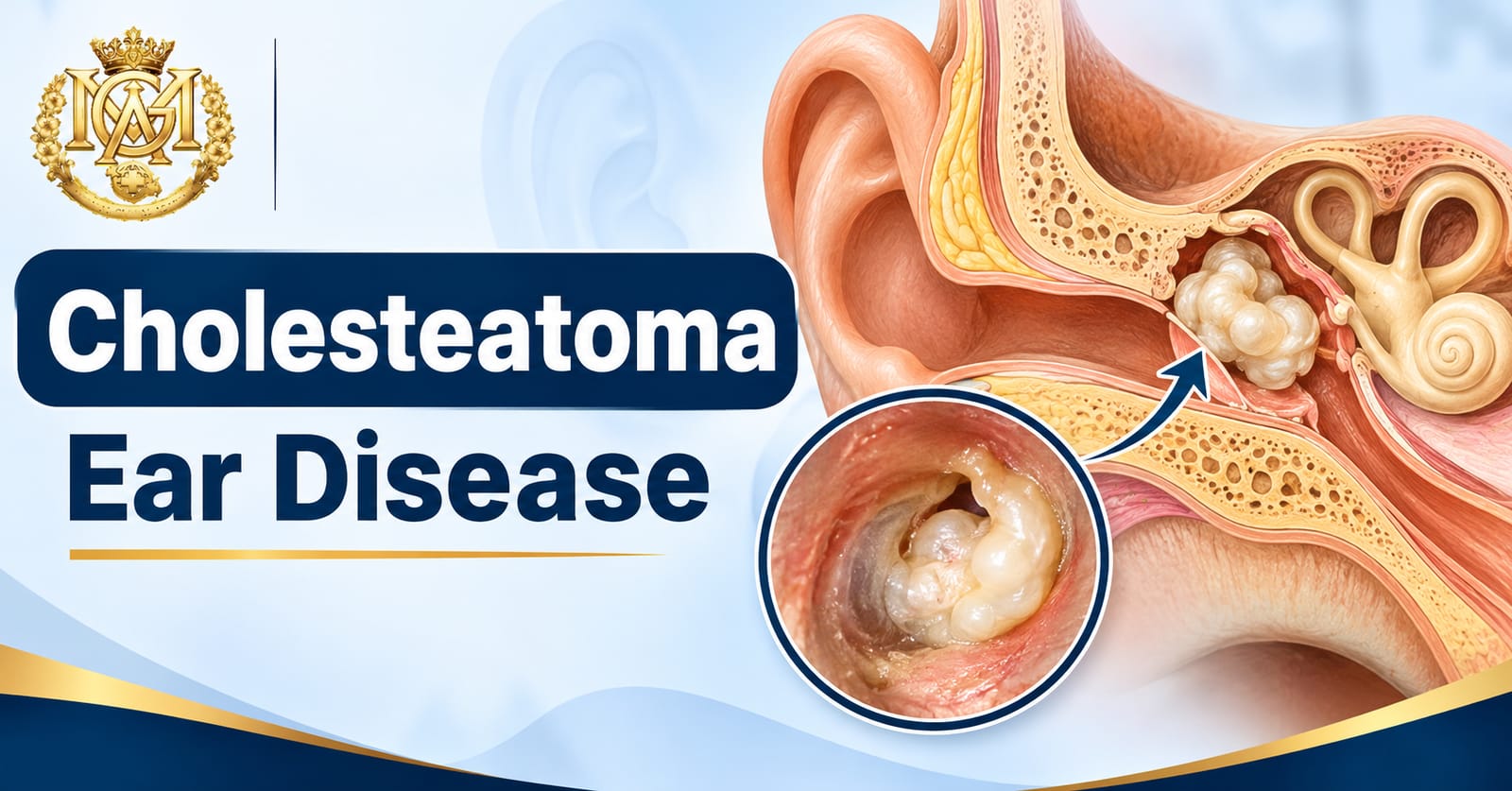
Cholesteatoma is a collection of skin cells that builds up inside the ear where it should not. The middle ear, the space behind the eardrum, is lined with a thin membrane, and when skin from the outer ear canal finds its way behind the eardrum — either through a retraction pocket or through a perforation — it accumulates instead of clearing itself. That growing mass is the cholesteatoma.
It is not a cancer. The concern is that the accumulating skin can press on and slowly erode the small bones of the middle ear, the mastoid bone, and in some cases the structures around them. The name sounds alarming, and many patients hear the word as a tumor. It is a skin accumulation, not a malignant growth, and while it needs proper assessment and management, the name does not carry the weight that word implies.
Can Cholesteatoma Be Treated Without Surgery?
This is one of the most common questions patients ask, and the honest answer is that cholesteatoma treatment without surgery is not a standard option for most established cases. Surgery is generally the recommended management when the lesion is confirmed and is causing symptoms, hearing loss, or erosion of nearby structures.
That said, not every case follows the same path. The treating team makes the decision based on the size and position of the lesion, the patient's age and general health, the hearing results, and whether complications are present. Some very small lesions may be monitored closely rather than operated on immediately, with follow-up examinations and imaging to check for change. That monitoring is itself active management, not an alternative to care.
Patients who ask about non-surgical options are usually asking because they want to understand what they are facing, which is a reasonable and sensible question. The treating surgeon can explain the specific findings and what the options are for that individual case.
What Is Primary Cholesteatoma?
Primary cholesteatoma refers to cases that develop without a preceding perforation or infection. The most common form is a retraction pocket in the upper part of the eardrum, called the pars flaccida or attic region, which gradually deepens and allows skin to accumulate behind it. Because there is no hole in the eardrum, the outer ear can look normal to a casual examination, which is one reason primary cholesteatoma is sometimes found later than other forms.
Primary cholesteatoma is distinguished from secondary acquired cholesteatoma, which develops through a perforation, usually following repeated ear infections, and from congenital cholesteatoma, which is present from birth behind an intact eardrum. The distinction matters for treatment planning and for understanding how the lesion reached its current position.
Can Cholesteatoma Affect the Facial Nerve?
Yes, and this is one of the reasons cholesteatoma ear is managed with care. The cholesteatoma facial nerve relationship arises from the anatomy: the facial nerve, which controls the muscles of the face on one side, runs very close to the middle ear as it passes through the temporal bone. If a cholesteatoma grows toward the facial nerve canal, it can erode the bone that protects the nerve.
Facial weakness — a drooping of one side of the face, or difficulty closing one eye fully — is an uncommon complication, but it is one of the symptoms that calls for prompt specialist review. Any patient with known or suspected cholesteatoma who notices new facial weakness should seek medical attention without delay, because early management reduces the risk of permanent injury.
Clinicians check for facial weakness as part of the routine assessment, and patients should be told to report any new change in facial movement before their next scheduled review.
Can Cholesteatoma Occur in the Nose?
Nasal cholesteatoma is a recognized but uncommon form. The term refers to a keratin-accumulating lesion that develops in the nasal cavity or the paranasal sinuses rather than in the middle ear. It follows the same basic biological process as the ear form — skin cells that cannot clear themselves accumulate and may erode nearby structures — but its location, presentation, and management pathway differ from cholesteatoma ear.
Patients researching cholesteatoma who come across the nasal form should know that it is distinct from the middle ear condition. A patient who has been told they have cholesteatoma in the ear should not assume that the nasal information applies to their case. Any concerns about symptoms in the nose or sinuses should be discussed with the treating team directly.
Is Cholesteatoma Hereditary?
This question comes up regularly, particularly in families where more than one member has been diagnosed. The answer is that the evidence for a hereditary pattern is not straightforward, and patients should raise this question with their doctor rather than relying on a general article.
Is cholesteatoma hereditary in the strict genetic sense? For acquired forms — which make up most diagnosed cases — the evidence for a direct hereditary pattern is not firmly established. The condition is associated with recurrent ear infections, abnormal Eustachian tube function, and certain anatomical variations that may have a familial tendency. Congenital cholesteatoma, the form present from birth, has been reported in siblings in some cases, though the picture is not fully understood.
Patients with a family history of cholesteatoma, or parents of a child diagnosed with the condition, should discuss it with their ENT team. Genetic counseling is not a standard recommendation for most cases at present, but the team can advise based on the specifics.
What Warning Symptoms Should a Patient Watch For?
Patients who have been told they have or may have cholesteatoma ear should know which symptoms should prompt an earlier visit than scheduled:
New or worsening facial weakness on the affected side
Sudden worsening of hearing in the affected ear
New headache, especially with other ear symptoms
Dizziness or balance problems that begin suddenly
Discharge that changes in character, increases in amount, or returns after a period of being clear
These are general prompts, not a complete list. The treating team will give individual guidance about which symptoms to act on and how to reach the team between visits.
Frequently Asked Questions
How is cholesteatoma diagnosed?
Diagnosis begins with a careful examination of the ear, usually with an otoscope. If the examination raises a concern, hearing tests and imaging — typically a CT scan of the temporal bone — help define the size and position of the lesion. The clinical picture, hearing results, and imaging are read together by the treating team.
Will the hearing loss from cholesteatoma recover?
That depends on the extent of damage to the ossicles and the duration of the hearing loss. Some patients recover hearing after treatment; others have residual loss. The treating surgeon can give a more specific assessment after reviewing the examination and imaging findings.
How long does cholesteatoma surgery take to recover from?
Recovery times vary with the type of operation and the individual patient. The treating surgeon explains what to expect before and after the procedure, including the follow-up schedule and the activities to avoid during recovery. This is a question for the treating team, not a general article.
Can cholesteatoma come back after treatment?
Recurrence is a recognized concern, which is why follow-up after treatment is important. Patients should understand that a single successful outcome does not close the question permanently, and that attending follow-up appointments matters. Data on recurrence rates were not available in the sources reviewed for this article; the treating surgeon can explain the figures relevant to their practice.
Summary
Cholesteatoma ear is a condition that patients can understand and manage well when they have clear information. It is not a cancer, treatment decisions are made case by case, the facial nerve can be affected, nasal forms are distinct from ear forms, and the hereditary evidence is uncertain. For more information on the postgraduate programs offered at Medical Global Academy, visit the homepage.