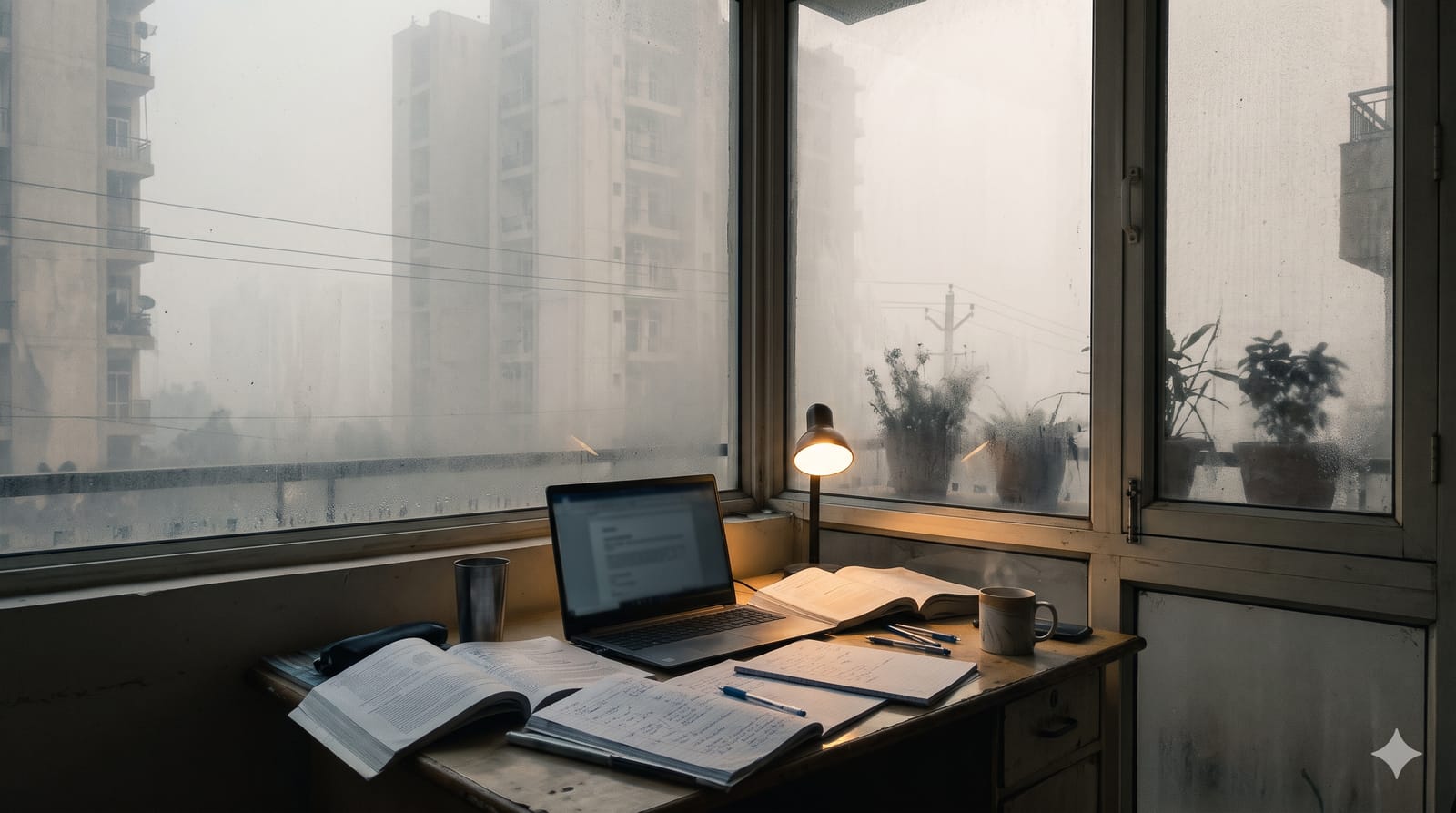
Every November, when the air in north India turns grey, a familiar question comes up: is the smog making it harder to think, or does it just feel that way? The research gives a more careful answer than either "yes, it fogs your brain" or "it's all in your head". Short-term exposure to fine particles seems to affect some kinds of thinking, mainly reasoning, more than others. Here is what three well-designed studies found, and what that means for studying and working through a bad-air month.
The particles in question
Most of these studies look at PM2.5: particles smaller than 2.5 micrometres, one of the pollutants India's AQI tracks. One reason researchers study it for indoor tasks like exams is that, as one paper puts it, PM2.5 easily penetrates indoor settings. Closing the classroom door doesn't keep it out.
The studies below measure performance on tasks, not what happens inside the brain. That matters for how confidently we can talk about causes.
Study 1: university students in Brazil
Researchers ran 54 lab sessions over three years with 464 students at a large Brazilian university, giving them a battery of sensitive cognitive tests while outdoor PM2.5 varied naturally from day to day. The result, published in 2021 in the Journal of the Association of Environmental and Resource Economists: high PM2.5 reduced performance on a fluid reasoning test.
Just as interesting is what didn't move. The study found no clear effect on simple attention, complex attention, arithmetic speed or working memory. The authors are honest that they may not have had enough data to detect small effects on those tests. But the pattern points somewhere specific: the kind of thinking where you work out something new, not the kind where you hold focus or recall.
Study 2: high-stakes exams in Israel
A 2016 study in the American Economic Journal: Applied Economics looked at Israeli students taking their matriculation exams between 2000 and 2002. Because the same students sat several exams on different days, the researchers could compare each student with themselves on cleaner and dirtier days.
They found that short-term PM2.5 exposure was linked to weaker exam performance. Then they followed the students to 2010 and found that pollution on exam days was also associated with lower post-school education and earnings. A bad-air exam day didn't make anyone less capable. It made the exam a noisier measure of what they could do, and that score went on to shape where they went next.
Study 3: cleaning the air for 90 minutes
If dirty air hurts thinking, does cleaning it help right away? A randomised trial in Barcelona tested exactly that. Researchers put 2,123 students aged 13 to 16, from 33 high schools, into classrooms with either a filtering air cleaner or a device that only recirculated air. Nobody knew which they had.
The filters worked: over the 90-minute session, PM2.5 was about 89% lower. But on an attention task, the trial found no difference between the groups. The authors concluded that 90 minutes of clean air didn't change adolescents' attention, and called for studies with longer exposures and other age groups.
Putting the three together
Read side by side, the studies are fairly consistent:
Reasoning and exam performance seem to dip on high-pollution days.
Simple attention shows little measurable change, either from pollution in Brazil or from a short burst of clean air in Barcelona.
The effects are modest. Nobody found that smog makes you unable to study. They found small shifts that matter most when a single test score carries a lot of weight.
So if you feel slower at hard problems on a bad-air day, that fits the evidence. If you feel unable to concentrate at all, pollution is probably not the only thing going on.
What to do during a bad-air month
Small, realistic steps, in order of how much they are likely to matter:
Protect your sleep first. Winter routines, late study nights and festival season all chip away at it, and short sleep makes hard thinking feel even harder. Here's why effort rises after a short night.
Match the task to the day. This is an inference from the Brazil study, not a tested rule: on the worst-AQI days, it may make sense to do review, flashcards and familiar practice, and save your hardest new problem sets for cleaner days. Try it for two weeks and notice whether it helps you.
Take care with outdoor exercise. Movement still helps mood and sleep, but timing and intensity matter when the air is bad. Our fitness writer looked at what the evidence says about exercising on poor-AQI days.
Don't over-read one bad day. The Israel study is a useful reminder that a test on a smoggy day measures you with extra noise. One weak mock test in November is not a verdict on your preparation.
Keep perspective. If worry about results is heavier than the smog, that is worth addressing directly. These research-backed ways to manage exam anxiety are a good start.
What we still don't know
None of these studies was done in India, where winter PM2.5 levels can be far higher than in Barcelona or Israel. Whether effects grow at those levels, or whether longer stretches of cleaner indoor air help thinking, isn't settled by this evidence.
For health decisions about pollution, especially if you have asthma, heart or lung conditions, follow official AQI advisories and your doctor's advice. This article is general information about focus and study, not medical advice.