
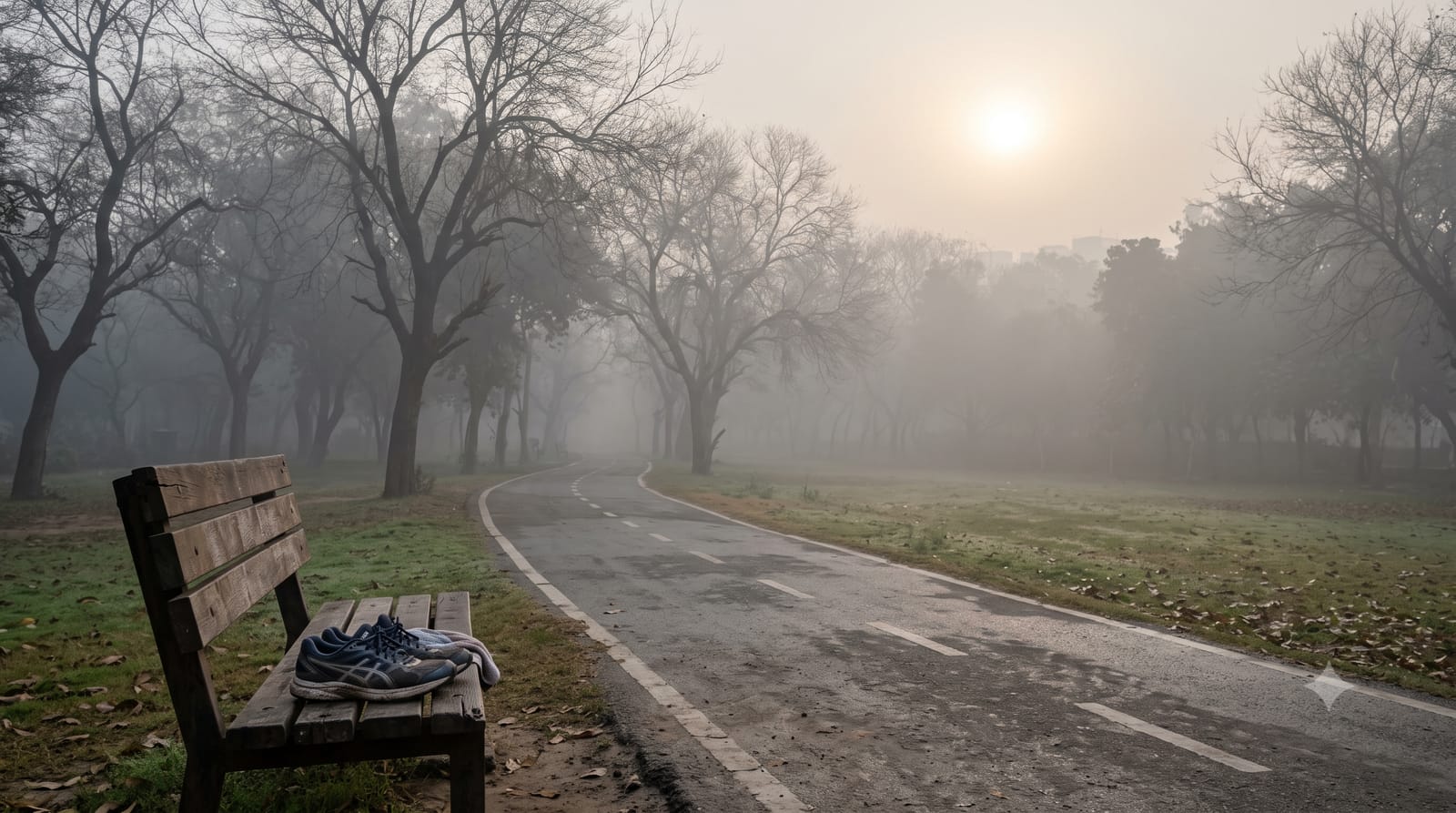
Every October the same question returns across north India: the air is turning hazy, so should you still go for your morning run, walk or cycle? Two bad answers float around. One says "never exercise outside when it is polluted". The other says "fresh air is fresh air, just go". The evidence sits in between, and it is more useful than either. Here is what the research found, how to read the AQI before you train, and a simple plan for bad-air weeks.
What the AQI categories actually mean
India's Air Quality Index, run by the Central Pollution Control Board, has six bands. As summarised in this Free Press Journal report of CPCB's categories:
Good (0 to 50): minimal or no health impact.
Satisfactory (51 to 100): sensitive people may feel slight discomfort.
Moderate (101 to 200): can trigger breathing difficulty in people with asthma, lung or heart disease.
Poor (201 to 300): prolonged exposure can cause breathing discomfort to most people.
Very Poor (301 to 400): risk of respiratory illness even in healthy people with prolonged exposure.
Severe (401 to 500): dangerous for everyone.
Notice the words "prolonged exposure". That matters for the next section.
The study everyone should know: when does pollution cancel out exercise?
In 2016, Marko Tainio and colleagues published a modelling study in Preventive Medicine asking exactly this: at what point does breathing more polluted air during exercise outweigh the benefit of the exercise itself? They looked at cycling and walking across fine particle (PM2.5) levels from 5 to 200 μg/m³, measuring the effect on risk of death from all causes.
According to the paper's abstract:
At the global average urban level of 22 μg/m³, the benefits of activity "by far outweigh" the pollution risk, even at extreme amounts of activity.
At 100 μg/m³, harms would exceed benefits only after about 1 hour 30 minutes of cycling a day, or more than 10 hours of walking a day.
If the alternative was driving rather than staying home, cycling stayed beneficial up to about 3 hours 30 minutes a day.
The authors concluded that the benefits outweighed the harm "in all but the most extreme air pollution concentrations".
As the Safe Routes Partnership summary puts it, long-term health gains from active travel generally exceed pollution risks in most real-world conditions.
Myth-busting, with the caveats
Myth: "Any outdoor exercise in pollution does more harm than good"
Not according to this model. For a typical 30 to 45 minute walk or jog, on most days in most cities, staying active wins. Skipping exercise for weeks every winter has its own cost.
Myth: "Pollution does not matter if you are fit"
Also wrong. The study's numbers are long-term averages of PM2.5, not single bad days, and they come from a model, not a trial. The authors note the results were sensitive to their assumptions. And they say nothing about people with asthma, heart disease or other conditions, who can react to a single bad day. On Very Poor and Severe days, CPCB's own descriptions say healthy people are affected too.
The honest middle
Keep moving through the season, but let the AQI decide where and how hard. A hard 10 km run on a Severe day is a bad trade. A brisk 30-minute walk on a Moderate day is a good one.
A simple AQI rule for your workouts
Check your city's current AQI from CPCB's official data before you head out, then:
Good to Moderate (0 to 200): train as planned, outdoors is fine. If you have asthma or a heart condition, watch how you feel on Moderate days.
Poor (201 to 300): keep outdoor sessions shorter and easier. Swap long runs for a shorter run plus an indoor strength session.
Very Poor (301 to 400): move intense workouts indoors. Easy walking outside only if you need it for daily life.
Severe (401+): train indoors. Rest is fine too.
Harder breathing means more air through your lungs, so intensity matters as much as duration. That is why the plan cuts intensity first.
A bad-air week that still keeps you fit
For a beginner aiming at 3 to 4 sessions, here is a sample week for when the air turns bad:
Monday: 25-minute home strength circuit. Squats, push-ups (on knees is fine), lunges, glute bridges, plank. Three rounds.
Tuesday: 20 to 30 minutes of easy walking, indoors at a mall or on a staircase if the AQI is Very Poor, outside if it is Moderate.
Thursday: skipping rope or spot jogging in short intervals: 30 seconds on, 60 seconds off, 10 rounds.
Saturday: your longer session, outdoors only if the AQI is Moderate or better. Otherwise, repeat Monday with an extra round.
Protein and recovery still matter more than anything fancy. Dal, eggs, paneer or curd at each main meal keeps your strength work paying off while cardio volume drops.
Who should be extra careful
If you have asthma, COPD, heart disease, are pregnant, or are training a child or an older parent, the general model above does not cover you well. Ask your doctor what AQI level should change your plan, and keep any inhaler with you when you train.
The bottom line: winter smog is a reason to adjust your training, not to stop it. Read the number, cut intensity on bad days, take the hard sessions indoors, and you will come out of the season fitter, not stiffer.
General information, not medical advice. Check with your doctor if you have a heart or lung condition.