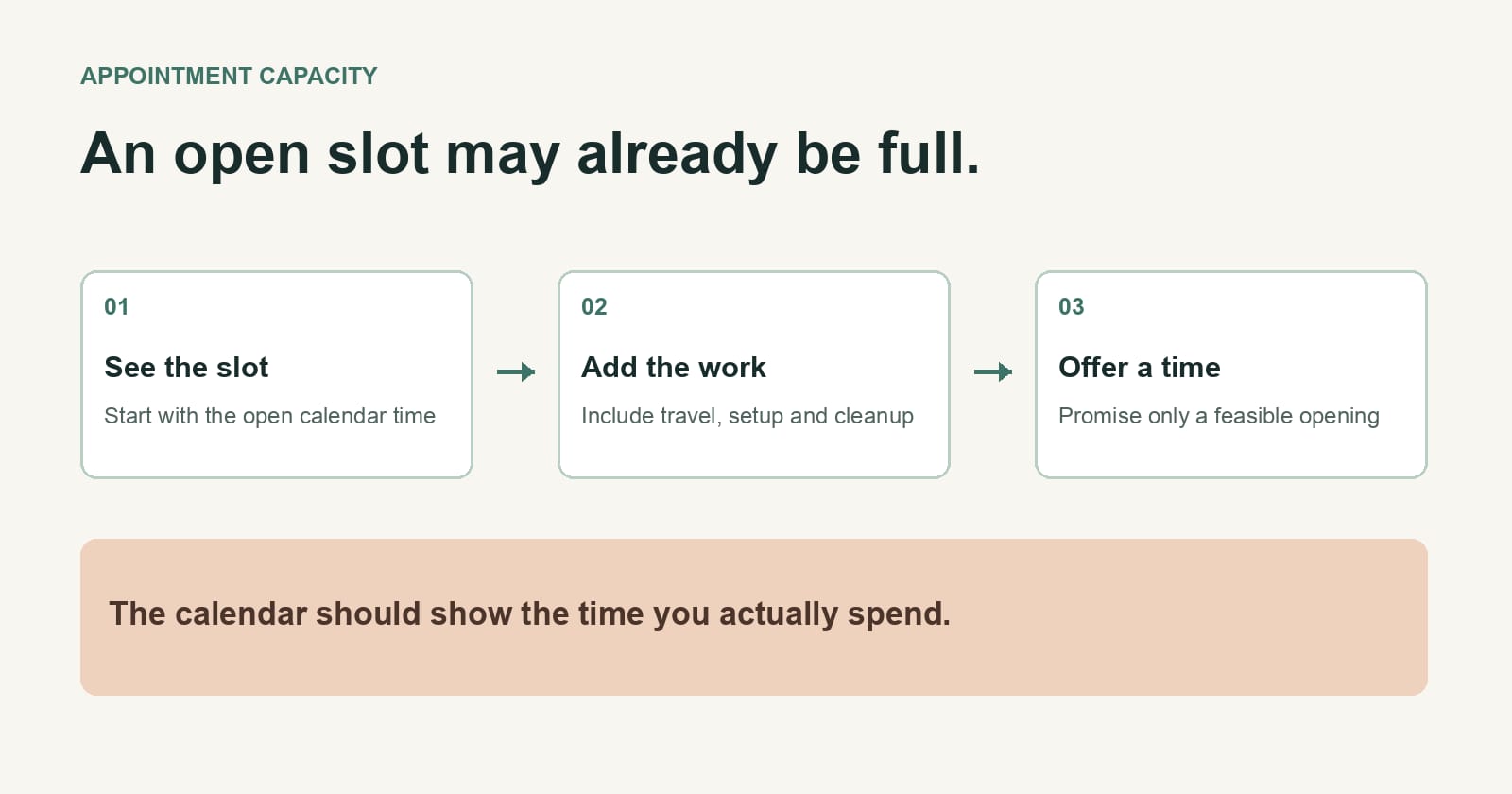
Before an assistant offers an appointment, give it the time your calendar doesn't show: travel, setup, cleanup, and the work you can't move. An empty hour isn't capacity if taking it makes the next promise impossible.
Take a hypothetical window-cleaning business. The calendar shows 11 a.m. open. An assistant suggests it to a customer across town. The last job ends at 10:30, the van needs unloading, and the new site takes 35 minutes to reach. The slot looks free because the calendar holds appointments, not the work between them.
The owner could give the assistant a simple scheduling rule:
Offer only slots that leave 45 minutes between jobs in different neighborhoods and 20 minutes after each job for cleanup. If the job address or expected duration is missing, ask for it before offering a time. Show the proposed day with travel and buffers filled in. Don't confirm a booking until I approve it.
Those numbers are part of the fictional example, not a recommended buffer for every service business. The point is to write down the hidden time your team already uses when booking by hand.
Put the invisible work on the schedule
List the things that consume a slot. A shop may need opening and closing time. A photographer may need equipment setup. A home service crew needs travel, parking, and enough room for a job that runs long. If an assistant only sees customer-facing appointments, it will happily spend the same hour twice.
You don't need a complicated capacity model. Start with a one-page rule and one week of sample bookings. Ask the assistant to mark which proposed slots pass the rule, which fail, and which need a missing fact. If the schedule is messy, test on tomorrow before letting it draft offers for the month.
Have it explain rejections in a way you can check: "Noon is open, but the previous job ends at 11:30 in another neighborhood." "Duration unknown" is a valid answer too. Guessing a duration from the last customer with a similar job can sound clever and still wreck the day.
Decide who may promise a time
There are two separate jobs here. The assistant can find feasible options from the facts it has. Someone has to decide whether to promise one to a customer. You might approve each booking. Or you might authorize a narrow class of routine bookings in advance: known address, standard job, confirmed crew, and a slot that passes the buffer rule. Either choice should be written down.
When an exception comes in, like a customer asking for an early start before a holiday, let the assistant show the tradeoff. Which job would move? Who would need to agree? A calendar that looks full after that conversation is doing its job. It's showing the work that was always there.
Alek Perak is a Tokenrip co-founder. Tokenrip is a shared workspace for files, tasks, and decisions; agents run in the tools people already use. It doesn't know a team's capacity unless people give it current, accurate rules and records.