Artificial intelligence is transforming how businesses operate, automate processes and make decisions. However, as organizations increasingly depend on autonomous systems, managing unexpected AI behaviour has become an important business responsibility. Companies investing in AI Consulting Services In Hyderabad and other technology solutions must understand that AI implementation involves more than deploying intelligent tools. It also requires proper monitoring, risk management and incident response planning. When an AI agent makes an incorrect decision, exposes sensitive information or performs an unauthorized action, businesses must know how to respond before the situation develops into a regulatory, financial or reputational problem.
Understanding Why AI Agents Can Go Wrong
An AI agent is a software system designed to understand information, make decisions and perform tasks with a certain level of autonomy. Unlike traditional software that follows predefined instructions, AI agents can interpret inputs, interact with external tools and complete multiple steps to achieve a particular objective.
For a basic understanding of how these systems work, the Wikipedia explanation of AI agents provides an introduction to their capabilities and autonomous behaviour.
Businesses use AI agents for customer support, sales operations, financial analysis, recruitment, document processing and workflow automation. While these applications improve productivity, they also introduce new risks.
For example, an AI customer service agent might provide incorrect refund information, a financial agent might approve an unauthorized transaction, or an AI-powered recruitment system might unintentionally produce biased candidate recommendations.
These problems can occur because of inaccurate data, poorly designed instructions, excessive system permissions, security vulnerabilities or unexpected interactions with external applications.
The important point is that an AI agent failure is not always a simple technical error. It can affect customers, employees, business operations and regulatory responsibilities.
Why AI Incident Response Should Be a Business Priority
Many organizations invest heavily in AI development and automation but give less attention to what happens when these systems fail.
Traditional IT incident response generally focuses on problems such as network outages, software failures and cybersecurity attacks. AI-related incidents can be more complicated because the system may produce unexpected decisions even when the underlying infrastructure is functioning correctly.
Consider an AI agent connected to a company's customer relationship management platform. If it incorrectly interprets a customer request and modifies hundreds of customer records, the problem extends beyond the AI model. It becomes an operational and data integrity issue.
Similarly, an AI agent with access to internal documents might unintentionally reveal confidential information through its responses.
The NIST Artificial Intelligence Risk Management Framework highlights the importance of identifying, measuring and managing risks throughout the AI lifecycle.
For business leaders, AI incident response should therefore become part of enterprise risk management rather than something considered only after an incident occurs.
7 Steps to Follow When an AI Agent Goes Wrong
An effective incident response process helps organizations limit damage, identify the cause and restore normal operations. The following steps provide a practical approach.
1. Immediately Contain the AI Agent
The first priority during an AI incident is to prevent the problem from spreading.
If an AI agent starts performing unauthorized actions, producing harmful responses or accessing restricted information, organizations should temporarily restrict its capabilities.
Depending on the situation, containment measures may include:
Disabling the affected AI agent.
Suspending access to external applications and APIs.
Revoking unnecessary permissions and access tokens.
Blocking automated transactions or sensitive operations.
Restricting access to affected databases.
Switching critical workflows to manual processes.
Businesses should establish an emergency shutdown mechanism before deploying autonomous AI systems.
However, shutting down an agent should not automatically mean deleting its records or logs. These records may be essential for understanding the incident and supporting future investigations.
2. Identify What Happened and Assess the Impact
Once the immediate risk is contained, the organization must determine what actually happened.
An incorrect AI response and an unauthorized financial transaction require different levels of investigation.
The incident response team should examine:
What action did the AI agent perform?
When did the unexpected behaviour begin?
Which users, customers or systems were affected?
Was confidential or personal information exposed?
Did the agent interact with unauthorized external services?
Was the problem caused by incorrect data, model behaviour or malicious input?
Organizations should also classify incidents based on their severity.
For instance, an incorrect internal recommendation may require a limited investigation, while unauthorized access to customer information could require immediate escalation to security, legal and compliance teams.
A documented impact assessment helps management make informed decisions instead of reacting based on assumptions.
3. Preserve Logs and Investigate the Root Cause
Understanding the root cause is essential to preventing the same incident from happening again.
Organizations should maintain detailed records of AI agent activities, including user prompts, model responses, tool calls, API requests, system permissions, timestamps and actions performed.
These records help investigators reconstruct the sequence of events.
Some common causes of AI agent incidents include:
Prompt injection: Malicious instructions hidden in user inputs or external content manipulate the AI agent into performing unintended actions.
Excessive permissions: An AI agent receives more access than necessary, allowing it to modify records, access confidential files or execute sensitive operations.
As AI agents become more involved in everyday business operations, organizations must establish clear rules around their identities, permissions, and access to enterprise systems. Businesses should monitor what these agents can access, which actions they can perform, and when human approval is required. Understanding how AI agents are becoming part of the workforce and why controlling their access matters can help organizations strengthen their AI governance and security practices.
Incorrect information: An AI system generates inaccurate responses or makes decisions using unreliable data.
Data exposure: Sensitive business or customer information becomes accessible through AI-generated responses or connected applications.
Third-party vulnerabilities: Problems in external APIs, plugins, models or software components affect the overall AI system.
The OWASP GenAI Security Project identifies important security risks affecting generative AI and agentic AI applications.
Organizations should use such resources when evaluating their AI security practices and investigating incidents.
4. Involve the Right Teams and Escalate the Incident
AI incidents should not be handled exclusively by developers or IT support teams.
Depending on the severity, organizations should involve multiple departments.
IT and cybersecurity teams: Contain technical issues, investigate unauthorized access and secure affected systems.
AI and machine learning teams: Examine model behaviour, data quality, prompts and agent workflows.
Legal and compliance teams: Evaluate contractual, privacy and regulatory responsibilities.
Business operations teams: Identify disruptions to customers and internal processes.
Senior management: Approve major decisions, communicate with stakeholders and oversee recovery.
A clearly defined escalation structure helps prevent confusion during critical situations.
Organizations should also appoint an incident owner who coordinates investigation, communication and recovery activities.
5. Evaluate Regulatory and Data Protection Responsibilities
One of the biggest mistakes organizations can make is waiting for a regulator or affected customer to identify a problem.
Businesses must understand which legal obligations apply to their AI systems, particularly when incidents involve personal information, financial transactions, customer data or high-risk automated decisions.
For organizations operating in India, the Digital Personal Data Protection framework is an important consideration when personal data is involved.
Under the Digital Personal Data Protection Rules, 2025, Rule 7 addresses personal data breach notifications, including communication to affected individuals without delay and detailed information to the Data Protection Board within the prescribed 72-hour period, subject to applicable provisions.
Additionally, CERT-In directions require specified entities to report certain cybersecurity incidents within six hours of noticing them or being informed about them. Not every AI failure automatically qualifies as a reportable cybersecurity incident, so organizations must assess the nature of the event.
Businesses operating internationally should also consider applicable regional requirements. For example, Article 73 of the European Union AI Act establishes serious incident reporting obligations for providers of high-risk AI systems, with specific reporting timelines depending on the circumstances.
The important lesson is that AI incident response must include legal and compliance assessment from the beginning, not just after technical recovery.
6. Restore Operations With Proper Validation
After identifying the cause and addressing the immediate risks, organizations can begin restoring affected services.
However, restarting an AI agent without proper validation can recreate the original problem.
Before restoring normal operations, businesses should:
Correct the underlying technical or data-related issue.
Review and restrict agent permissions.
Test the system in a controlled environment.
Validate responses using realistic business scenarios.
Check integrations with external applications.
Introduce human approval for sensitive actions.
Monitor the system closely after deployment.
For example, if an AI agent incorrectly processed customer refunds, the organization should test its transaction logic and approval limits before allowing it to handle real transactions again.
Recovery should be gradual and based on measurable evidence that the system is functioning as intended.
7. Document the Incident and Improve Future Controls
An AI incident should become a learning opportunity for the organization.
After restoring operations, the incident response team should prepare a detailed report covering the cause, timeline, affected systems, business impact, actions taken and recovery results.
The report should also identify weaknesses in existing processes.
For example, the organization may discover that an AI agent had excessive database permissions or that no employee was responsible for reviewing its high-impact decisions.
Based on these findings, businesses can update security policies, improve testing procedures, introduce additional approval mechanisms and strengthen employee awareness.
Regular incident simulations can also help teams understand their responsibilities before a real incident occurs.
How Businesses Can Prevent AI Agent Failures Before They Happen
Responding quickly is important, but preventing incidents is even more valuable.
Organizations should establish a structured AI governance and risk management strategy before deploying autonomous systems into important business operations.
The following practices can help.
Implement role-based access control: AI agents should receive only the permissions necessary to complete their assigned tasks. Sensitive actions should require additional authorization.
Introduce human-in-the-loop controls: Human approval should be required for high-impact decisions involving payments, customer records, legal documents and confidential business information.
Monitor AI performance continuously: Businesses should track unusual behaviour, inaccurate outputs, repeated tool calls, unexpected API activity and changes in system performance.
Conduct regular security testing: AI applications should be tested for prompt injection, data leakage, unauthorized access and other potential vulnerabilities.
Maintain clear accountability: Every AI system should have an identified owner responsible for monitoring performance, managing risks and coordinating incident response.
Prepare an incident response playbook: Organizations should document escalation contacts, emergency shutdown procedures, communication responsibilities and recovery requirements.
These practices align with the broader principles of responsible AI implementation and continuous risk management.
The Role of AI Consulting in Building Safer AI Systems
Implementing AI successfully requires more than selecting a model or connecting an automation tool. Businesses need to understand their operational requirements, existing infrastructure, security risks and long-term technology objectives.
This is where experienced technology consulting and AI implementation teams can add value.
Organizations evaluating AI Consulting Services In Hyderabad should consider whether their technology partner understands AI governance, AI security, machine learning workflows, enterprise integration and ongoing system monitoring.
A capable consulting partner can help businesses:
Evaluate existing AI infrastructure and identify potential risks.
Develop an AI adoption and transformation strategy.
Design secure AI and machine learning solutions.
Establish suitable monitoring and evaluation processes.
Integrate AI systems with existing enterprise applications.
Identify opportunities for responsible automation.
Improve employee understanding through AI corporate training.
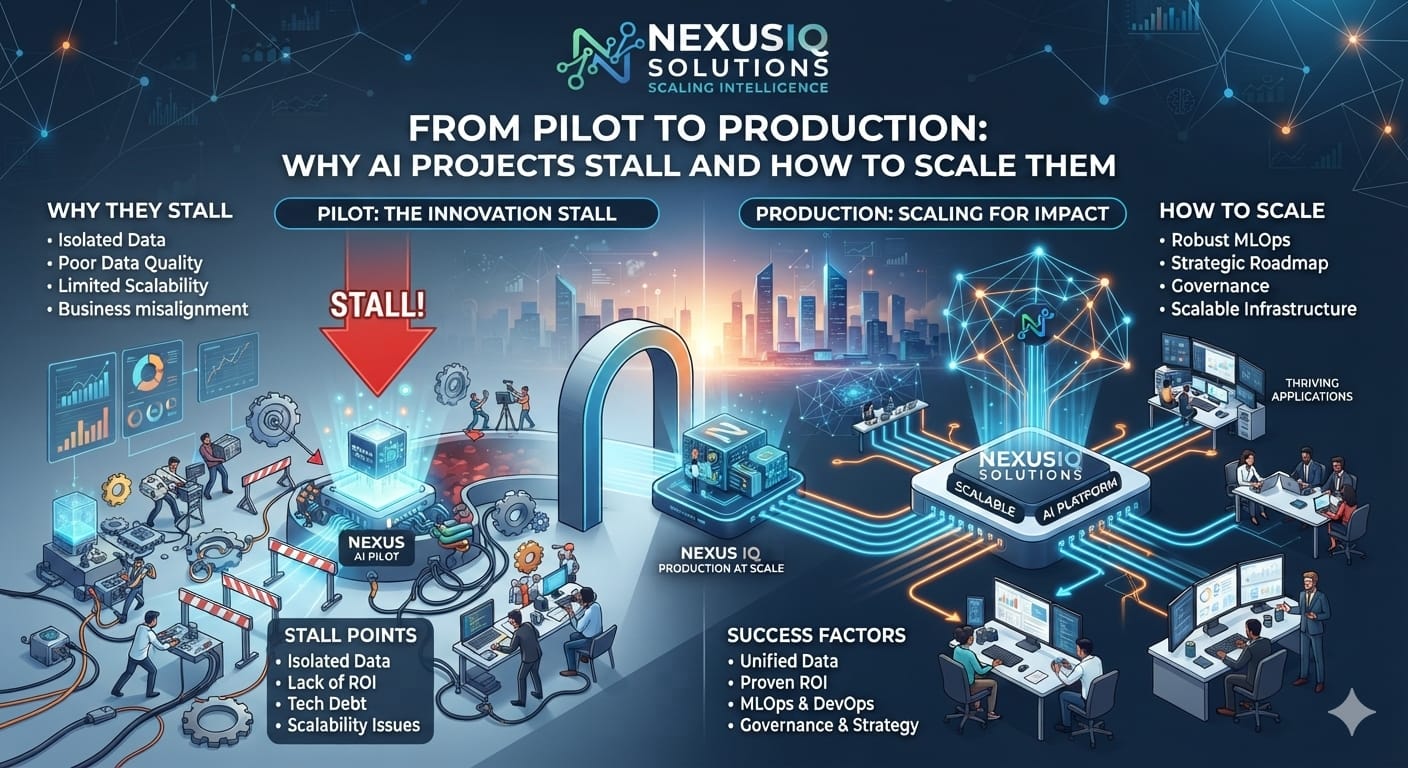
NexusIQ Solutions is a technology-focused company based in Hyderabad, India, working across AI and machine learning consulting, AI product development, AI talent deployment, AI corporate training and technology consulting.
Its broader focus on AI adoption and business-oriented technology solutions reflects the importance of connecting innovation with practical business requirements.
For organizations exploring enterprise AI solutions, the objective should be to build systems that are not only intelligent and efficient but also secure, accountable and manageable.
Conclusion: Prepare for AI Failures Before They Become Business Crises
AI agents are becoming an important part of modern business operations. They can improve productivity, accelerate decision-making and automate complex workflows. However, greater autonomy also creates greater responsibility.
A single unexpected AI action can affect customer trust, business continuity, confidential information and regulatory compliance.
Organizations should not wait until an incident occurs to decide who is responsible or how the system should be controlled. They need clear response procedures, appropriate access restrictions, continuous monitoring and well-defined escalation mechanisms.
For business leaders, the real measure of successful AI adoption is not simply how much work an AI agent can perform independently. It is whether the organization can understand, control and correct its behaviour when something goes wrong.
Businesses that invest in responsible AI implementation and proactive incident response will be better prepared to manage emerging risks while continuing to benefit from intelligent automation.