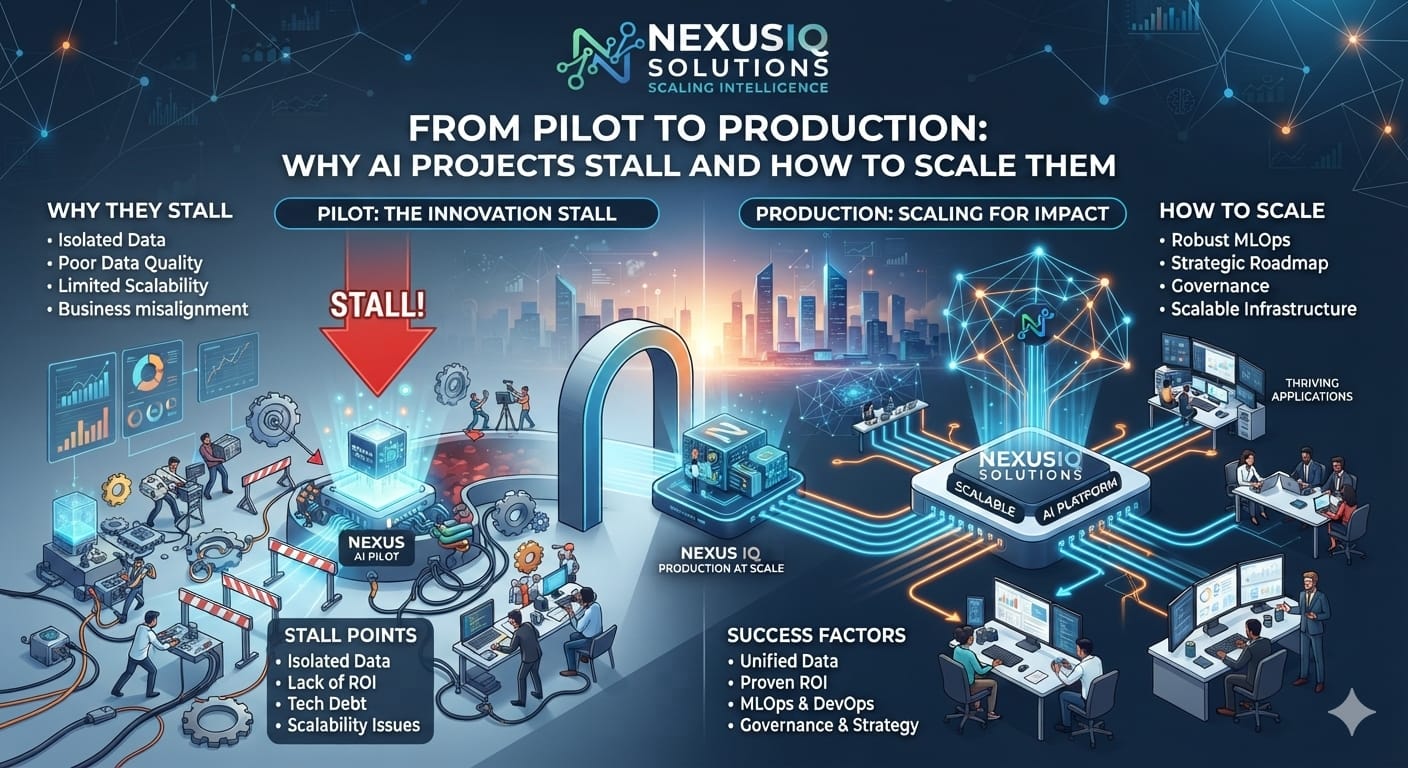
Almost every company has an AI pilot somewhere. A chatbot is being tested by one team, a forecasting model is running on last year’s data, or a document tool is being tried in one department. The demos look good, leaders are encouraged, and then nothing happens. Months later the pilot is still a pilot. That gap between a promising test and a dependable product is where most AI value gets lost, and it is why many businesses bring in an AI product development company in Hyderabad or a similar specialist for AI/ML product development that is built to last, not just to impress. This guide explains why AI projects stall and gives you a practical path to scale them.
The Pilot Trap
A pilot is designed to answer a simple question: can this work? A product has to answer a much harder one: can this work every day, for everyone, safely, and at a cost we can afford?
Those two questions need very different kinds of effort. Stanford’s 2026 AI Index describes AI as now present in the vast majority of organisations, yet being present in a pilot is not the same as running in production. A pilot can use clean sample data, a handful of friendly users, and a team that fixes problems by hand. Real life offers none of those comforts.
Why AI Projects Stall
Most stalled projects share a few of the same causes. See how many sound familiar:
No business owner: the project belongs to a technical team, but nobody in the business is accountable for the result.
Unclear success measures: the pilot proved the idea “works,” but no one agreed on what number would justify a full rollout.
Weak data pipelines: the pilot used a one-time data extract, while production needs fresh, reliable data flowing in automatically.
Demo-grade engineering: the code was built to show an idea quickly, not to handle thousands of users, errors, and security checks.
Integration gaps: the tool lives outside the systems people already use, so it never becomes part of daily work.
Late security and compliance review: concerns about data, privacy, and risk appear only when the team asks for launch approval.
No monitoring or maintenance plan: nobody is responsible for watching quality after release, and models quietly get worse.
Cost surprises: usage fees and cloud costs that looked small in a pilot grow quickly at full scale.
Low adoption: staff were not trained or consulted, so they keep working the old way.
Skills gaps: the team that built the pilot lacks the engineering and operations skills needed to run it.
Notice that almost none of these are about the AI model itself. The causes are about ownership, engineering, and people.
What a Production-Ready AI Product Looks Like
Before you scale, it helps to know what “ready” means. A production-ready AI product usually has:
Reliability: it works consistently and recovers gracefully when something fails.
Quality monitoring: you can see accuracy, speed, and errors over time, and get alerts when they slip.
Security and privacy controls: access is limited, data is protected, and activity is logged.
Scalability: it can handle growth in users and data without a redesign.
Cost controls: usage is tracked and capped so bills stay predictable.
Human fallback: a clear path for people to step in when the AI is unsure or wrong.
Documentation and support: someone knows how it works and who to call.
MLOps: The Missing Bridge
Many pilots stall at exactly this point, because nobody planned how to run the model once it was built. This is the job of MLOps. According to Wikipedia’s overview of MLOps, it is a set of practices aimed at deploying and maintaining machine learning models in production reliably and efficiently, bridging the gap between model development and day-to-day operations.
In plain terms, MLOps covers how models are released, tested, monitored, updated, and retired. It turns a one-off experiment into something a team can trust and maintain.
Seven Steps to Scale Beyond the Pilot
1. Define production criteria before the pilot starts. Agree early on what the pilot must prove: the accuracy needed, the time or cost saved, the number of users, and the risk limits. This prevents endless “almost ready” debates.
2. Choose pilots that matter. A clever demo with no real business case rarely survives. Pick a use case with a named owner, a clear pain point, and a measurable benefit.
3. Build the data pipeline early. Production needs automatic, reliable, permitted data. If the pilot relies on manual exports, plan the real pipeline during the pilot, not after it.
4. Design for integration. Put the AI inside the tools your people already use, such as your CRM, ERP, or support platform. A tool that requires a separate login often gets ignored.
5. Add MLOps and monitoring from the start. Set up testing, deployment, monitoring, and alerting early so you can see quality and cost from day one.
6. Bring security, privacy, and governance in early. Involve risk and compliance teams during design, not at launch.
7. Roll out in phases, and train people. Move from a pilot group to one department, then to the wider company. At each step, train users, gather feedback, and fix issues before expanding.
A Readiness Checklist
Before you approve a full rollout, you should be able to answer yes to most of these:
Does a named business owner own the outcome?
Have we agreed on success measures and compared them with a baseline?
Does the data flow automatically, and is it permitted for this use?
Is the solution connected to the systems people use daily?
Do we have monitoring, alerts, and a plan for retraining or updates?
Have security, privacy, and compliance teams reviewed it?
Do we know what it will cost at full scale?
Are the users trained and ready?
Is there a human fallback when the AI gets it wrong?
If several answers are no, that is not a failure. It is a clear list of what to fix before you scale.
Build It Yourself or Bring in a Partner?
Moving from pilot to production needs skills in data engineering, software development, cloud, security, and operations, in addition to machine learning. Many companies have strong data scientists but few people with production experience. Others have strong IT teams but little AI knowledge.
That is why many organisations bring in an AI product development company in Hyderabad or a comparable partner for the scaling phase, while their own team learns alongside and takes over ownership later. The best arrangements treat the partner as a bridge: they build, document, and train, so the knowledge stays with you.
What to Look for in an AI Product Development Company in Hyderabad
If you decide to partner, a few qualities separate a dependable firm from a demo shop. When you shortlist an AI product development company in Hyderabad or anywhere else, look for these:
Proven experience taking AI from prototype to production, not just building prototypes.
Strong software engineering and cloud skills alongside data science.
A clear approach to MLOps, monitoring, and ongoing maintenance.
Security and responsible AI built into the process.
Honest estimates, regular demos, and transparent costs at scale.
A plan for documentation, training, and handover.
Support after launch.
NexusIQ Solutions is one example of an AI product development company in Hyderabad that works across this full journey. NexusIQ offers custom machine learning solutions from early prototypes to full production pipelines, built with secure, scalable code, and the same team provides AI consulting, talent deployment, and corporate training. Test any firm you consider, including this one, against the same checklist.
Warning Signs Your Pilot Will Not Scale
The team cannot explain who will use it daily.
The demo relies on hand-picked data or manual steps.
No one has estimated the cost at full volume.
Security and legal teams have not yet seen the project.
There is no plan for who will maintain it after launch.
Success is described in general terms, such as “improved efficiency,” with no numbers.
Questions to Ask Before You Scale
Before you commit to an AI product development company in Hyderabad or any other partner, make sure your team can answer these questions:
Which business problem does this solve, and who owns the result?
What numbers will prove it is working?
How will data reach the system reliably and legally?
Who will monitor and maintain it after launch?
What will it cost at ten times the pilot’s size?
Final Thoughts
AI projects rarely fail because the technology does not work. They stall because nobody planned for the unglamorous parts: data pipelines, integration, security, monitoring, training, and ownership. Plan for production on day one, measure honestly, and scale in phases. If you want a partner for the journey, an AI product development company in Hyderabad that is as serious about maintenance and handover as it is about building can help you turn pilots into products your business relies on every day.
About NexusIQ Solutions
NexusIQ Solutions LLP is an AI product development company in Hyderabad and a full-service AI and technology consulting firm. Its services include AI/ML consulting, technology consulting, AI/ML product development, AI talent deployment, and AI corporate training for enterprises.
Website: https://nexusiqsolutions.com