For the past few years, many business owners assumed artificial intelligence would completely replace manual data entry. The promise sounded simple: upload a stack of invoices, product sheets, or customer forms, let an AI tool extract the text, and push everything straight into your CRM or ERP system.
In reality, most companies that tried pure automation ran into a frustrating problem. AI works fast, but it still makes confident mistakes when documents are messy, incomplete, or formatted differently from one vendor to the next. One wrong decimal in an invoice or a mislabeled product size in an online store can create hours of cleanup work later.
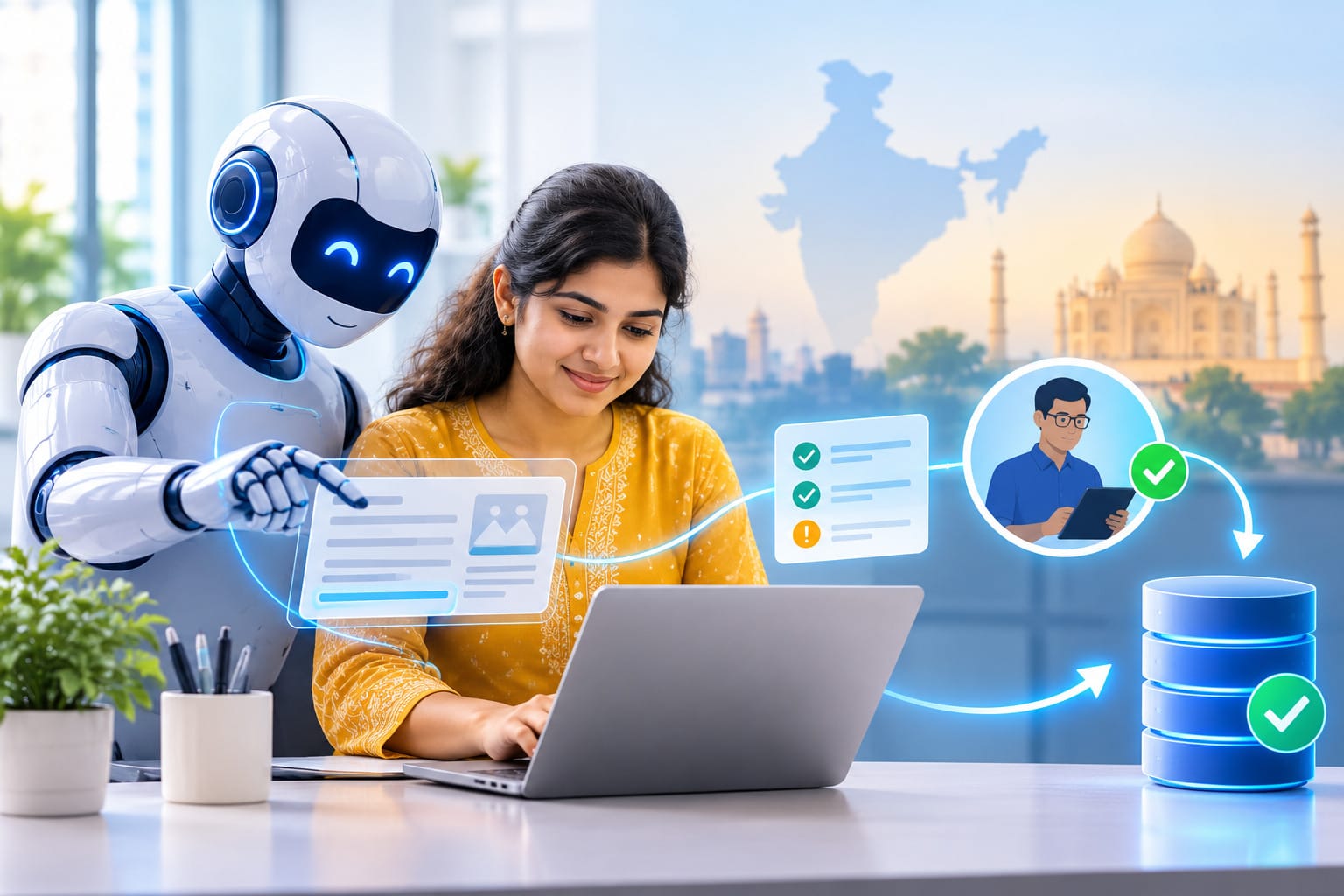
This is why data entry in India is going through a major shift. Instead of choosing between slow manual typing and error-prone software, leading Indian outsourcing teams are combining AI automation with Human-in-the-Loop (HITL) workflows. The result is simple: businesses get the speed of machines along with the judgment and accuracy of trained specialists.
Why Standalone AI Still Struggles with Real Business Data
Modern Optical Character Recognition (OCR) and AI extraction tools are great at reading clean, standard templates. However, daily business operations rarely look neat and uniform. Real-world files come with plenty of edge cases where automated tools still trip up:
Inconsistent Vendor Formats: Two suppliers might send invoices with completely different layouts, tax labels, or currency symbols.
Low-Quality Scans and Handwriting: Faded receipts, skewed PDFs, and handwritten delivery notes often confuse automated readers.
Context-Dependent Details: An AI tool might extract a number correctly, but it cannot always tell whether that number is a SKU code, a batch number, or a discount percentage without human context.
Silent Errors: Unlike a human worker who flags a blurry line and asks a question, standalone AI often guesses and fills in the blank letting bad data slip quietly into your database.
When poor data enters a CRM, accounting platform, or e-commerce catalog, small mistakes multiply across billing, shipping, and customer support.
How the Human-in-the-Loop (HITL) Model Works
A Human-in-the-Loop workflow keeps AI and human operators working side by side in a clear, repeatable pipeline. Rather than having people type every single field from scratch, specialists focus only on verification, exceptions, and quality control.
Here is how a typical HITL data workflow runs step by step:
Automated Ingestion and Pre-Extraction: AI tools scan incoming PDFs, images, spreadsheets, or web pages and pull out the raw fields in seconds.
Confidence-Based Routing: Every extracted field gets a confidence score. Clear, high-confidence entries pass through automatically, while uncertain or unusual entries are flagged for human review.
Human Verification and Enrichment: Trained data specialists check the flagged fields against the source file, fix formatting issues, fill missing attributes, and verify business rules.
Feedback Loop for Continuous Improvement: Every correction made by the human reviewer helps fine-tune the extraction rules, reducing future errors on similar documents.
This balanced approach cuts turnaround time drastically while keeping accuracy levels at 99.9% or higher.
Why India Is Leading This Hybrid Data Shift
India has been a global hub for back-office operations for decades, but the role of Indian data teams has evolved far beyond basic keyboard work. Today, companies looking for reliable data entry India partners benefit from a mature ecosystem built specifically around hybrid delivery:
Upskilled Data Specialists: Teams are trained not just in fast typing, but in data validation, taxonomy mapping, CRM hygiene, and AI output auditing.
Overnight "Follow-the-Sun" Turnaround: Companies in the US, UK, Europe, and Australia can send raw files at the end of their workday and wake up to clean, verified records ready for use.
Flexible Scaling for Peak Seasons: Whether an e-commerce brand needs 50,000 new SKUs uploaded before a holiday sale or a logistics firm faces a quarterly backlog, hybrid teams scale up quickly without permanent hiring overhead.
Strong Data Security Standards: Reputable providers operate under strict NDAs, encrypted VPN access, role-based permissions, and compliance frameworks such as ISO 27001, GDPR, and HIPAA.
Industries Seeing the Biggest Impact in Data Entry
Hybrid AI and HITL workflows are already solving daily bottlenecks across several high-volume sectors:
E-Commerce and Retail: Cleaning supplier product feeds, standardizing size and color attributes, and updating bulk pricing across multiple marketplaces.
Finance and Accounting: Extracting line-item details from multi-vendor invoices, receipts, and purchase orders with double-check verification before ledger entry.
Healthcare and Insurance: Digitizing patient intake forms and insurance claims accurately while protecting sensitive personal records.
Logistics and Real Estate: Converting bills of lading, customs forms, and property records into structured, searchable databases.
What This Means for Growing Businesses
You do not need to build an expensive internal AI engineering team or hire a large room of full-time clerks to keep your business data clean. The smartest path forward is a hybrid workflow where automation handles the repetitive heavy lifting and experienced human reviewers guarantee accuracy before anything touches your live systems.
Providers like eDataIndia already follow this hybrid model, helping global businesses handle everything from e-commerce catalog management to CRM. As AI tools continue to improve, human oversight is not disappearing; it is becoming the quality filter that makes automation safe to trust at scale.