On 12 September 2012, Apple told millions of iPhone owners that their docks, speaker stands and car chargers were about to become obsolete. On 12 September 2023, exactly eleven years later, it did the same thing again.
Same date, same question from every iPhone owner: why? The first change made sense the moment you held an iPhone 5. The second felt like Apple giving up something it had guarded for a decade. If you want the full port-by-port primer, our types of charging ports guide covers that. This article is about the decisions behind the ports.
What Was the iPhone Charging Port Before Lightning?
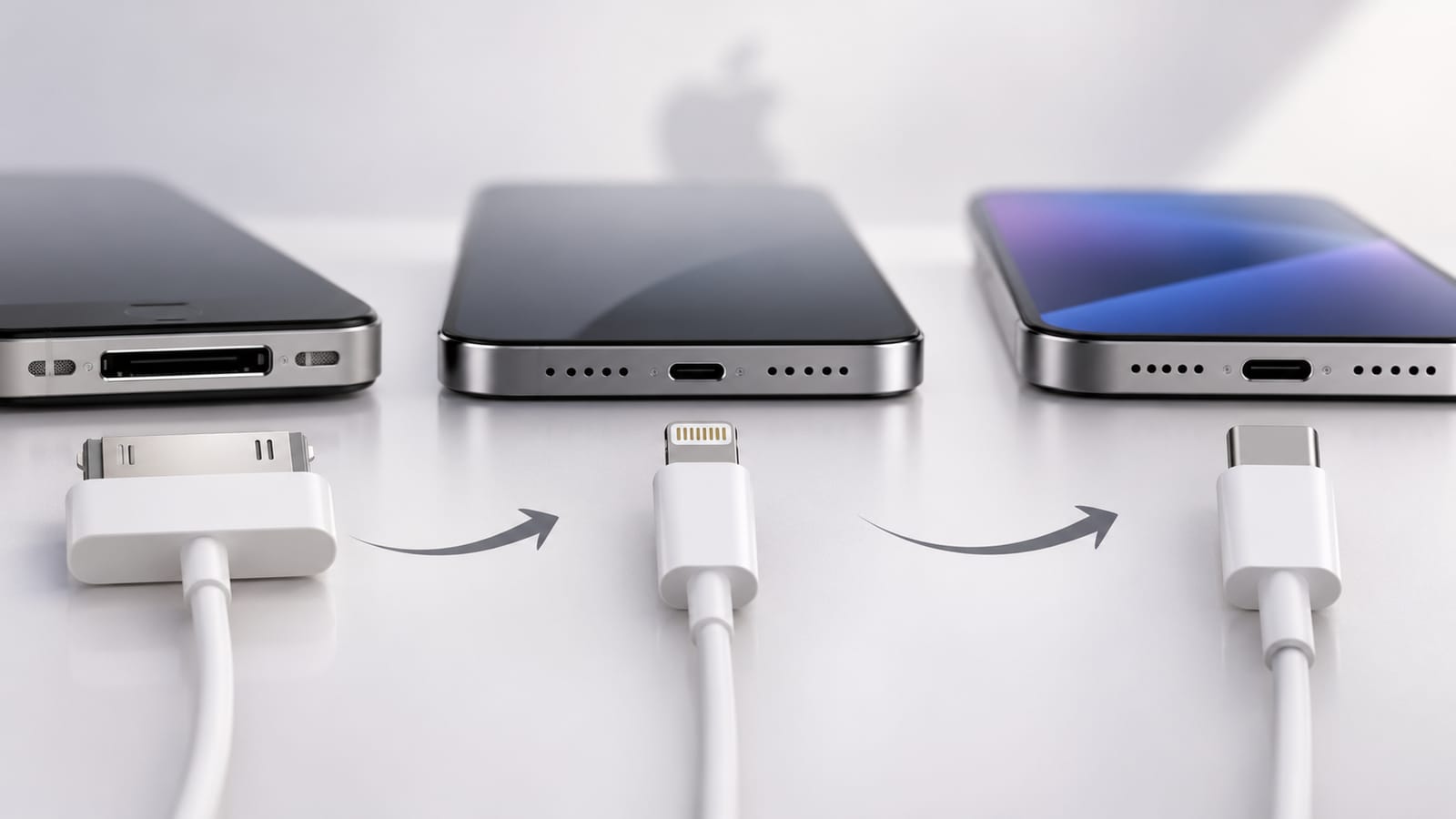
Before Lightning, every iPhone and iPad used Apple's 30-pin dock connector. One wide port handled charging, syncing, audio and video output. It stayed on iPhones from the original model in 2007 until the iPhone 4S, and the iPhone 5 was the first to leave it behind.
Note for anyone who remembers a "12-pin" cable: the old Apple connector had 30 pins, not 12, which is exactly why it was so wide.
Apple introduced the connector with the third-generation iPod in 2003, replacing FireWire on iPods. An entire accessory industry grew around it: speaker docks, alarm clocks, car mounts, even gym equipment. It did its job well for nine years.
But it was large and only went in one way. As phones got thinner, a port that size became the obstacle.
Why Did Apple Replace the 30-Pin Connector With Lightning?
Apple replaced it because the iPhone 5 needed to be thinner and lighter, and the 30-pin port was too big. Lightning used 8 pins instead of 30, plugged in either way up, and freed internal space. The price was a generation of accessories that stopped fitting.
Apple's own announcement said it plainly: making the iPhone 5 slimmer required a smaller, newer connector. Lightning was all-digital, reversible and a fraction of the size. After years of fumbling with a one-way plug in the dark, a connector that worked either way up felt like a small miracle.
It was also controversial. Millions of people had bought speaker docks and chargers built for 30-pin, and those were suddenly stranded. Apple sold a Lightning-to-30-pin adapter, but it started at around $29, which did not help the mood.
Lightning also gave Apple something quieter: control. It was a proprietary connector, so accessory makers needed Apple's MFi certification to build with it. That worked for Apple while Lightning was ahead of everything else. The trouble started when it stopped being ahead.
When Did the iPhone Switch to USB-C?
The iPhone switched to USB-C with the iPhone 15 series, announced on 12 September 2023 and on sale from 22 September 2023. All four models, iPhone 15, 15 Plus, 15 Pro and 15 Pro Max, dropped Lightning at the same time.
So if you have been asking when Apple switched to USB-C, the answer is the iPhone 15 generation, in 2023. Older iPhones, up to and including the iPhone 14 series, stayed on Lightning.
At the launch event, Apple described USB-C as a "universally accepted standard". It pitched the practical upside: the same cable now charges an iPhone, iPad, Mac and second-generation AirPods Pro. You can also charge AirPods or an Apple Watch straight from the iPhone 15's port, and Apple announced USB-C EarPods to match. US news coverage called it the biggest change to the iPhone's design in 11 years.
One detail mattered for data. The Pro models got a faster USB-C controller, which Apple pitched at up to 20 times USB 2 speed. That is a long way from the Lightning era, when every iPhone moved data at USB 2.0 speed.
Why Did Apple Switch to USB-C After Holding Out for 11 Years?
Mainly because European law forced a deadline. The EU's Common Charger Directive required new phones sold there to use USB-C from 28 December 2024, and Apple said it would comply. Apple's own Macs and iPads already used USB-C, which made the decision easier.
Here is the timeline. The EU Council approved the Common Charger Directive in October 2022. From 28 December 2024, it applies to phones, tablets, digital cameras, headphones, handheld consoles, portable speakers, e-readers, keyboards and mice sold in the EU. Laptops followed from 28 April 2026. Devices charging above 15W must also support USB Power Delivery.
Apple launched USB-C iPhones in September 2023, about fifteen months before the deadline. Building one global design was simpler than making a Lightning iPhone for the rest of the world and a USB-C iPhone for Europe.
So why did Apple change to USB-C? Apple's stated reason was that USB-C had become the accepted standard. My read of the timeline is that the law set the date and the ecosystem made it easy: Apple already sold USB-C Macs and iPads, and one cable across the whole line-up is a cleaner story than two. Apple has not said the regulation was its only reason, so treat that part as analysis, not an Apple statement.
Was Lightning Really Worse Than USB-C?
Not in every way. Lightning was compact, reversible and reliable, and at launch it was a real upgrade on 30-pin. Its weakness was that it stayed an Apple-only port at USB 2.0 speeds while the rest of the industry settled on USB-C.
Tech commentators at the time of the switch made a fair point: Lightning's advantages over the 30-pin connector were very real, and USB-C would not repeat that kind of leap. What USB-C offered instead was convenience. One port across phone, tablet and laptop. One charger in a travel bag.
That is the quiet truth behind the second change. The first switch improved the iPhone itself, because it made the phone slimmer. The second improved the world around the iPhone, because it stopped the iPhone from being the odd one out. Nobody had to give up the reversible, compact design. They only had to give up a connector that only Apple used.
For Apple, there was also a practical limit. Lightning moved data at USB 2.0 speed, and the company's own laptops and tablets had already moved on. A person with an iPhone, an iPad and a MacBook was carrying two cable families from the same brand, which is hard to defend when you are selling a premium ecosystem.
What Happened to Lightning After the Switch?
Lightning was phased out of Apple's iPhone line-up during 2024 and 2025, ending with the withdrawal of the iPhone 14 from sale. Millions of Lightning iPhones are still in daily use, and they keep working exactly as before.
The change did not happen overnight. Apple launched the iPhone 15 on USB-C in 2023, then moved the rest of the range over as older models were retired. The EU rule reached laptops on 28 April 2026, so the shift now covers far more than phones.
For owners, nothing breaks. An iPhone 14 or earlier charges over Lightning today, as it did last year. An iPhone 15 or later charges over USB-C. The two generations will share homes, desks and car consoles for years, because people keep phones for a long time.
Lightning will not vanish from daily life soon. It simply stops being the connector Apple designs for.
What Does the Switch Mean for the Lightning Cables You Already Own?
Nothing breaks. iPhone 14 and earlier still charge over Lightning, and iPhone 15 and later charge over USB-C, so a mixed household just needs the right connector on each end. Check the connector before replacing anything.
If you are still sorting out which plug is which, our charger types and plug names guide explains how to read connector names on any listing.
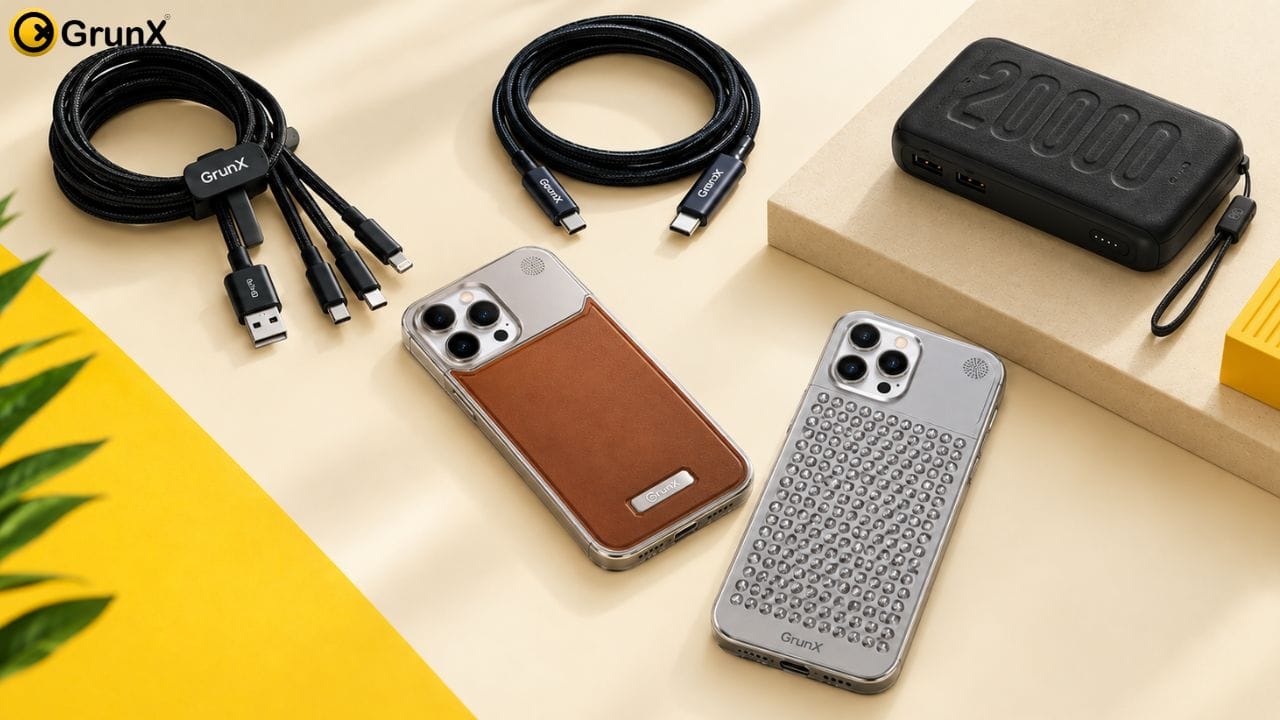
For households mid-upgrade, GrunX makes two cables worth knowing about. The INBAE 4-in-1 cable switches between Lightning to Type-C, Lightning to Type-A, Type-C to Type-C and Type-C to Type-A, so one cable covers an older iPhone, a newer one and an older USB-A adapter. The GrunX Flash 100W USB-C cable is a straightforward USB-C to USB-C cable for newer iPhones, iPads and laptops.
So Why Did Apple Really Change the iPhone Port Twice?
Because each change solved a different problem. The 30-pin port stood in the way of a thinner iPhone, and Lightning stood in the way of one cable for everything. The first change was a design choice, and the second was a mix of regulation and ecosystem.
Apple changed its iPhone port twice in eleven years, both times on the same date in September, and both times the reason was less about the cable and more about what the phone needed next.
If you own an iPhone from either side of that line, you do not need to throw anything away. You need cables that match the port you actually have. Browse GrunX's fast charging cables to find the right fit, or start from the GrunX homepage to compare iPhone charging accessories in one place.