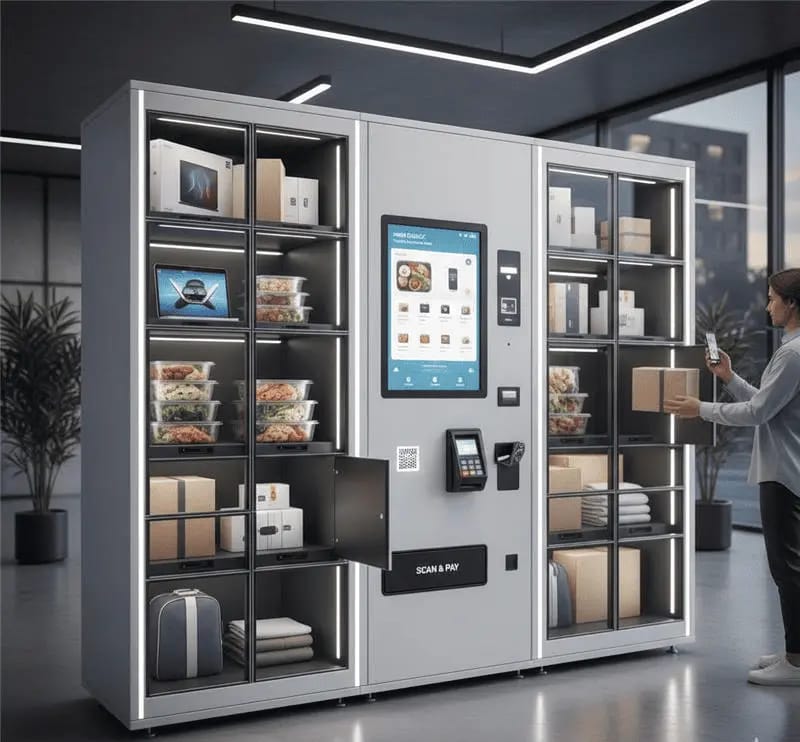
How Smart Locker Systems Are Transforming Secure Storage and Package Management
A parcel locker that needs a key is just a box with extra steps. The interesting shift happens when the locker knows who you are, talks to your phone, and tells the building manager which door has been sitting full for three days. That's the jump from mechanical storage to a smart locker system — and it's mostly a hardware and firmware problem, which is the part we spend our time on.
We've built locker controllers for parcel rooms, staff storage in hospitals, and equipment cages on industrial sites. The electronics differ, but the architecture converges. Here's what actually matters when you design one.
What makes a locker "smart"
Strip away the marketing and a smart locker system is three things: a controller that opens locks, a network link that authenticates users, and software that tracks state. The intelligence lives in how those three talk to each other.
On the hardware side, most of our builds start with an ESP32 or an nRF52840. The ESP32 handles Wi-Fi and gives you enough flash for a local web UI and OTA updates. The nRF52 is the better pick when the locker runs on batteries or when you want BLE unlock from a phone without touching a keypad. Some designs use both — nRF52 for the lock nodes, ESP32 as the gateway. That split keeps wiring simple: a two-wire bus daisy-chains the lock boards, and the gateway handles the cloud.
The unlock path is where systems succeed or fail
Users judge the whole product on one moment: does the door open in under two seconds. Every design decision should protect that.
We typically run three unlock methods in parallel. A QR code or PIN goes through the cloud over MQTT, so the controller needs a live connection. BLE unlock works offline — the phone and the lock exchange a signed token, which matters in basements and dead zones. And there's always a physical override, usually a keyed cylinder behind a tamper switch, because facilities teams will not accept a locker they can't open during a network outage.
The firmware detail that bites teams: debounce and lock feedback. A solenoid that reports "open" the moment it's energised will lie to you. We read a door sensor — usually a hall-effect switch — and only mark a compartment as occupied after the sensor confirms it. That single change cut false "door left open" alerts by most of the noise on one deployment we worked on.
Power, locks, and the boring parts that matter
A locker bank with 48 doors draws real current when several solenoids fire at once. We size the 12V rail for peak simultaneous draw, add bulk capacitance at each lock board, and stagger unlock commands by 50–100ms in firmware so the supply never sees the full surge. Cheap lock drivers skip this and you get brownouts that look like random firmware crashes.
Cable routing deserves a mention too. Locker banks get installed by people who aren't electronics engineers, so we design PCBs in KiCad with keyed connectors, silkscreen labels on every port, and a wiring harness that only fits one way. It sounds trivial until you're debugging a site install over a video call.
Software: state, not just access
The cloud side of a smart locker system operates as a state machine. Every compartment has a status — free, reserved, occupied, overdue, fault — and every transition gets a timestamp and a user ID. That log is what lets an operator answer "who had locker 23 last Tuesday" without guessing.
We build the backend around MQTT topics per locker bank, with the controller publishing state changes and subscribing to commands. Retention policies matter more than people expect: parcel lockers churn fast, so we keep full event history for 90 days and aggregated stats beyond that. For staff lockers in a hospital, the same code ran with a 12-month retention because HR needed the audit trail.
Firmware updates are the other half. Zephyr RTOS on the nRF52 nodes gives us a clean OTA path and a scheduler that keeps the radio asleep between events. On the ESP32 gateway we use a dual-partition scheme so a failed update rolls back instead of bricking a locker bank. Nobody wants to send a technician to reflash 48 doors.
Where the market is heading
Two trends are shaping new builds. First, contactless standards — we're seeing more requests to expose locker state over Matter so building management systems can read it alongside HVAC and access control. Second, modular lockers: instead of one controller per bank, each column has its own board and they auto-discover each other on the bus. That makes expansion a plug-in job rather than a rewire.
Neither trend changes the fundamentals. A smart locker system is still a network of locks that must open reliably, report honestly, and survive a power cut. Get the electronics and firmware right and the software has something solid to stand on. Get them wrong and no app will save it.
If you're scoping a locker product — parcel, staff, or industrial — the decisions that matter most happen in the first few weeks: which radio, how the locks are driven, and how state is reported. We design and ship those boards and the firmware that runs them, from KiCad schematics through to a working prototype you can install.