Jaimini Astrology in 60 Seconds
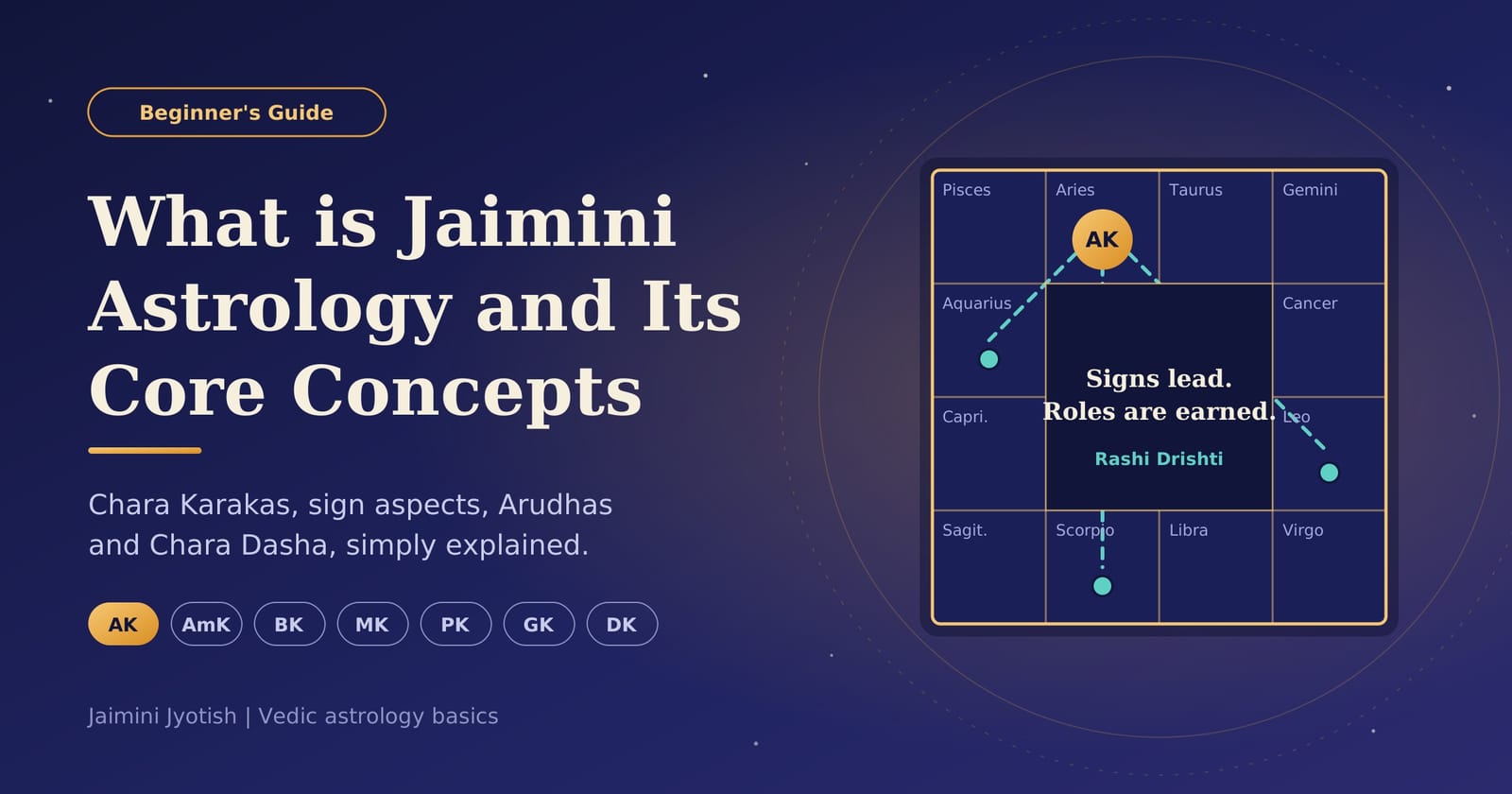
Jaimini astrology is a branch of Vedic astrology (Jyotish) that reads the birth chart mainly through signs, degrees, and variable significators.
It uses the sidereal zodiac, like all Jyotish. What changes is the method of analysis.
Three ideas define it:
Planets get roles based on their degrees.
Signs, not planets, cast aspects.
Time is read through sign-based periods.
Who Was Maharishi Jaimini?
Tradition describes Maharishi Jaimini as a student of Sage Vyasa. The system carries his name and rests on one text: the Jaimini Sutras.
You’ll also see it called the Jaimini Upadesa Sutras or Jaimini Sutram. The text has four chapters, each divided into four sections.
The verses are brief and cryptic. A single line can hold a whole rule, so commentary matters.
K.N. Rao and Sanjay Rath are two names students meet early, since both have written and taught widely on the subject.
The Big Idea: Roles Are Earned, Not Fixed
In many approaches, a planet’s meaning stays constant. Venus always points to relationships, and the Sun to the father or authority.
Jaimini keeps those natural meanings in the background. But it adds a second layer: Chara Karakas, meaning “changing significators.”
Here’s how it works. List your planets by their degree within their sign, ignoring the sign itself. Highest degree comes first. That ranking hands out the roles.
Core Concepts of Jaimini Astrology
Chara Karakas
The seven commonly used roles, in order of degree, are:
Atmakaraka (AK): the self, the soul planet
Amatyakaraka (AmK): career, advisors, work life
Bhratrikaraka (BK): siblings, courage, effort
Matrikaraka (MK): mother, comfort, education
Putrakaraka (PK): children, creativity, intellect
Gnatikaraka (GK): rivals, health struggles, obstacles
Darakaraka (DK): spouse, partnerships
Some traditions use eight karakas and bring Rahu into the ranking. Beginners usually start with seven.
A Quick Mini Example
Say a chart shows these degrees (purely illustrative):
Saturn 27°, Sun 24°, Moon 18°, Mars 12°, Mercury 9°, Jupiter 5°, Venus 2°
Then Saturn becomes the Atmakaraka, Sun the Amatyakaraka, Moon the Bhratrikaraka, and so on. Venus, with the lowest degree, becomes the Darakaraka.
Notice what happened. Venus is the spouse significator here because of its degree, not because of its usual reputation.
The Atmakaraka: Your Soul Planet
The Atmakaraka (AK) is the strongest-degree planet. Jaimini treats it like the king of the chart.
It shows your core motivation, your recurring life themes, and the lessons you keep meeting. Many astrologers begin every reading here.
Karakamsha
Take the Navamsa sign where your Atmakaraka sits. That’s your Karakamsha.
It’s used to read inner calling, natural talents, and spiritual direction. Think of it as a window into what the soul wants to do with this life.
Rashi Drishti: Sign-Based Aspects
Here Jaimini parts ways clearly with the Parashari system. Signs aspect signs.
The pattern is easy to remember:
Movable signs (Aries, Cancer, Libra, Capricorn) aspect fixed signs, except the neighbouring one.
Fixed signs (Taurus, Leo, Scorpio, Aquarius) aspect movable signs, except the neighbouring one.
Dual signs (Gemini, Virgo, Sagittarius, Pisces) aspect each other.
Any planet sitting in a sign simply inherits that sign’s aspects.
Arudha Padas
An Arudha is your image, meaning how things appear to the outside world.
The Arudha Lagna (AL) reflects your public persona. It can differ sharply from your real nature, which is why two people with similar charts can be perceived very differently.
Upapada Lagna
Upapada is the Arudha of the 12th house. It’s the main reference point for studying marriage, the spouse, and long-term bonds.
Astrologers read it together with the Darakaraka.
Chara Dasha
Chara Dasha is Jaimini’s own timing system. Instead of planetary periods, it runs through signs.
It’s popular for predictive astrology, particularly when timing events like career changes and marriage.
Jaimini vs Parashari: How They Differ
Instead of treating them as rivals, think of two different lenses.
Aspects: Jaimini uses sign aspects. Parashari uses planetary aspects.
Significators: Jaimini assigns variable roles. Parashari relies on fixed natural significators.
Timing: Jaimini leans on Chara Dasha. Parashari leans on Vimshottari Dasha.
Emphasis: Jaimini highlights signs and the soul planet. Parashari highlights houses, lords, and yogas.
Many experienced astrologers read both, then trust a prediction more when both agree.
Where Jaimini Shines
People often reach for Jaimini astrology when looking at:
Marriage prediction astrology: Darakaraka, Upapada Lagna, and sign aspects to them
Career prediction astrology: Amatyakaraka and Arudha Lagna
Life purpose: Atmakaraka and Karakamsha
Remember, astrology shows tendencies. It doesn’t hand out guaranteed outcomes.
Mistakes Beginners Commonly Make
Avoid these early traps:
Mixing rules: applying planetary aspects to a Jaimini reading
Ignoring degrees: karakas depend on exact degrees, so rough estimates mislead
Skipping the Atmakaraka: it anchors everything else
Memorising without practice: rules only make sense on real charts
How to Start Learning
A simple path works best:
Revise signs, houses, and planets in Vedic astrology.
Calculate Chara Karakas for your own chart.
Practise sign aspects on three or four sample charts.
Learn Arudha Lagna and Upapada Lagna.
Study Chara Dasha with a good commentary.
Hand calculation for Arudhas and dashas is slow. A reliable Jaimini astrology software can produce karakas, padas, and dashas in seconds, so you can spend your energy on interpretation.
Final Thoughts
Jaimini Jyotish is a different way of looking at the same sky. Once you accept that roles are earned by degree and that signs lead the analysis, the logic feels surprisingly tidy.
Begin with your own Atmakaraka. Everything else grows from there.
If you want more chart-analysis options beyond Jaimini, browse these astrology software tools.
Frequently Asked Questions
What is Jaimini astrology in simple terms?
It is a branch of Vedic astrology based on the Jaimini Sutras. It uses variable significators, sign-based aspects, and sign-based dashas to interpret a birth chart.
Who wrote the Jaimini Sutras?
They are traditionally attributed to Maharishi Jaimini, a disciple of Sage Vyasa.
What are Chara Karakas?
Chara Karakas are planetary significators assigned by degree. The highest-degree planet becomes the Atmakaraka, and the others follow in descending order.
How is Jaimini astrology different from Parashari?
Jaimini uses sign aspects, variable karakas, and Chara Dasha. Parashari uses planetary aspects, fixed significators, and Vimshottari Dasha.
Is Jaimini astrology good for marriage predictions?
Many astrologers use the Darakaraka and Upapada Lagna to study marriage and partnerships, though no method guarantees results.
Can a beginner learn Jaimini astrology?
Yes, ideally after learning basic Vedic astrology. A Jaimini astrology calculator or software helps with practice.