Introduction
Steel is one of the most important materials used in the construction industry. It provides reinforcement to concrete structures and helps buildings withstand different types of structural forces.
However, not all steel bars have the same properties or applications. TMT steel bars and mild steel bars are two types of steel products that are often discussed in construction and fabrication.
Understanding the difference between TMT steel bars vs mild steel bars can help homeowners, builders, contractors, and engineers select the right material for their requirements.
Although both products are made from steel, their manufacturing processes, surface characteristics, mechanical properties, and applications differ significantly.
What Are TMT Steel Bars?
TMT stands for Thermo-Mechanically Treated. TMT bars are reinforcement steel products manufactured using a controlled heating and cooling process.
During manufacturing, heated steel passes through a rapid water-cooling stage. This creates a hardened outer layer while the inner core undergoes controlled self-tempering and cooling.
The resulting structure provides a combination of strength and ductility.
TMT bars typically feature a ribbed surface that improves mechanical bonding with concrete.
They are commonly used in:
Residential buildings
Commercial complexes
Bridges and flyovers
Industrial structures
Foundations and columns
Reinforced concrete slabs
What Are Mild Steel Bars?
Mild steel bars are manufactured using low-carbon steel. Their comparatively low carbon content provides good workability and makes them suitable for several fabrication and engineering applications.
Mild steel is generally easier to cut, bend, weld, and shape depending on the product specifications.
Mild steel products are used in:
Fabrication work
General engineering
Machinery components
Metal structures
Manufacturing applications
Certain construction applications
However, conventional plain mild steel bars should not automatically be treated as equivalent to modern TMT reinforcement bars. The suitability of any reinforcement product must be verified against the structural design and applicable standards.
TMT Steel Bars vs Mild Steel Bars: 7 Major Differences
1. Manufacturing Process
TMT Steel Bars: Manufactured using thermo-mechanical treatment involving controlled heating, rapid cooling, and self-tempering.
Mild Steel Bars: Produced through steelmaking and rolling processes based on the required product specifications, generally without the same TMT treatment.
2. Strength
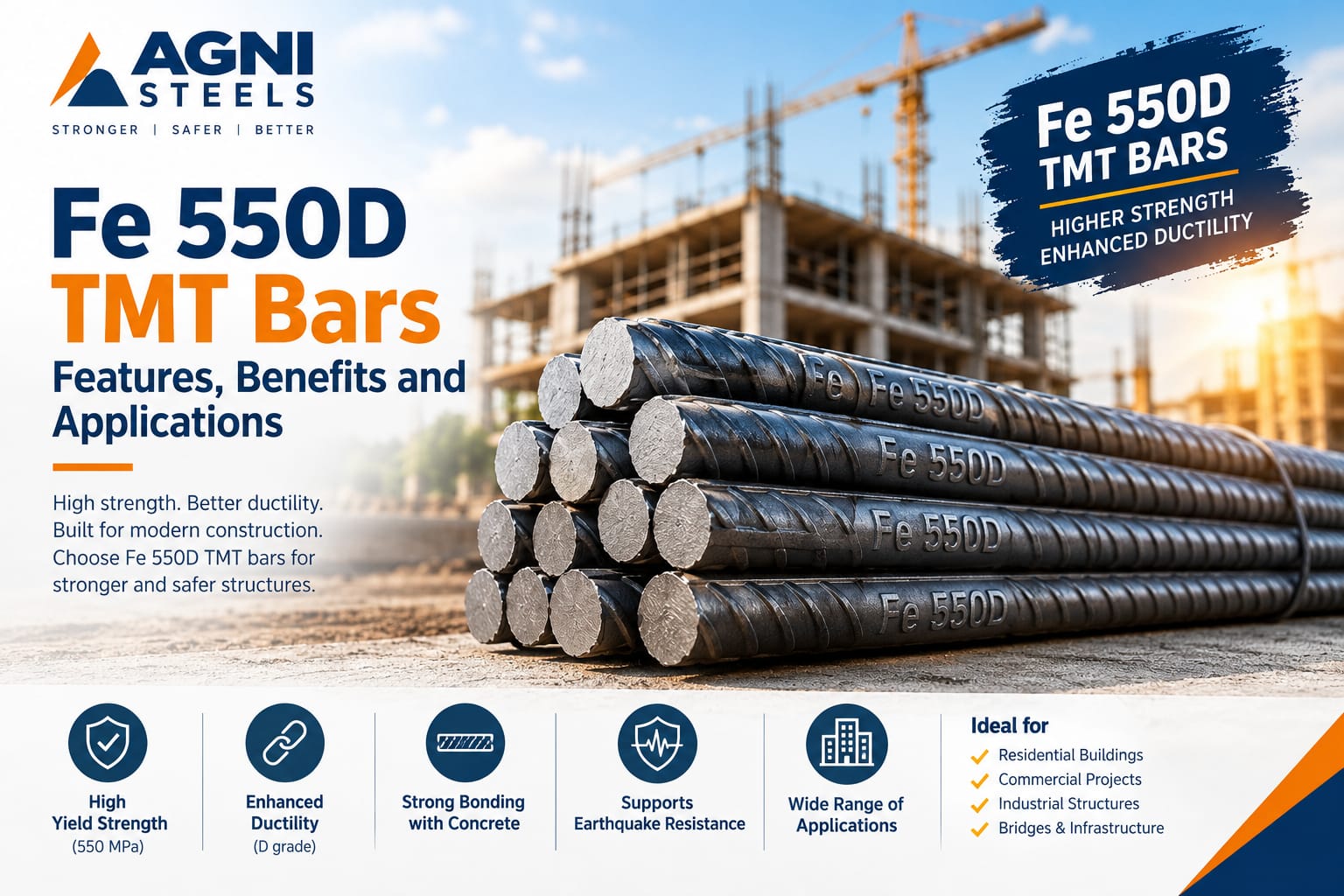
TMT bars are available in different grades, including Fe 415, Fe 500, Fe 500D, Fe 550, and Fe 550D.
These grades provide specified yield-strength characteristics.
Mild steel has comparatively lower strength in many conventional product forms. Its actual properties depend on the grade and manufacturing specification.
3. Ductility
Ductility refers to the ability of a material to deform before failure.
TMT bars are available in ductile grades designed to meet specified elongation and tensile-to-yield strength requirements.
Mild steel also has good ductility and workability, but the mechanical properties must be evaluated based on the particular product.
4. Surface Structure
TMT reinforcement bars generally have ribs or deformations on their surface.
These ribs improve mechanical interlocking with concrete.
Mild steel bars may be available in plain or other specified forms. Plain bars do not provide the same ribbed surface characteristics.
5. Construction Applications
TMT bars are specifically designed for reinforcement in concrete structures.
Mild steel products are widely used in fabrication, general engineering, and other applications.
The choice depends on the purpose, mechanical properties, and applicable product standards.
6. Corrosion Performance
Neither TMT steel nor mild steel should be assumed to be completely corrosion-proof.
Corrosion resistance depends on material composition, surface condition, environmental exposure, concrete cover, and construction practices.
Proper concrete cover and suitable durability measures are essential for reinforced concrete structures.
7. Cost and Material Efficiency
TMT bars may help optimize reinforcement quantities because of their higher specified yield strength compared with some conventional reinforcement products.
However, actual material savings and total costs depend on structural calculations, market prices, fabrication, and installation.
Which Is Better for House Construction?
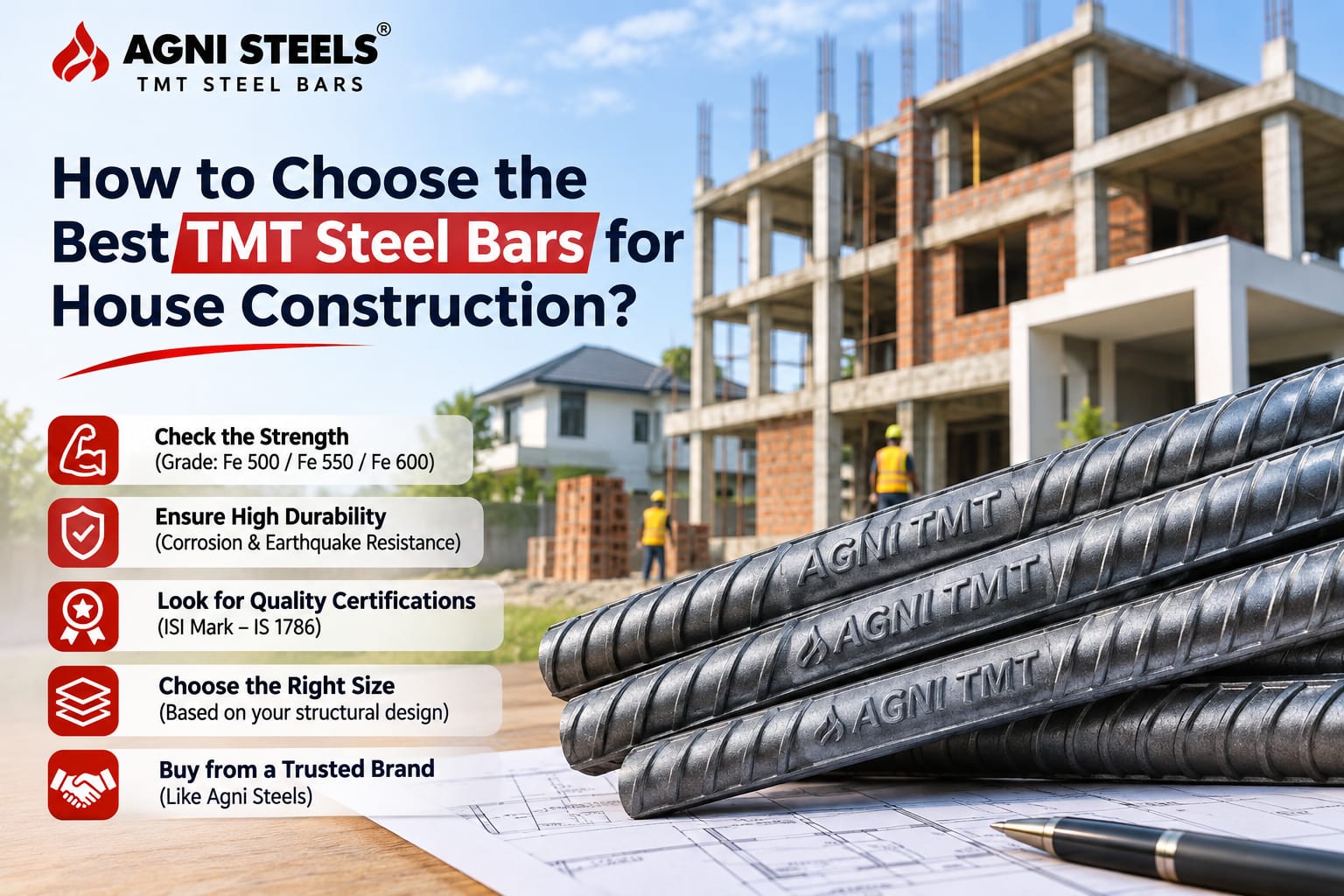
For modern reinforced concrete house construction, TMT reinforcement bars are commonly specified because they are available in standardised grades with defined strength and ductility requirements.
They provide the reinforcement properties required for foundations, columns, beams, and slabs when correctly selected and installed.
However, the best material must always be selected according to structural calculations and applicable Indian Standards.
Using a material that is not specified for the intended structural application can compromise construction quality.
Why Are TMT Bars Widely Used in Modern Construction?
TMT reinforcement bars offer several advantages:
High yield strength across different grades.
Ribbed surfaces for improved concrete bonding.
Controlled mechanical properties.
Availability of enhanced ductility grades.
Suitability for various reinforced concrete applications.
These characteristics make TMT reinforcement an important part of modern building construction.
Why Choose Agni Steels?
Agni Steels offers TMT steel reinforcement solutions for different construction needs.
When selecting reinforcement steel, consider the grade, product specifications, manufacturing quality, and applicable certification.
Whether you are constructing a residential property or planning a larger development, choosing suitable reinforcement steel is an important step towards achieving the required structural performance.
Frequently Asked Questions
1. What is the main difference between TMT and mild steel bars?
TMT bars undergo a controlled thermo-mechanical treatment process and are manufactured in specified reinforcement grades. Mild steel is a low-carbon steel product commonly used in fabrication and engineering applications.
2. Are TMT bars stronger than mild steel bars?
TMT bars are available in higher-strength reinforcement grades. The exact comparison depends on the mechanical specifications of the products.
3. Can mild steel bars be used in construction?
Mild steel products can be used in certain construction applications when they meet the relevant specifications. Reinforcement selection must follow structural requirements.
4. Why are TMT bars ribbed?
Ribs improve mechanical bonding between the reinforcement bar and surrounding concrete.
5. Which TMT grade is suitable for residential construction?
Fe 500 and Fe 500D are commonly considered, but the structural engineer should determine the appropriate grade.
Conclusion
Understanding the difference between TMT steel bars and mild steel bars helps builders make better material decisions.
TMT bars are widely used for reinforced concrete construction because they offer standardized reinforcement grades, strength, and suitable ductility properties.
For construction projects, explore Agni Steels' TMT reinforcement solutions and consult your structural engineer before finalizing the steel grade.