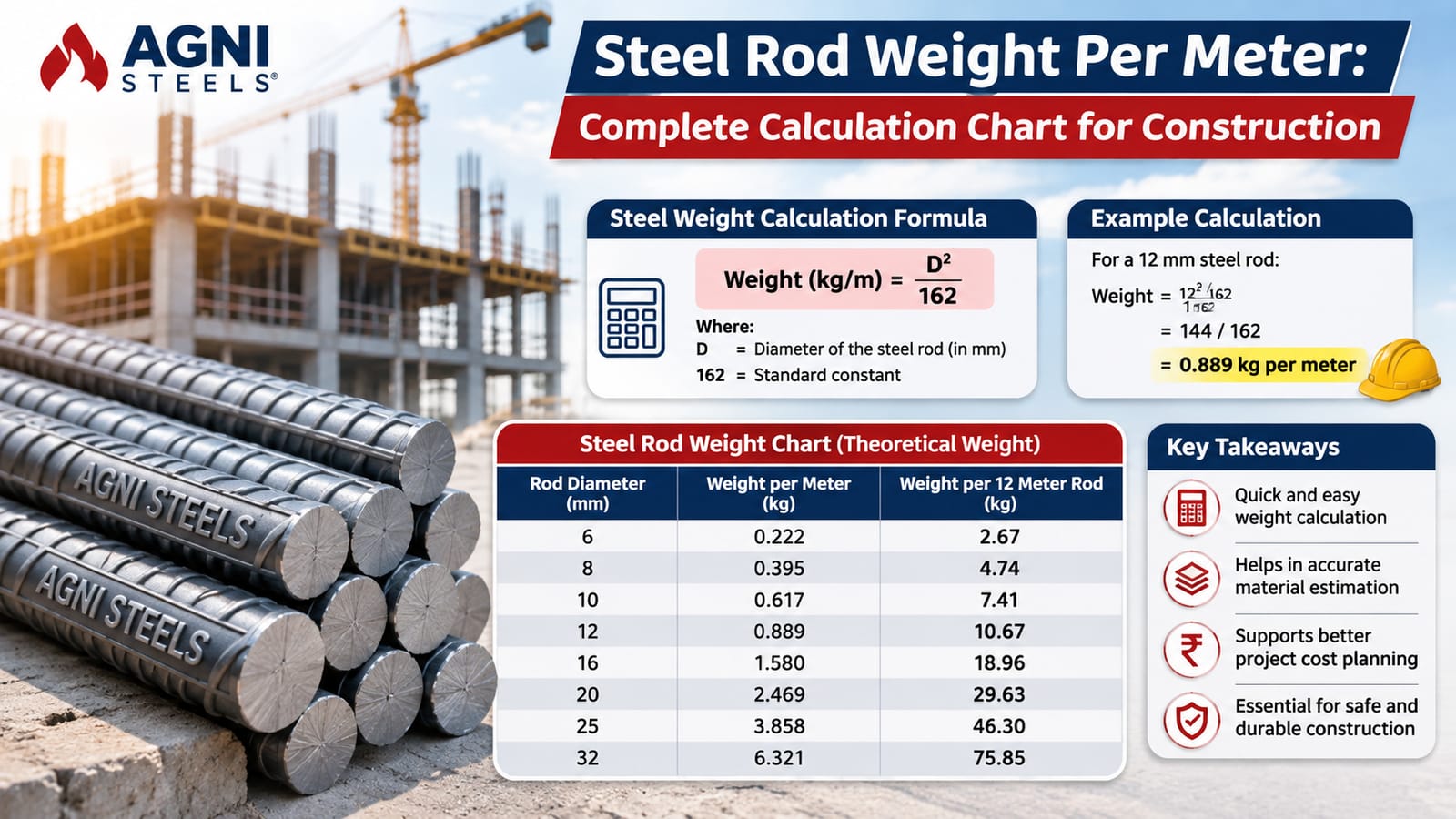
Knowing the weight of steel rods is essential for construction projects, steel procurement, and material estimation. Whether you are a civil engineer, builder, contractor, or homeowner, understanding steel rod weight per metre helps you estimate the quantity of reinforcement steel required for different applications.
Steel rods are manufactured in various diameters, and each diameter has a different theoretical weight. Calculating the weight manually for every rod can become time-consuming, especially when working with large construction projects.
A steel weight calculator and a standard weight chart make the process easier.
In this guide, we will explain steel rod weight per metre, the calculation formula, a complete weight chart, and practical examples.
What Is Steel Rod Weight Per Metre?
Steel rod weight per metre refers to the approximate weight of one metre of a steel rod.
It is generally measured in kilograms per metre (kg/m).
The weight depends primarily on the diameter of the rod and the density of the steel.
For example:
A 10 mm steel rod weighs approximately 0.617 kg per metre.
A 12 mm steel rod weighs approximately 0.889 kg per metre.
A 16 mm steel rod weighs approximately 1.580 kg per metre.
A 20 mm steel rod weighs approximately 2.469 kg per metre.
As the diameter increases, the weight per metre also increases.
Steel Rod Weight Calculation Formula
The standard theoretical formula used for calculating round steel rod weight is:
Weight per metre = D² / 162
Where:
D = Steel rod diameter in millimetres
162 = Approximate conversion constant
For calculating the total weight of a rod:
Total Weight = D² × L / 162
Where L represents the length in metres.
This formula is widely used for estimating the theoretical weight of reinforcement steel bars.
Steel Rod Weight Chart Per Metre
Here is a reference chart showing the approximate weight of common steel rod diameters.
Steel Rod DiameterWeight Per Metre6 mm0.222 kg8 mm0.395 kg10 mm0.617 kg12 mm0.889 kg14 mm1.210 kg16 mm1.580 kg18 mm2.000 kg20 mm2.469 kg22 mm2.988 kg25 mm3.858 kg28 mm4.840 kg32 mm6.321 kg
The values are approximate theoretical weights calculated using the standard formula.
How to Calculate the Weight of a Steel Rod
Let's understand the calculation with practical examples.
Example 1: 10 mm Steel Rod
Diameter = 10 mm
Length = 12 metres
Weight = 10² × 12 / 162
Weight = 1,200 / 162
Total weight = 7.41 kg approximately.
Example 2: 12 mm Steel Rod
Diameter = 12 mm
Length = 12 metres
Weight = 12² × 12 / 162
Weight = 1,728 / 162
Total weight = 10.67 kg approximately.
Example 3: 16 mm Steel Rod
Diameter = 16 mm
Length = 12 metres
Weight = 16² × 12 / 162
Weight = 3,072 / 162
Total weight = 18.96 kg approximately.
Example 4: 20 mm Steel Rod
Diameter = 20 mm
Length = 12 metres
Weight = 20² × 12 / 162
Weight = 4,800 / 162
Total weight = 29.63 kg approximately.
How to Calculate the Weight of Multiple Steel Rods
When estimating steel requirements for a construction project, you may need to calculate the combined weight of several rods.
Use this formula:
Total Steel Weight = Weight of One Rod × Number of Rods
For example, consider a requirement of 100 steel rods with a diameter of 12 mm and a length of 12 metres.
Weight of one rod = 10.67 kg
Number of rods = 100
Total weight = 10.67 × 100
Total weight = 1,067 kg approximately.
This means the requirement is approximately 1.067 metric tonnes.
Why Is Steel Rod Weight Important?
1. Construction Cost Estimation
Steel is an important component of construction budgets. Calculating the approximate weight helps estimate purchasing costs.
2. Quantity Surveying
Quantity surveyors use steel weight calculations when preparing material estimates, bills of quantities, and project budgets.
3. Procurement Planning
Knowing the approximate weight helps contractors communicate their steel requirements to manufacturers and suppliers.
4. Transportation Planning
Steel weight information helps estimate transportation requirements and manage vehicle load planning.
5. Material Verification
Theoretical weight calculations provide a reference for comparing estimated and delivered steel quantities, while actual acceptance should follow applicable specifications and tolerances.
Difference Between Theoretical and Actual Steel Weight
Theoretical weight is calculated using a mathematical formula based on nominal dimensions and assumed steel density.
Actual weight is determined by physically weighing the material.
Differences can occur because of manufacturing tolerances, dimensional variations, and product specifications.
For this reason, a steel weight calculator should be used for estimation rather than as a replacement for actual weighing or product documentation.
Tips for Accurate Steel Weight Estimation
Confirm the correct rod diameter before calculating.
Measure the actual length of the material.
Use the appropriate formula for round steel rods.
Calculate each diameter separately.
Maintain a record of total bar quantities.
Consider cutting schedules and structural detailing.
Verify delivered material against purchase specifications.
Conclusion
Steel rod weight per metre is an important measurement for construction planning and steel procurement. Using the formula D² / 162, you can quickly estimate the theoretical weight of different steel rod sizes.
A standard steel weight chart and calculator help save time, improve material estimation, and support better project management.
Agni Steels understands the importance of quality reinforcement materials in construction. Make informed steel selection decisions and build with confidence using suitable TMT steel solutions.