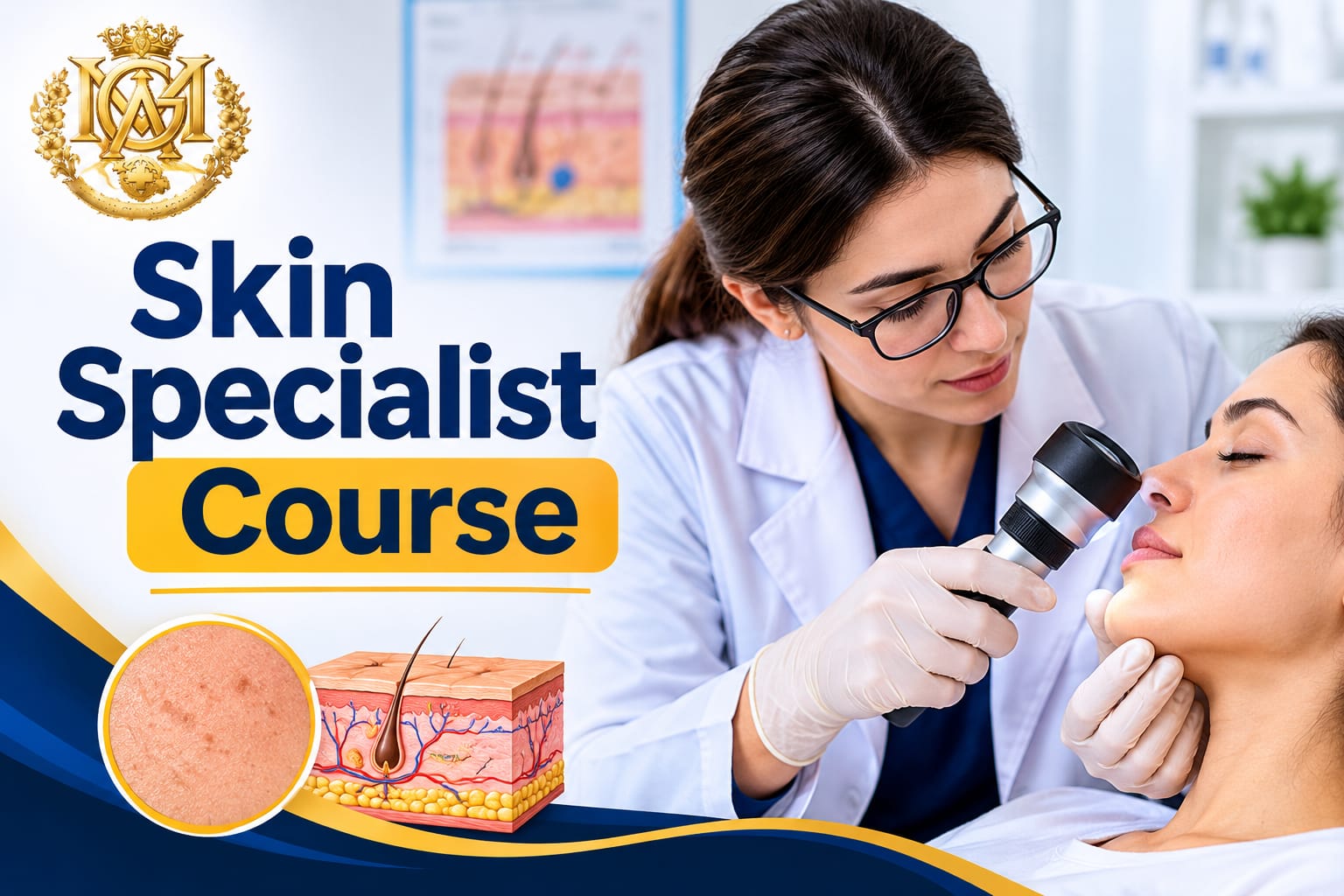
Doctors who are thinking about a skin specialist course tend to ask the same practical questions, often late in the evening after a long clinic. This page answers fourteen of them in plain language. Where the answer depends on the provider, it says so and tells you what to check. That honesty is deliberate: fees, duration, and eligibility change between programmes and over time, so the safest source for them is always the current programme page and a written reply from the provider. Use this page to know what to ask, not to replace those answers. The Fellowship in Dermatology programme is one structured option, and the questions below apply whichever course you consider.
1. What is a skin specialist course?
It is a structured programme that teaches doctors about the diagnosis and management of skin, hair, and nail conditions. Courses range from short certificates to longer fellowships. A course builds knowledge and skills, and its recognition and scope depend on the provider.
2. Is it the same as an MD in dermatology?
No. In India, the regulated route to the dermatologist title is a postgraduate degree, usually an MD in dermatology, venereology and leprosy, or a DNB in the same area. A course is a different kind of credential, and a good provider says plainly what it is and what it is not.
3. What is the skin specialist course eligibility?
It differs between programmes. Valid registration with the National Medical Commission or a State Medical Council is a common starting point, and some programmes expect a period of clinical experience. Read the current requirement on the programme page before you plan around it, and ask the provider to confirm it in writing.
4. Can I take a skin specialist course online?
Many programmes are delivered online, with live classes and recordings. Online learning can build knowledge, clinical reasoning, and image interpretation well. If a course includes procedures, ask how they are taught, who supervises them, and what the credential allows you to do.
5. What does the skin specialist course syllabus usually cover?
Most curricula include medical dermatology, diagnostic skills, hair and scalp disorders, pigmentary conditions, paediatric skin disease, and some aesthetic topics. Some add dermoscopy and basic dermatopathology. Read the topic outline on the programme page, because depth and balance vary widely.
6. What is the usual skin specialist course duration?
It depends on the format. Certificates are generally shorter, and fellowships are longer. Check the duration, the weekly time commitment, and the assessment schedule on the programme page, and compare them with the time you can protect.
7. How much do skin specialist course fees run?
Fees vary by provider and format, so no single figure applies. Ask for the total cost in writing, including registration, examination, and any extra charges, before you commit.
8. Which format should I choose?
Match the format to your goal and your time. A PG Diploma in Dermatology offers a defined scope with assessment, which suits doctors who already see skin patients. A Certificate in Dermatology is a lighter, structured first step. A fellowship covers the most ground. Read each programme page before you decide.
9. Will my certificate be recognised?
Recognition depends on the provider and on who is judging it. Ask what recognition the provider claims, and check that claim against a published source. Do not assume that a course certificate carries the same standing as a postgraduate degree. It also helps to ask a simple question: if a colleague or an employer looked at this certificate, what would it tell them about my training? A clear, honest answer is a good sign.
10. Can I study while I work?
Many doctors do. Programmes designed for working doctors often schedule sessions in the evening or at weekends and provide recordings. A realistic weekly routine matters more than the number of hours, so protect a few fixed blocks in your diary. Review each session soon after it ends, and connect it to a patient you saw that week. Doctors who do this tend to keep going, while those who rely on free evenings often fall behind.
11. Will a course let me perform skin procedures?
Not by itself. What you may practise depends on your qualification, your experience, the facility where you work, and the rules that apply to you. Check the position with the National Medical Commission and your State Medical Council before you offer any procedure.
12. How do I know when to refer a patient?
Refer early when a lesion is changing, bleeding, not healing, or spreading quickly, or when there is pain, fever, blistering, or other systemic symptoms. A good course teaches clear thresholds and how to write a useful referral letter.
13. How do I compare providers?
Compare the curriculum, the assessment, the teaching team, the time commitment, eligibility, and the exact name and issuer of the credential. Look for a provider that states what the course does not allow you to do. Put your findings in a simple table of your own, with one row per provider and one column per question, so that differences are easy to see. Avoid choosing on price or on a single advertisement alone. To compare programmes across other specialities, visit the Medical Global Academy homepage.
14. What should I ask before I pay?
Ask five things in writing: what the credential is, what the curriculum covers, how you will be assessed, what the total cost is, and what the course does not qualify you to do. Keep the replies, and compare them across providers.
A Quick Checklist Before You Enrol
Keep this short list beside you when you read a programme page.
Credential: the exact name of the certificate and the organisation that issues it.
Eligibility: the current requirement, confirmed in writing.
Curriculum: a topic-by-topic outline, not only a headline.
Assessment: how and when you are tested.
Time: the weekly hours and the timing of live sessions.
Cost: the total, including every extra charge.
Limits: what the course does not qualify you to do.
If a provider cannot answer one of these clearly, treat that as useful information. A trustworthy provider answers without being pushed, and it is happy for you to compare it with others.
Final Thoughts
A skin specialist course is a useful tool when its content matches your goal and you will use the skills in daily practice. It is a poor fit when you expect it to replace a degree or to guarantee income. Read the programme page, check every claim, and choose the format that fits your time. Take your time with the decision, because a well-chosen course repays the effort, while a rushed choice often disappoints. If you are also weighing what a dermatology skill set can mean for your earnings, read the dermatologist salary in India guide for a realistic view before you decide.