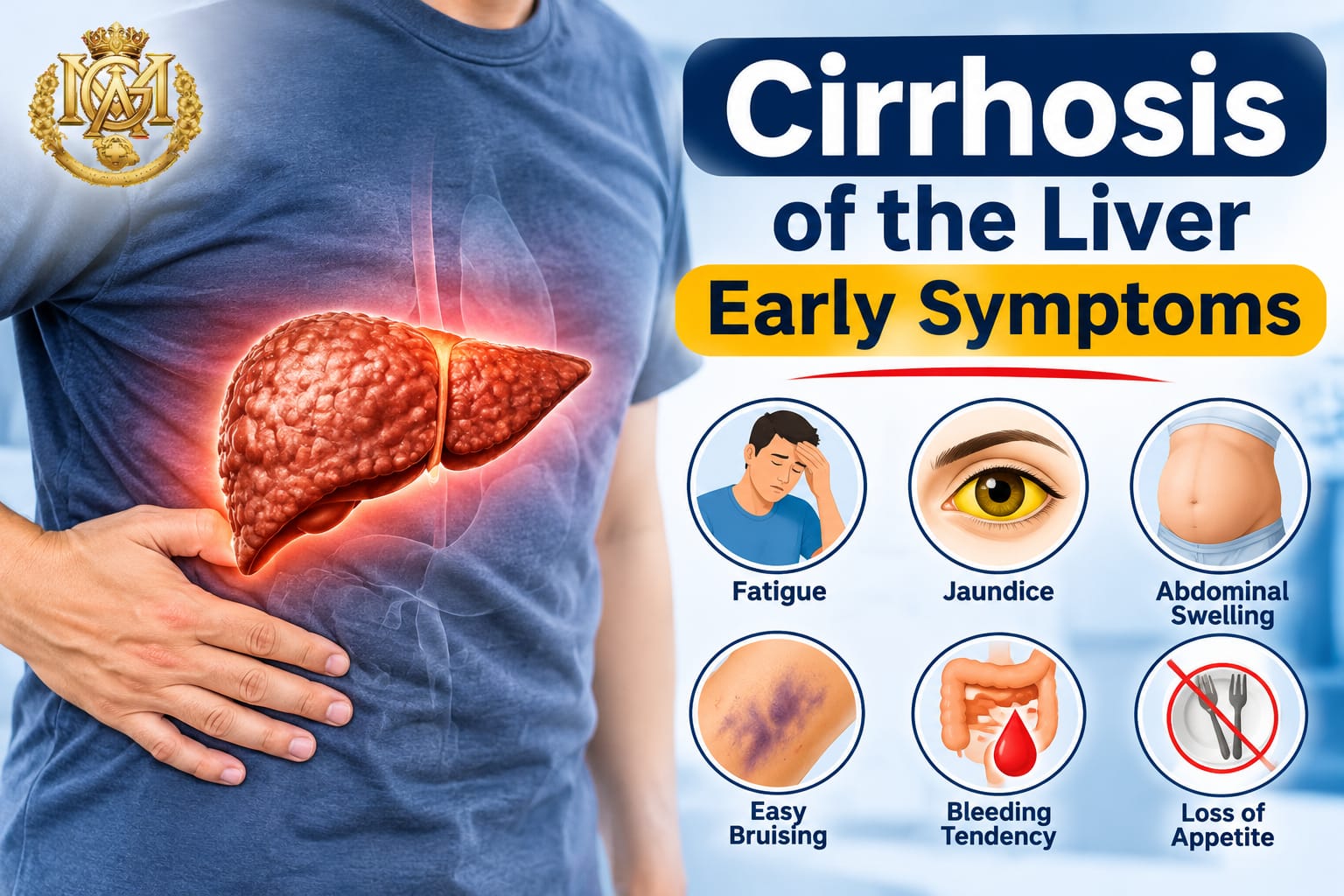
Early cirrhosis is seldom picked up by one clinician in one visit. A general physician may see fatigue, a nurse may notice a patient losing weight, a laboratory may flag a low platelet count, and a radiologist may describe a small liver with an irregular surface. Each of these is a fragment. Putting them together is what finds the disease early. Doctors who want to explore internal medicine subspecialties can review the Fellowship in Pulmonary Medicine programme page.
The Symptoms Each Member Sees First
Early symptoms are vague, so they tend to be recorded differently by different people:
Persistent tiredness and reduced activity are often first raised by the patient or a family member
Reduced appetite and weight loss are often noticed by nursing and dietary staff
Itching, bruising, or easy bleeding may be mentioned in primary care or at a dermatology or dental visit
A low platelet count or abnormal liver tests appear in routine laboratory reports
None of these confirms cirrhosis. Each one should be written down with the date, so that the team can see the pattern.
The General Physician's Role
The physician's task is to ask about risk before symptoms. Hepatitis B or C, heavy alcohol intake, metabolic risk factors, and autoimmune disease all raise the chance that a symptom means liver injury. A symptom in a patient without a risk factor is usually worked up in other directions first.
When risk and symptoms coincide, the physician orders liver function tests, a full blood count, and renal function, then decides whether to refer for imaging and fibrosis assessment.
The Nurse and Support Staff
Nurses and support staff often see the patient more often than anyone else. They are well placed to record changes in appetite, weight, sleep, mood, and urine colour, and to flag a patient who is becoming confused or drowsy. A clear, dated record of these changes helps the physician judge whether the disease is progressing.
Confusion or drowsiness in a patient with known liver disease is a reason to raise the alarm the same day, not at the next scheduled review.
The Laboratory and Imaging Team
The laboratory is often the first place that suggests liver disease. A falling platelet count, a raised bilirubin, or a low albumin can be reported before any clinician has seen the patient. Reporting these with a comment, rather than as isolated numbers, helps the physician notice the pattern.
Imaging can show a nodular liver surface, an enlarged spleen, or fluid in the abdomen. These findings should be reported clearly, with the date of any previous scan for comparison.
When the Case Moves to a Specialist
A case should be referred to a hepatologist or gastroenterologist when:
Liver tests are persistently abnormal, or abnormal with a risk factor
Platelets are falling over time
Imaging shows signs of chronic liver disease, such as a nodular surface or ascites
Any complication appears, such as jaundice, confusion, or bleeding from the gut
Referral should not wait for jaundice. A patient who already has a known risk factor and abnormal tests is a reasonable candidate for specialist input even when the patient feels well.
Keeping the Record Useful
The team's notes are only as useful as their clarity. Record the date, the test, the result, and the source of each observation. Avoid writing "unwell" or "tired" without detail. A note such as "reduced appetite for three weeks, weight down 2 kg, no vomiting" gives the next person something to act on.
For a related article on lung infection, see lung infection types and the pulmonary medicine fellowship, which covers a different team workflow in respiratory medicine.
Frequently Asked Questions
Can early cirrhosis be missed by a care team? Yes. Symptoms are vague and spread across roles. A shared, dated record and a clear referral threshold reduce the chance of a miss.
Who should order the first liver tests? Usually the physician responsible for the patient's care, based on the risk history. Local protocols may differ.
Is a normal enzyme result reassuring? Not on its own. Enzymes can be normal in advanced fibrosis, so fibrosis assessment is needed when risk is present.
Final Thought
Early cirrhosis is found by a team, not by a single moment of insight. Each role has something to contribute, and the most useful thing any member can do is write down what they see, clearly and with a date. For a structured route into internal medicine and its subspecialties, visit the MGA homepage. Check the curriculum, eligibility, and format of any programme against your own background and documents before deciding.