
Did you ever see a little brown animal running through your garden and then disappear a second later?
Could've been a weasel.
They will sometimes move into gardens, farms and around houses, especially when there are plenty of mice and voles. They are fast and they love to hide in the shadows so they are hard to spot.
But you don't always have to see one to suspect that one is around. Here are seven clues to look out for.
1. A Small Animal With a Long, Thin Body
The biggest clue is seeing the animal itself.
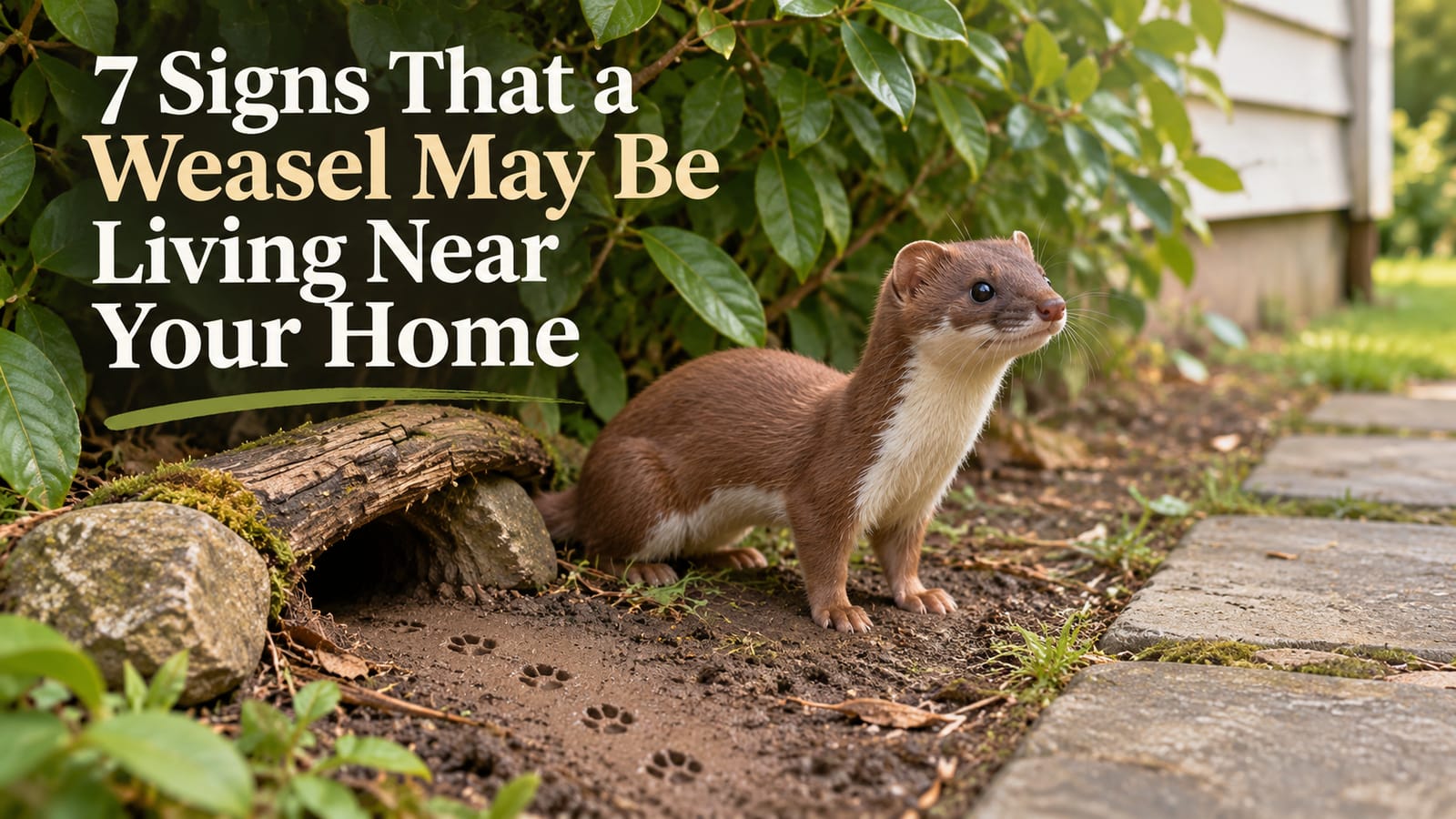
Least weasels have long, slender bodies, short legs, rounded ears and pointed faces. They have brown backs and usually white or cream bellies.
They can easily be mistaken for stoats. One useful difference is the tail. Least weasels have shorter tails without the black tip found on stoats.
If you've spotted something similar, learning more about weasel characteristics can help you identify what you've seen.
2. Tiny Footprints in Mud or Soft Soil
After a rainy day, take a look at the muddy patches around your garden.
Weasels have five toes on each foot, although not all five always appear clearly in their tracks.
Their footprints are small, and when they move in bounds, they may leave pairs of tracks close together.
You might notice these marks near fences, garden edges, or places where animals regularly pass.
Footprints alone won't confirm a weasel, though. Other small mammals can leave similar tracks.
3. Thin, Twisted Droppings
Nobody likes to find animal droppings, but they can tell you what kind of wildlife has been visiting.
Weasel droppings are usually thin, dark and a bit twisted. They can have little bits of fur, feathers or bones from their prey.
You can find them on rocks or logs or near a sheltered spot.
However, stoats and other small carnivores make similar droppings, so it is not always easy to identify them.
DO NOT TOUCH THEM. Keep children and pets away from the area.
4. Signs of Small Rodents Being Hunted
Active predators, weasels prey primarily on small mammals such as mice and voles.
If you have a garden full of rodents, a weasel may turn up to feed.
Sometimes you might find the remains of prey near a sheltered area or a weasel with a mouse.
But don't think that every dead rodent signals a weasel is around. Other predators that hunt small mammals include cats and birds of prey.
If you saw it directly too, that would help.
5. Small Holes Beneath Rocks or Logs
Weasels don’t always dig their own holes. Often they will occupy an existing rodent burrow or other small, protected spot.
A resting place might be a gap under a stone wall, a hollow log or an old mouse tunnel.
You might see a small, vegetated entrance or signs of recent animal activity.
But a hole in the ground doesn’t tell you what animal uses it.
Do not touch or disturb the shelter inside. There could be young animals lying there.
At Animal Kingdom, you can explore more wildlife guides to learn how different animals find shelter and adapt to their surroundings.
6. Quick Movement Along Garden Edges
A weasel will run across open ground, but it usually hunts in places with cover.
Search for likely rodent locations such as hedges, stone walls, long grass, and fallen branches.
You might see something brown running low to the ground before it disappears.
A rabbit tends to hop in a more rounded body shape, while a running weasel is decidedly elongated.
One quick sighting is not enough to identify but seeing the same type of animal around the edge of your garden a few times is worth noting.
7. Repeated Sightings in the Same Area
It is not enough to spot a weasel once to know that it lives in your garden.
It could just be passing through on a hunt.
However, if it is spotted a number of times close to the same hedge, wall or patch of vegetation this could indicate the area forms part of its normal hunting range.
If you want to know more, a wildlife camera will help you see the visitors without getting too close.
A good photo or short video may tell you more about the animal than just tracks or droppings.
Note that several sightings may be of the same weasel, and using an area for hunting does not mean that it was used for denning.
Final Thoughts
Seeing a weasel around the home can be an interesting wildlife experience.
The little predators are good at keeping hidden so footprints, droppings and occasional sightings may be the only clues you see.
Look for several signs together rather than relying on just one.
And if you do find a weasel, there's usually no reason to disturb it. Give it space and enjoy the chance to observe a wild animal going about its day.