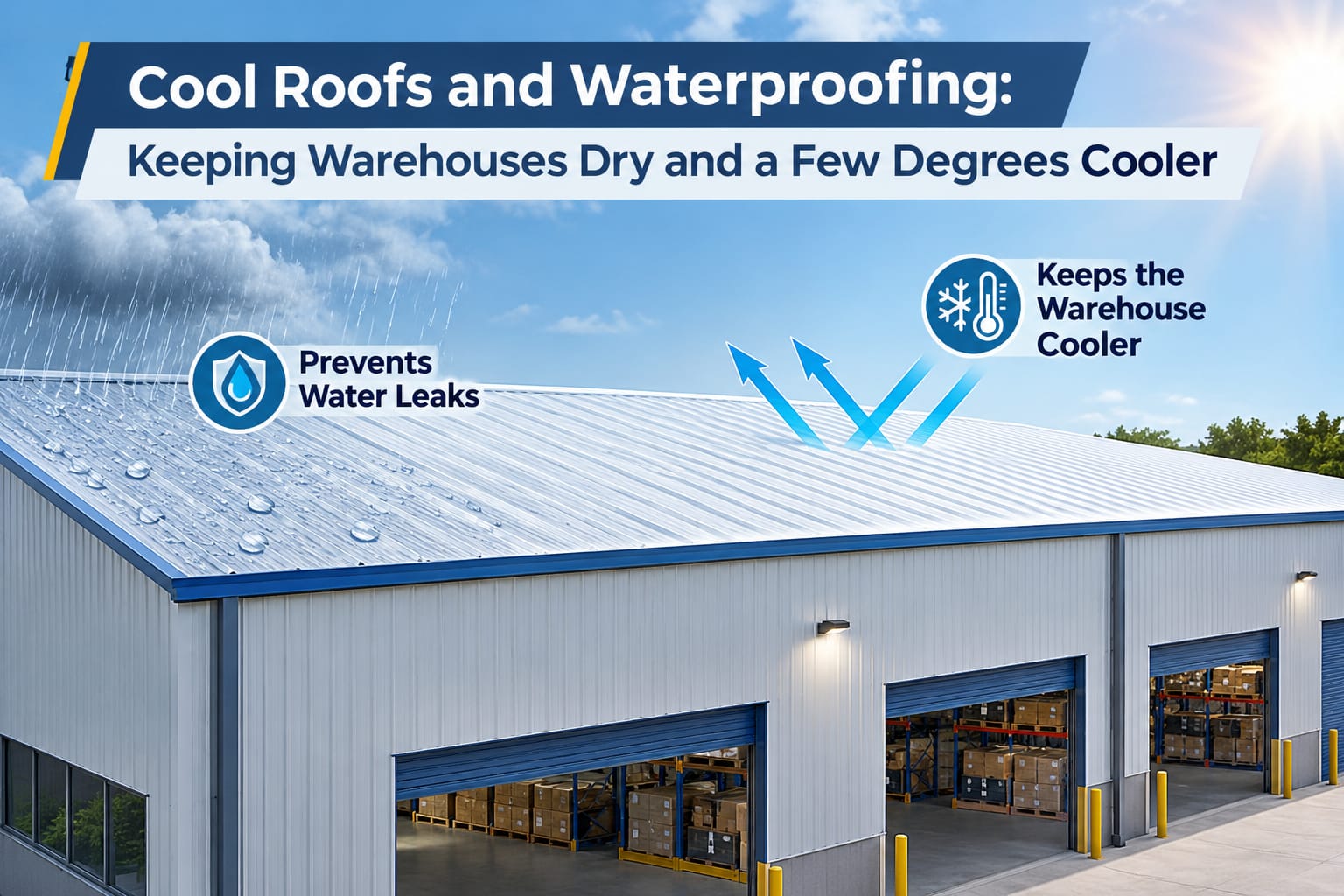
If you've ever stepped into a warehouse in July, you know that the roof is doing something to the air in there. Metal and concrete soak up the sun all day, then radiate that heat down onto people, stock and air-conditioning systems. Cooling a building like that is expensive. Which is why more owners are asking whether the same roof upgrade that stops leaks can also help with the heat.
The short answer is often yes, with a few caveats. Let's go through it.
Waterproofing and heat are connected
It's tempting to treat them as two separate problems. One is about water, the other about temperature. But the same hot surface that makes a building uncomfortable is also the one wearing out your waterproofing layer. High roof temperatures speed up ageing, increase expansion and contraction, and push materials toward cracking.
So reducing the heat load on a roof can, in principle, be good for the waterproofing as well as the energy bill.
What a "cool roof" actually is
A cool roof is simply a roof that reflects more sunlight and absorbs less heat than a conventional one. Light-coloured or specially formulated reflective surfaces send a good part of the sun's energy back towards the sky instead of into the building. The US Environmental Protection Agency has a clear explainer on how cool roofs work and the benefits they offer, including lower roof surface temperatures and reduced cooling demand in air-conditioned buildings.
Researchers at the US Department of Energy's national laboratories have also looked at this for decades. The Lawrence Berkeley National Laboratory's heat island group publishes background on cool roof science, and older DOE-supported field studies recorded reductions in air-conditioning energy use ranging widely from building to building, which is why you should treat any single saving figure with caution.
Why it matters more in hot climates
Cool roofs tend to pay off most where the sun is strong and cooling runs for much of the year. That fits the Gulf quite well. In colder climates there can be a small winter penalty because you lose some free heat, but where air-conditioning is running for most of the year, reflecting heat away is generally a sensible approach.
How much you save depends on the building. A well-insulated roof gets less benefit than a poorly insulated one. A warehouse with a large roof area compared with its volume gains more than a tall multi-storey block. Anyone promising a precise percentage without looking at your building is guessing.
Where waterproofing fits in
Here's the practical side. Many modern waterproofing systems are available with reflective finishes or topcoats, so you can get a waterproof layer and a heat-reflective surface in a single job. For metal roofs, an elastomeric coating can seal seams and fasteners and reflect heat at the same time. On concrete roofs, a membrane with a reflective cap or finish can do the same.
Some things to check when you're specifying:
Reflectivity and emissivity. Ask for the product's solar reflectance data, not just a colour.
Flexibility. The surface still has to cope with daily thermal movement.
Durability of the reflective layer. Dust and dirt reduce reflectivity over time, so find out how easily it can be cleaned or refreshed.
Compatibility. A coating must bond with what's underneath, whether that's old paint, bitumen or bare metal.
Slip and traffic. If people walk on the roof for maintenance, a glossy white surface can be slippery or glaring.
Don't forget the basics
A reflective surface won't help a roof that's already leaking. Fix the water problem first: sort drainage, repair cracks, treat rust, seal penetrations and prepare the surface properly. Putting a cool coating over a wet, damaged substrate just traps the problem under a nicer-looking layer.
It's also worth remembering that cool roofing is part of the picture, not the entire thing. Insulation, ventilation, shading and the efficiency of your cooling equipment all affect the result.
Rules and approvals
If your project is in Dubai, remember that waterproofing products and systems have to meet local requirements. Dubai Municipality publishes guidance on products and materials used in waterproofing systems, and checking it early can prevent trouble at approval or handover.
A realistic plan for a warehouse owner
Inspect. Establish the roof's condition, the substrate, and where it leaks or ponds.
Repair first. Drainage, cracks, corroded areas, failed seals.
Choose a waterproofing system with a reflective finish suited to the roof type and its movement.
Ask for data. Reflectance, thickness, warranty, maintenance requirements.
Measure the results. If you track electricity use before and after, you'll know what it actually did for your building.
For large commercial and industrial buildings, manufacturers who work in this climate can help with specification. Organix, a construction chemical manufacturer in Dubai, covers industrial roof solutions on its website, which is a decent starting point if you're pulling together a shortlist.
In summary
A roof that keeps water out and heat down is better value than one that only manages one of the two. Start with the waterproofing, choose a finish that suits your climate, and be wary of big promises. Do it properly and your warehouse gets drier, a little cooler, and easier to look after for years to come.