Artificial intelligence is transforming how businesses operate, but generic AI models have one major limitation: they don't automatically understand your company's private documents, internal processes, product information, or customer records.
Imagine having an AI assistant that can answer questions using your company's actual business data instead of relying only on general knowledge.
That's exactly what Retrieval-Augmented Generation (RAG) makes possible.
RAG connects Large Language Models (LLMs) with your business knowledge base, allowing AI systems to retrieve relevant information before generating responses. This helps businesses build more accurate, context-aware, and up-to-date AI applications.
At THE TISA, we provide custom RAG development services to help startups and enterprises transform scattered business information into intelligent AI-powered solutions.
Whether you need an AI chatbot, enterprise knowledge assistant, or advanced document search system, we build scalable RAG solutions designed around your business requirements.
What Is Retrieval-Augmented Generation (RAG)?
Retrieval-Augmented Generation (RAG) is an AI architecture that combines information retrieval with Large Language Models to generate responses using relevant external knowledge.
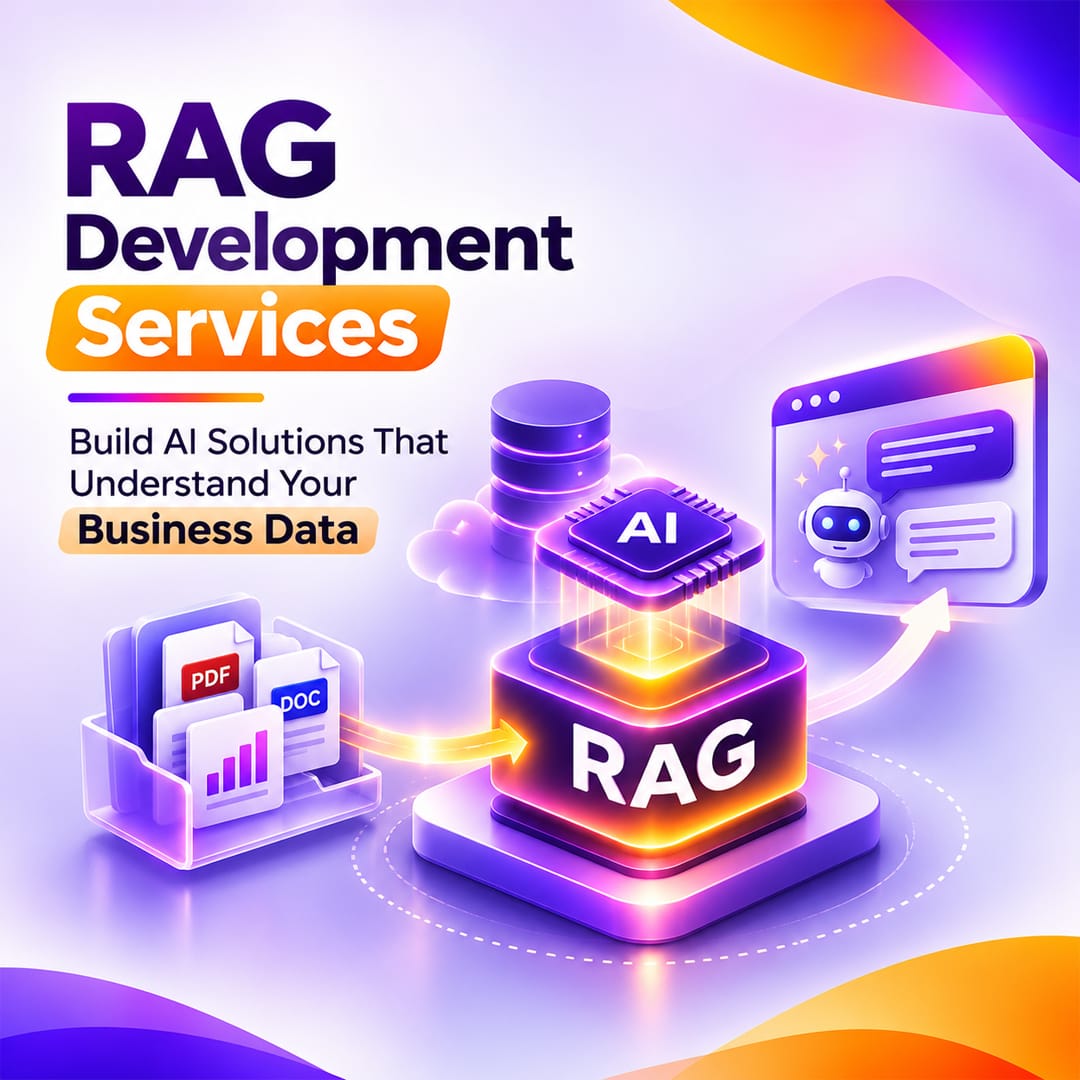
In simple terms, RAG allows an AI model to search your business documents, retrieve useful information, and use that information to answer questions.
For example, imagine your company has thousands of documents containing product details, employee policies, technical guides, and customer support information.
Instead of manually searching through these documents, employees can ask an AI assistant questions and receive answers based on relevant company information.
How Does RAG Work?
A typical RAG system follows three main stages:
1. Retrieval
The system searches your knowledge base to identify information relevant to the user's question.
2. Augmentation
The retrieved information is added to the original question as context for the language model.
3. Generation
The LLM uses the provided context to generate a relevant, natural-language response.
This approach allows businesses to connect AI models with changing information without retraining the entire model every time their data changes.
Why Does Your Business Need RAG Development Services?
Businesses generate large amounts of information every day. However, finding the right information at the right time can be challenging.
RAG helps make this information more accessible through intelligent AI applications.
1. Reduce AI Hallucinations
Generic AI models can sometimes generate incorrect or unsupported information. RAG grounds responses in retrieved business data, helping reduce hallucinations.
2. Access Updated Business Information
When company policies, product details, or internal documents change, the knowledge base can be updated without retraining the underlying LLM.
3. Improve Data Privacy and Control
RAG solutions can incorporate encryption, access permissions, and private deployment options to help protect sensitive business information.
4. Reduce Operational Costs
Instead of building and maintaining a custom-trained model for every knowledge requirement, businesses can use existing LLMs with a retrieval system.
5. Improve Employee Productivity
Employees can find answers from internal documents faster, reducing repetitive searches and manual information retrieval.
Our RAG Development Services
At THE TISA, we provide end-to-end RAG development services, from architecture planning and implementation to deployment and continuous optimization.
1. Custom RAG Chatbot Development
We develop intelligent RAG-powered chatbots for websites, mobile applications, WhatsApp, and internal business platforms.
These chatbots can use your company documents, product information, FAQs, and knowledge bases to answer user questions.
Common applications include:
Customer support automation
Product information assistance
HR helpdesk automation
Sales support chatbots
Internal employee assistants
2. Enterprise Knowledge Search and AI Assistants
Large organizations often store information across multiple platforms, including Google Drive, SharePoint, Slack, and Confluence.
We build unified AI-powered knowledge search systems that allow employees to retrieve relevant information using natural-language questions.
Access permissions can be integrated to ensure users only retrieve information they are authorized to view.
3. RAG Pipeline Development
A reliable RAG system requires a well-designed data processing pipeline.
Our RAG pipeline development services include:
Document ingestion and extraction
Data cleaning and preprocessing
Intelligent document chunking
Metadata extraction and tagging
Embedding generation
Vector indexing
OCR and multimodal document processing
We design pipelines that help AI systems retrieve relevant information from different document formats and data sources.
4. Vector Database Setup and Optimization
Vector databases help RAG applications store and retrieve information based on semantic similarity.
We work with technologies such as:
Pinecone
Weaviate
Qdrant
Milvus
PostgreSQL with pgvector
Chroma
Depending on your requirements, we implement vector search, hybrid search, metadata filtering, and re-ranking to improve retrieval quality.
5. LLM RAG Implementation and Integration
We integrate RAG architectures with leading language models and existing business applications.
Our integration capabilities include:
OpenAI GPT models
Anthropic Claude
Google Gemini
Llama
Mistral
We also connect RAG applications with CRMs, ERPs, helpdesk platforms, websites, and mobile applications.
6. RAG Evaluation, Monitoring, and Optimization
Building a RAG application is only the beginning. Its performance must be continuously evaluated.
We monitor important metrics such as:
Retrieval relevance
Answer quality
Response latency
Token and infrastructure costs
System reliability
We use testing, evaluation datasets, and user feedback to improve the overall performance of your RAG solution.
How Does a RAG Architecture Work?
A production-ready RAG architecture generally consists of the following stages:
Data Ingestion: Collect information from PDFs, websites, databases, APIs, and other sources.
Data Cleaning and Chunking: Convert documents into smaller, meaningful information segments.
Embedding Generation: Convert text chunks into numerical vector representations.
Vector Storage: Store embeddings and associated metadata in a vector database.
Query Processing: Convert the user's question into a searchable representation.
Information Retrieval: Find relevant document chunks using semantic or hybrid search.
Re-ranking: Improve the relevance of retrieved information.
Response Generation: Provide relevant context to the LLM to generate an answer.
Guardrails and Monitoring: Apply security controls, evaluate responses, and monitor system performance.
Each stage plays an important role in determining the accuracy, reliability, and scalability of the overall system.
Real-World Applications of RAG Development
RAG technology can support multiple business operations across different industries.
Customer Support Automation
RAG-powered chatbots can retrieve information from FAQs, product documentation, and support articles to answer customer questions.
Internal Knowledge Management
Employees can use AI assistants to search HR policies, training materials, IT documentation, and company procedures.
Legal and Compliance
Legal teams can retrieve relevant information from contracts, policies, and regulatory documents.
Healthcare and Education
RAG applications can provide information based on approved medical literature, institutional documents, and educational resources. Appropriate validation and professional oversight remain essential.
E-commerce and Real Estate
Businesses can build conversational search experiences that help customers discover relevant products or properties using their preferences.
Sales Enablement
Sales teams can access pricing information, case studies, product documentation, and sales resources through AI assistants.
Software Development
Developer documentation can be connected to RAG chatbots that help developers find API information, code examples, and troubleshooting guidance.
RAG vs Fine-Tuning: Which Approach Is Better for Your Business?
RAG and fine-tuning solve different problems. Choosing the right approach depends on your business objectives.
ComparisonRAGFine-TuningPrimary purposeAccess external knowledgeAdapt model behaviourData updatesUpdate knowledge baseMay require additional trainingSource citationsCan provide retrieved sourcesNot inherently providedBest forDocument-based AI applicationsSpecialized tasks and response patternsImplementationRetrieval pipeline requiredTraining process requiredKnowledge updatesGenerally easierCan require retraining
When Should You Choose RAG?
Choose RAG when your business needs AI to access frequently changing documents, internal knowledge, or private information.
When Should You Choose Fine-Tuning?
Choose fine-tuning when you want to adapt a model's response style, task-specific behaviour, or output patterns.
Can You Combine Both?
Yes. Combining RAG and fine-tuning can be useful when an application needs both business-specific knowledge and specialized model behaviour.
For many document-based business applications, RAG is a practical starting point.
Our RAG Development Process
At THE TISA, we follow a structured development process to build reliable and scalable RAG applications.
Step 1: Discovery and Requirement Analysis
We understand your business objectives, target users, data sources, and expected outcomes.
Step 2: Data Audit and Architecture Planning
We evaluate your existing data, document formats, access permissions, and technical requirements before selecting the architecture.
Step 3: Proof of Concept (PoC)
We develop an initial working prototype using your actual business data to validate the solution.
Step 4: Production Development
We build the complete RAG application with data pipelines, APIs, user interfaces, authentication, and required integrations.
Step 5: Testing and Evaluation
We evaluate retrieval relevance, response quality, security, performance, and system reliability.
Step 6: Deployment and Team Training
We deploy the solution using an appropriate cloud or private infrastructure setup and provide the required documentation and training.
Step 7: Monitoring and Continuous Support
We monitor performance, optimize retrieval quality, update knowledge sources, and support future improvements.
Technology Stack We Use for RAG Development
1. LLMs (Large Language Models)
OpenAI GPT, Claude, Gemini, Llama, Mistral
2. Frameworks
LangChain, LlamaIndex, Haystack
3. Vector Databases
Pinecone, Qdrant, Weaviate, Milvus, Chroma
4. Embeddings
OpenAI, Cohere, Sentence Transformers
5. Backend Technologies
Python, FastAPI, Node.js
6. Frontend Technologies
React, Next.js
7. Cloud Platforms
AWS, Microsoft Azure, Google Cloud
8. Evaluation Tools
Ragas, LangSmith, Custom Evaluation ToolsOur technology choices are flexible. We recommend the tools that best match your application instead of forcing every project into the same technology stack.
How Much Do RAG Development Services Cost?
The cost of developing a custom RAG solution depends on the complexity, features, infrastructure, and integration requirements of your project.
Some important cost factors include:
1. Data Volume: Processing thousands of text documents is different from handling millions of files, scanned PDFs, and complex tables.
2. Data Source Integrations: Connecting multiple platforms, databases, and business applications can increase development complexity.
3. Security Requirements: Applications handling sensitive information may require additional encryption, access controls, and compliance-related testing.
4. Deployment Model: Cloud-based and private on-premise deployments have different infrastructure requirements.
5. Application Features: Voice interaction, multilingual support, analytics, source citations, and human-agent handoff can affect the overall cost.
6. Ongoing Infrastructure: LLM API usage, vector database hosting, and cloud infrastructure contribute to recurring expenses.
A simple proof of concept may take a few weeks, while a complete enterprise deployment may require several months.
At THE TISA, we evaluate your requirements before providing a project-specific estimate and development timeline.
Why Choose THE TISA for RAG Development Services?
Choosing the right development partner is important when building AI applications that depend on business-critical information.
Here's how THE TISA approaches RAG development:
AI-First Development: We focus on building practical AI products that solve real business problems.
Production-Ready Architecture: We develop beyond basic demonstrations, focusing on scalability, reliability, and performance.
Security-Focused Design: We consider data privacy, access permissions, and security requirements during architecture planning.
Flexible Technology Stack: We select technologies according to your project needs.
Transparent Communication: We maintain clear communication throughout the development process.
Flexible Engagement: Choose project-based development, dedicated development teams, or ongoing technical support.
Whether you are a startup exploring your first AI product or an enterprise modernizing its knowledge management system, THE TISA can help you build a suitable RAG solution.
Frequently Asked Questions About RAG Development Services
1. What are RAG development services?
RAG development services involve building AI applications that connect Large Language Models with external knowledge sources. These applications retrieve relevant information before generating responses.
2. What is the difference between a RAG chatbot and a normal chatbot?
A traditional chatbot may rely on predefined rules or general model knowledge. A RAG chatbot retrieves relevant information from a connected knowledge base to generate context-aware responses.
3. Is RAG safe for private business data?
RAG can be designed with encryption, role-based access control, data masking, and private deployment options. However, security depends on the complete system architecture and implementation.
4. How long does RAG development take?
A basic proof of concept may take approximately 2–4 weeks, while a production-ready system may take 6–16 weeks or longer, depending on project complexity.
5. How much does a custom RAG solution cost?
The cost depends on data volume, integrations, security requirements, features, and infrastructure. A detailed estimate can be provided after understanding your requirements.
6. Does RAG completely eliminate AI hallucinations?
No. RAG can significantly reduce unsupported responses by grounding answers in retrieved information, but it cannot guarantee that every generated answer will be correct.
7. Can RAG work in multiple languages?
Yes. With suitable multilingual embedding models and LLMs, RAG applications can support English, Hindi, Hinglish, and other languages.
8. Which industries can benefit from RAG?
Healthcare, education, finance, legal, e-commerce, real estate, SaaS, and customer support businesses can benefit from RAG-based applications.
9. Can RAG integrate with an existing website or application?
Yes. RAG applications can be integrated with websites, mobile apps, CRM platforms, helpdesks, Slack, and WhatsApp through APIs and suitable integrations.
10. Does THE TISA provide post-deployment support?
Yes. Ongoing support can include system monitoring, performance optimization, knowledge base updates, maintenance, and feature enhancements.
Build Your Business AI Solution with THE TISA
Your business already has valuable information. The challenge is making that information accessible, useful, and actionable.
With custom RAG development services, you can transform internal documents, business knowledge, and operational data into intelligent AI-powered applications.
At THE TISA, we help startups and enterprises design, develop, integrate, and optimize RAG solutions according to their business requirements.
Whether you need a custom RAG chatbot, enterprise knowledge assistant, or advanced AI search platform, our team can help turn your idea into a practical solution.
Ready to make your business data AI-ready?
Contact THE TISA today to discuss your RAG development project and explore the right AI solution for your business.
Let's build smarter AI solutions together.