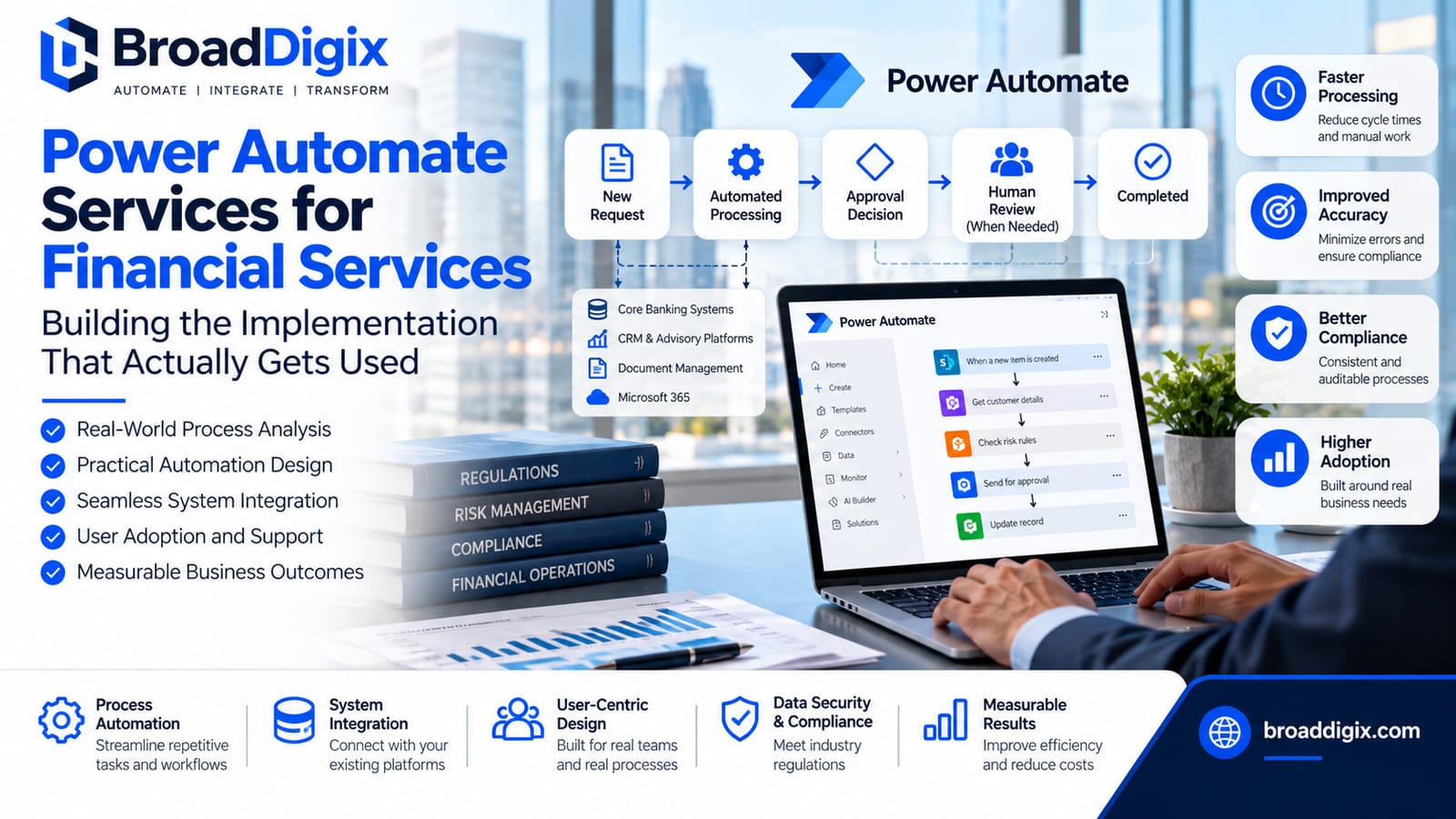
Power Automate Services for Financial Services: Building the Implementation That Actually Gets Used
There is a version of financial services process automation that looks impressive in the demonstration environment, gets approved through the technology governance process, gets implemented by a capable technical team, and then gets used by approximately twenty percent of the staff it was designed for.
The other eighty percent found workarounds. Or continued doing the process manually. Or use the automation for some steps and revert to email for others.
This implementation failure pattern is common enough in enterprise technology deployments that it has its own body of research. The failure is almost never technical. The automation works as designed. The failure is organizational the automation was designed for a process as it should work rather than as it actually works, or the staff whose work it changes were not adequately involved in its design, or the change management that should have accompanied the technical implementation was not given adequate investment.
Power Automate services for financial services implementations that achieve genuine adoption share a set of characteristics that distinguish them from technically successful but organizationally failed implementations.
Starting With the Process as It Actually Exists
The most common technical mistake in financial automation implementations is designing the automation for the idealized process rather than the actual process. The process as documented in the procedure manual and the process as executed by experienced staff in daily operations are frequently different — not because staff are doing something wrong but because the actual process has evolved to handle conditions that the documented process does not capture.
When the automation is designed for the documented process it encounters the undocumented conditions that the experienced staff handle intuitively and fails to handle them appropriately. The result is either exceptions that the automation cannot process and routes to humans constantly, or incorrect handling of conditions the automation was not designed for.
BroadDigix approach to power automate services for financial services engagements starts with process analysis that documents the process as it actually executes — including the exceptions, the informal handling rules, the conditions that experienced staff recognize and manage without articulating them. This actual-process documentation is the basis for the automation design rather than the procedure manual.
Designing the Human Touch Points Explicitly
Good automation design is not about minimizing human involvement. It is about optimizing where human involvement occurs. The power automate services for financial services implementations that work best are the ones where the human touch points are explicitly designed rather than being whatever is left over after the automation handles what it can handle.
The questions worth asking in every financial automation design are specific. Which decisions in this process genuinely require human judgment and which are deterministic applications of defined rules? Which exceptions can be handled by a second-level automation rule and which genuinely require a person? When a person does need to intervene, what information do they need to make the decision efficiently and what tools should the automation provide to support that decision?
The answers produce an automation design where the human involvement is concentrated at the points where it adds the most value where judgment matters, where relationship context matters, where the situation is genuinely complex rather than distributed across the entire process by default.
Change Management as a Project Deliverable
The staff whose work changes when an automation is deployed need to understand what is changing, why, and what their role looks like in the automated environment. Not in a general announcement that automation is being deployed. In specific, honest terms about this process, what the automation will handle, what they will handle, and how the two parts interact
Power automate services for financial services implementations that treat change management as a project deliverable with planned communication, with training appropriate to the changed role, with a feedback mechanism that captures adoption issues early enough to address them achieve adoption rates significantly higher than implementations that treat the technical go-live as the end of the project.
BroadDigix builds change management planning into every power automate services for financial services engagement scope. The technical implementation and the organizational adoption planning proceed together rather than sequentially because adoption success depends on preparation that needs to happen before go-live, not after.