Autonomous AI Agents for Business: The Honest Guide to What They Are, What They Are Not, and How to Get Them Working
Every significant technology category goes through a phase where the gap between what vendors claim it does and what it actually does in real organizational environments is at its widest. That gap is where expectations are set incorrectly, where projects are scoped too ambitiously, and where implementations fail in ways that damage organizational confidence in the technology for years.
Autonomous AI agents for business are currently in that phase. The capability is real and the business value is genuinely significant. But the distance between a compelling demonstration and a reliable production deployment is larger than most vendor presentations acknowledge. Understanding that distance honestly, and knowing how to close it, is what separates organizations that build genuine autonomous agent capability from organizations that have a collection of expensive disappointments.
What the Gap Between Demonstration and Production Looks Like
The demonstration of an autonomous agent handling a business process looks impressive because demonstrations use conditions that are favorable to the agent. The inputs are well formed and representative of the cases the agent handles best. The integrations are set up and verified specifically for the demonstration. The edge cases that would reveal the agent’s limitations are not included.
Production environments are different from demonstrations in every one of these dimensions. Inputs are messier and more varied than demonstration scenarios. Real customers write in unexpected ways. Real documents arrive in formats that were not anticipated during design. Real situations combine elements from different process categories in ways that the agent was not explicitly designed for.
Integrations in production encounter conditions that demonstrations never see. API rate limits under high transaction volume. Authentication token expiry. System maintenance windows. API version changes that break established connections. These conditions require integration engineering that builds reliability through retry logic, error handling, and monitoring rather than simply connecting the agent to the systems it needs and hoping the connections hold.
Organizational resistance in production creates adoption challenges that demonstrations never reveal. Staff whose work changes when an autonomous agent is deployed are not always equally invested in the agent’s success as the stakeholders who approved it. Workarounds that route work around the agent rather than through it, failure to report agent errors that would allow performance improvement, and simple unfamiliarity with how to work effectively alongside the agent all undermine production performance in ways that controlled demonstrations do not surface.
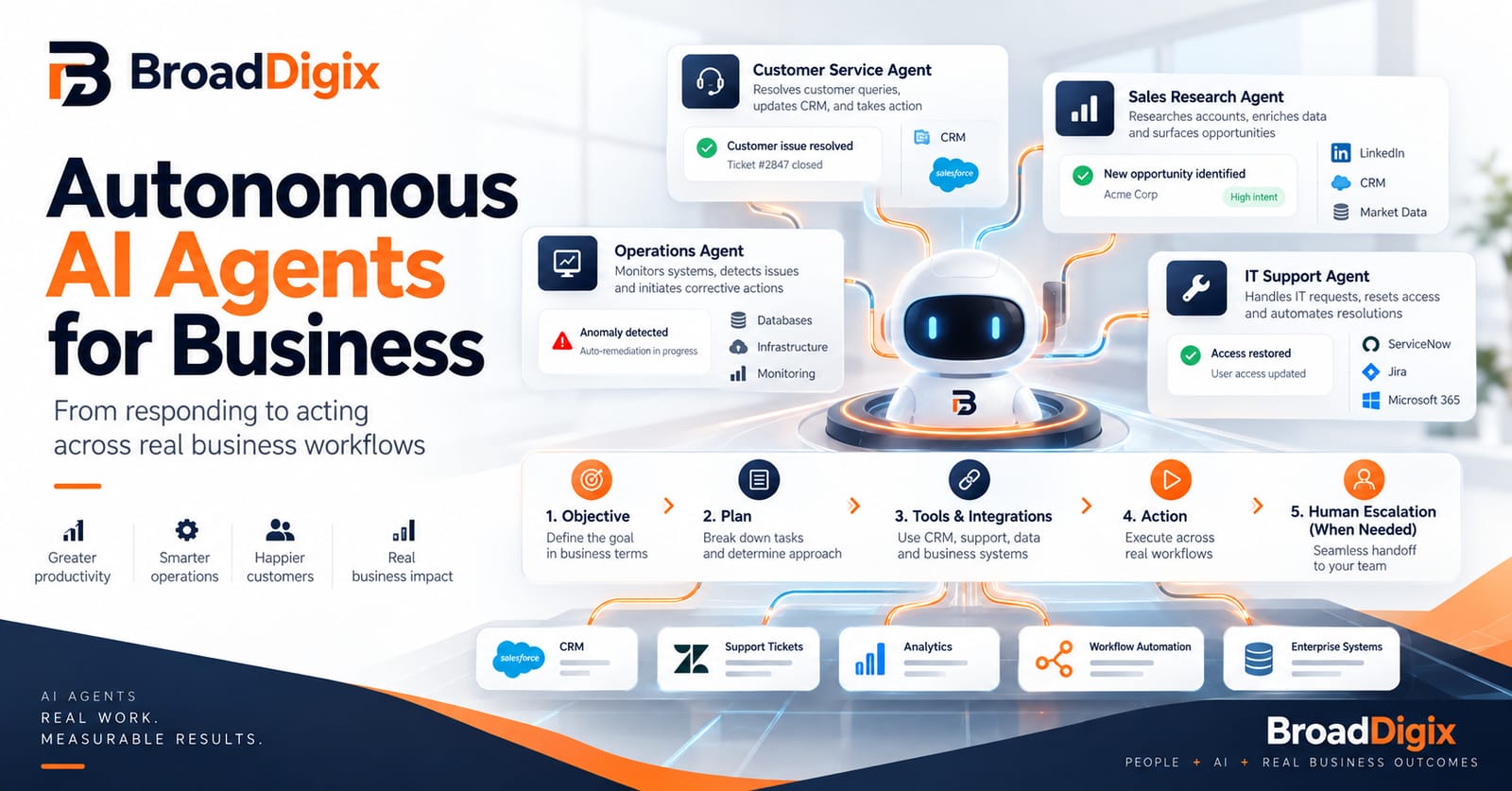
BroadDigix’s approach to autonomous AI agents for business implementation is built around closing this gap through rigorous testing, reliable integration engineering, and change management that prepares the organization for the automated environment before the agent goes live.
The Use Cases That Work Best Right Now
Not every business process benefits equally from autonomous agent deployment at the current state of the technology. The use cases that consistently produce the strongest results in production share specific characteristics that distinguish them from use cases that sound compelling but prove more difficult than anticipated.
The objective is clearly definable. Success can be described specifically enough that the agent can pursue it and a human reviewer can evaluate whether it was achieved. Vague objectives produce vague agent behavior that is difficult to evaluate and difficult to improve.
The information the agent needs is available through accessible, reliable integrations. Agents that depend on information in systems without accessible APIs, or in systems whose APIs are unreliable, are constrained by their information access rather than by their reasoning capability.
The actions the agent needs to take are executable through the available tools. An agent that can reason perfectly about what needs to happen but cannot take the required actions because the necessary tool integrations do not exist or do not work reliably produces no operational value.
The edge cases are identifiable enough to be handled in the agent design. Every process has unusual situations that require different handling from the standard sequence. For autonomous agent deployment to work in production these edge cases need to be identified during design and handled either through agent logic or through escalation to human review, not discovered in production where they produce errors or incorrect outcomes.
Customer inquiry resolution for businesses with well documented policies and integrated systems fits these criteria well. Research and synthesis tasks where the sources are accessible and the output format is defined also fit these criteria well. Internal service requests for routine, well defined request types are strong candidates. Complex judgment tasks with poorly defined success criteria and unpredictable information requirements are not.
Building the Integration Foundation Before Building the Agent
The most common technical mistake in autonomous AI agents for business projects is treating the integration work as a detail to be addressed after the agent reasoning capability is built. This sequencing produces agents whose reasoning is sophisticated but whose real world capability is limited by integrations that were not adequately designed or tested.
BroadDigix inverts this sequencing for every autonomous agent engagement. The integration work is planned and executed before the agent design is finalized. Every system the agent needs to interact with is inventoried. The API capabilities and limitations of each system are assessed. The data quality of each system’s relevant data is evaluated. The authentication and authorization requirements for each integration are documented. The rate limits and reliability characteristics of each API are understood.
This groundwork produces integration designs that are reliable in production because the design accounted for the conditions that production creates. It also defines the realistic capability of the agent before the agent is built, allowing the agent design to work within the actual tool set rather than assuming tool capabilities that the integrations cannot reliably provide.
For BroadDigix engagements involving Microsoft Dynamics, Microsoft 365, SharePoint, and the broader Microsoft ecosystem, the integration foundation reflects deep platform knowledge developed through years of enterprise Dynamics implementation work. Autonomous agents that interact with Dynamics environments benefit from integration design that anticipates Dynamics specific behaviors rather than discovering them in production.
The Testing That Actually Reveals Production Problems
The testing phase that precedes production deployment of autonomous AI agents for business needs to be designed around one principle. Find the problems before production finds them. This requires testing approaches that go significantly beyond the demonstration scenarios that make agents look good.
Functional testing confirms the agent handles standard case types correctly. This is necessary but not sufficient. The agent that handles standard cases correctly and fails on edge cases will encounter those edge cases in production because production contains edge cases regardless of how well the standard process is defined.
Edge case testing runs the agent against inputs that represent unusual cases, boundary conditions, and ambiguous situations that production will inevitably include. These edge cases are identified from thorough process documentation during the requirements phase, specifically from the conversations with experienced staff about the situations that require handling outside the standard sequence.
Adversarial testing attempts to get the agent to behave outside its design parameters. Real production environments include inputs that are formatted to be difficult to parse, requests that combine elements the agent was not designed for, and in some cases deliberate attempts to get the agent to take actions it was designed to refuse. Testing against adversarial inputs before production deployment reduces the vulnerability to these inputs when they appear in real use.
Volume testing runs the agent under transaction volumes that reflect actual production load rather than demonstration volume. Performance issues that are invisible at low volume become apparent under production load and need to be identified and addressed before they affect real operations.
The Change Management That Determines Whether Agents Get Used
Technical performance in testing does not guarantee adoption in production. The autonomous AI agents for business implementations that achieve high adoption rates invest in change management that prepares the staff whose work changes alongside the technical deployment rather than addressing organizational adoption as an afterthought after go-live.
The people whose work is most directly affected by the autonomous agent deployment need to understand what it handles, how it makes decisions, what it routes to them, and how their role changes in the agent assisted environment. This understanding is the foundation for appropriate trust in the agent, neither blind reliance that allows errors to accumulate without being reported nor reflexive distrust that routes work around the agent rather than through it.
Role redesign is often necessary when an autonomous agent handles a significant share of a team’s current workload. The work that remains is different in character from the work that was automated. More exception handling. More quality oversight. More focus on the complex cases that genuinely require human judgment. Redesigning roles explicitly around the agent assisted workflow produces better outcomes for both the organization and the individual staff members than leaving staff to figure out what their changed role looks like through experience.
Performance measurement needs to be realigned when autonomous agents change how work gets done. If staff performance is still measured on metrics that the agent now handles, the performance measurement system creates incentives that work against adoption rather than supporting it. Updating performance metrics to reflect what the human contribution looks like in the agent assisted environment is one of the most important organizational changes that BroadDigix helps clients navigate.
What a Realistic First Year of Autonomous Agent Deployment Looks Like
The first year of a serious autonomous AI agents for business program in an organization that has not deployed autonomous agents before follows a realistic timeline that is worth setting expectations against.
The first three to four months involve requirements definition, process mapping, integration architecture development, and agent design. This phase is slower than many organizations expect because getting the requirements right before any development begins is what determines whether the development produces the right thing.
The next two to three months involve agent development, integration development, and the testing phases described above. The testing phase in particular takes longer than organizations anticipate because thorough testing surfaces issues that require design or integration changes before the testing can conclude successfully.
The deployment and initial monitoring phase takes an additional two to three months as the agent operates in production under close observation, performance issues are identified and addressed, and the organization develops the operational familiarity with the agent that allows oversight to be appropriately calibrated.
By the end of the first year an organization that has followed this process has an autonomous agent in reliable production operation, a team that understands how to work alongside it and improve it, and a documented set of performance results that forms the evidence base for the second autonomous agent deployment.
This is not the transformation narrative that the most optimistic autonomous agent conversations project. It is the honest account of what disciplined implementation produces. And the organization with a reliable production autonomous agent at the end of year one is in a meaningfully better competitive position than the organization that attempted an over ambitious first deployment and has a failed project to explain instead.
BroadDigix’s autonomous AI agents for business practice is built around producing the reliable production outcome, not the impressive demonstration. Every engagement design, testing approach, and change management investment reflects that priority.