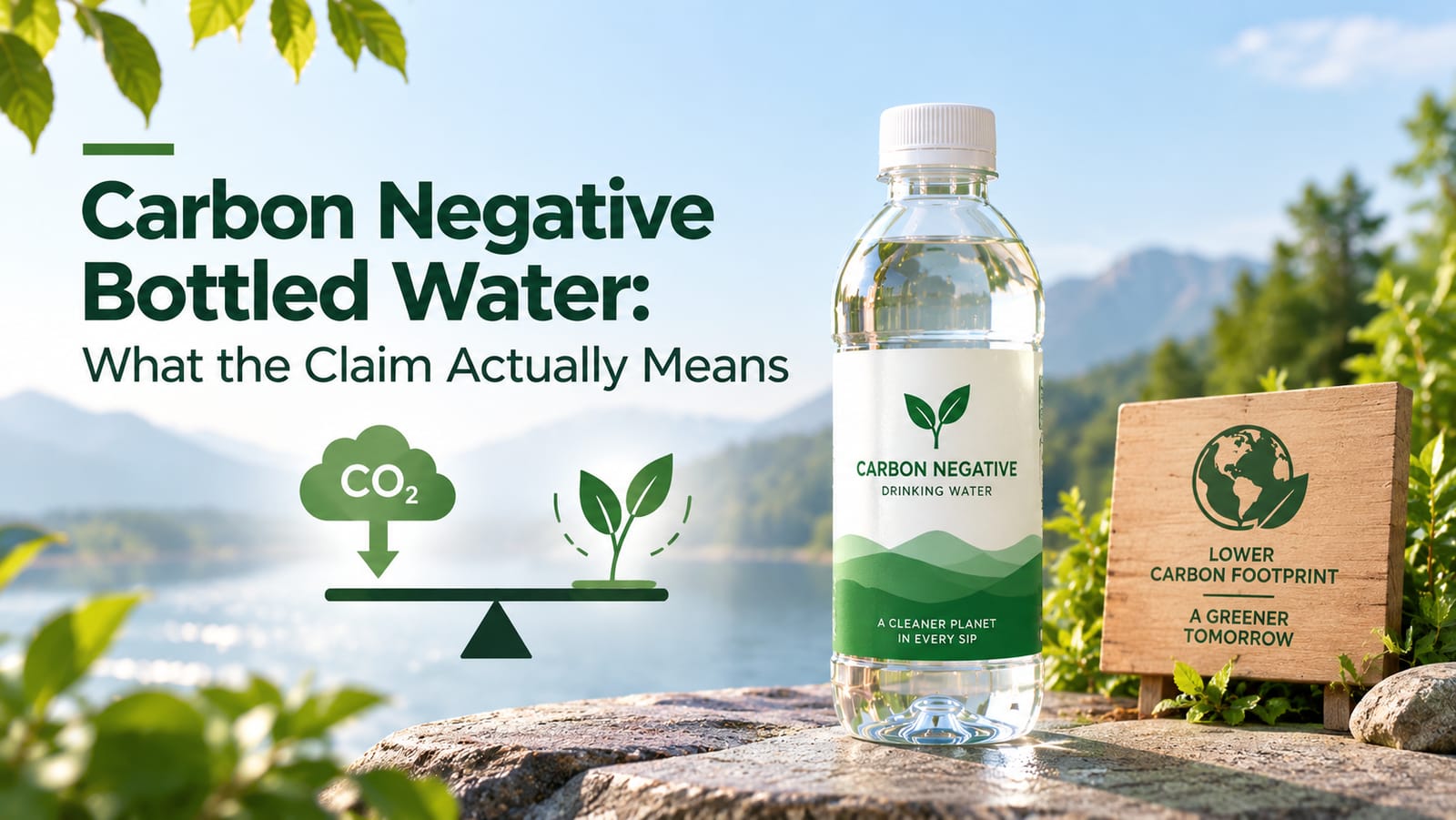
Environmental sustainability is becoming an important consideration in the bottled water industry. As businesses and consumers become more conscious of their environmental impact, terms such as carbon neutral, low carbon and carbon negative are appearing more frequently in discussions about sustainable products.
Among these terms, carbon negative bottled water is particularly interesting because it suggests that a product or its associated activities remove more carbon dioxide from the atmosphere than they generate.
However, what does carbon negative actually mean? Does it refer to the water itself, the bottle, transportation or the entire production process? And how can businesses determine whether such a claim is supported by credible evidence?
Understanding these questions is essential before accepting environmental claims or choosing bottled water products based on their sustainability positioning.
1. What Does Carbon Negative Bottled Water Mean?
Carbon negative bottled water refers to a product or production system that achieves a net removal of greenhouse gas emissions from the atmosphere beyond the emissions associated with its defined lifecycle.
In simple terms, the objective is not just to reduce the carbon footprint but to go further by removing more greenhouse gases than the product generates.
Producing bottled water involves several activities that contribute to its carbon footprint, including:
Sourcing and treating water.
Manufacturing bottles and packaging materials.
Operating production facilities.
Transportation and distribution.
Storage and refrigeration.
Waste collection and end-of-life processing.
Each stage can generate greenhouse gas emissions.
For a bottled water product to credibly qualify as carbon negative, its total emissions must be assessed using a clearly defined lifecycle boundary. Any claimed carbon removals must be additional, measurable and supported by reliable verification.
Simply using alternative packaging or supporting tree-planting activities does not automatically make a bottled water product carbon negative.
2. Carbon Negative vs Carbon Neutral vs Low Carbon
These three terms are often used in sustainability marketing, but they describe different environmental outcomes.
Low Carbon
A low-carbon product is designed to generate fewer greenhouse gas emissions compared with a relevant alternative or baseline.
For example, a bottled water company might reduce its emissions by improving manufacturing efficiency, using renewable electricity or optimising transportation routes.
However, a low-carbon product can still generate greenhouse gas emissions throughout its lifecycle.
Carbon Neutral
Carbon neutrality generally means balancing the greenhouse gas emissions within a defined boundary through a combination of emissions reductions and eligible carbon credits or removals.
The objective is to achieve a net balance of zero emissions within the stated accounting framework.
Businesses making carbon-neutral claims should explain which emissions are included and how the remaining emissions are addressed.
Carbon Negative
Carbon negative goes beyond carbon neutrality.
A genuinely carbon-negative product or system must achieve net negative emissions, meaning that verified carbon removals exceed the greenhouse gas emissions generated within the defined boundary.
For bottled water businesses, this requires more than reducing packaging emissions or purchasing carbon credits. The complete claim must be supported by credible carbon accounting and evidence of actual removals.
3. Where Do Carbon Emissions Come From in the Bottled Water Industry?
To understand carbon negative bottled water, it is important to examine the different sources of emissions associated with packaged drinking water.
Bottle and Packaging Production
Packaging is one of the important factors in the environmental footprint of bottled water.
Conventional PET bottles are generally manufactured using petroleum-derived materials. Their production involves raw material extraction, processing, manufacturing energy and transportation.
Alternative materials, including plant-based bioplastics such as PLA, offer different sourcing possibilities. However, their environmental performance must also be assessed across manufacturing, transportation and disposal.
Choosing a plant-based material does not automatically make the complete product carbon negative.
Water Processing and Bottling
Water treatment, filtration, purification, bottling equipment and facility operations all require energy.
The source of electricity used in these operations can influence the overall carbon footprint. Facilities relying on renewable electricity may have lower operational emissions than facilities using more carbon-intensive energy sources.
Transportation and Distribution
Packaged drinking water is distributed through supply chains involving manufacturers, warehouses, distributors, retailers and end customers.
Transportation emissions depend on several factors, including distance, vehicle efficiency, fuel type, shipment size and distribution planning.
For businesses ordering bottled water in bulk, efficient logistics and consolidated deliveries can help reduce emissions per unit.
Refrigeration and Storage
Some bottled water products are refrigerated before being served or sold. Refrigeration equipment consumes electricity, which can contribute to the product's overall carbon footprint.
Storage conditions, equipment efficiency and energy sources should therefore be considered when assessing the complete environmental impact.
End-of-Life Management
What happens after a bottle is used also matters.
Different packaging materials require different waste-management approaches. PET can enter established recycling streams when collected and processed properly, while PLA generally requires suitable industrial composting conditions for effective composting.
The availability of collection, recycling and composting infrastructure can significantly influence the actual environmental outcome.
4. How Can Bottled Water Become Carbon Negative?
Achieving a credible carbon-negative position requires a structured approach to emissions measurement, reduction and carbon removal.
Businesses cannot rely on a single sustainability initiative to establish this outcome.
Measure the Complete Carbon Footprint
The first step is to calculate greenhouse gas emissions across the relevant product lifecycle.
This assessment may include raw material sourcing, packaging production, manufacturing, transportation, storage and disposal.
A lifecycle assessment helps businesses identify where the largest emissions occur and which activities require improvement.
The methodology, assumptions and system boundaries should be clearly documented.
Reduce Emissions at the Source
Before considering carbon offsets or removal projects, businesses should focus on reducing emissions generated by their operations.
Practical measures include:
Improving manufacturing energy efficiency.
Using renewable electricity where feasible.
Optimising transportation routes.
Reducing unnecessary packaging.
Improving material efficiency.
Consolidating bulk deliveries.
Working with suppliers that follow measurable environmental practices.
Reducing emissions directly is an important part of building a credible sustainability strategy.
Support Verified Carbon Removal Projects
After reducing avoidable emissions, businesses may support credible carbon removal projects to address remaining emissions and potentially achieve net-negative outcomes.
Examples include verified reforestation, ecosystem restoration and other recognised carbon removal approaches.
However, not every environmental contribution qualifies as a carbon removal. Businesses must evaluate whether a project demonstrates additionality, permanence, accurate measurement and independent verification.
Maintain Transparent Documentation
A carbon-negative claim should be supported by accessible evidence.
Businesses should be able to explain how emissions were calculated, which activities were included, how carbon removals were measured and what verification procedures were followed.
Without this information, consumers and procurement teams cannot independently evaluate the credibility of the claim.
5. Does Plant-Based Packaging Make Bottled Water Carbon Negative?
Plant-based packaging is increasingly discussed as an alternative to conventional petroleum-derived plastic.
Materials such as PLA (Polylactic Acid) are generally produced using renewable biological feedstocks, including corn starch and sugarcane-derived sugars.
This offers a different approach to sourcing packaging materials and can help reduce dependence on fossil-based resources.
However, there is an important distinction between renewable material sourcing and carbon-negative production.
A PLA bottle still requires agricultural inputs, material processing, manufacturing energy and transportation. Its end-of-life treatment also influences its environmental performance.
Therefore, businesses should avoid assuming that plant-based packaging automatically results in a carbon-negative product.
Instead, it is more accurate to evaluate packaging as one part of a broader environmental strategy that includes material sourcing, manufacturing efficiency, logistics and waste management.
6. How Can Businesses Verify Carbon Negative Claims?
For hotels, restaurants, corporate buyers and distributors, evaluating environmental claims is becoming an important part of procurement decisions.
Before selecting a bottled water supplier based on carbon-negative positioning, businesses should examine the evidence behind the claim.
Request a Carbon Footprint Assessment
Ask the supplier whether a product-level or lifecycle carbon footprint assessment is available.
The assessment should explain the emissions included, the methodology used and the boundaries of the calculation.
Understand the Carbon Removal Method
Find out whether the business supports tree planting, ecosystem restoration or other carbon removal projects.
More importantly, ask how the carbon benefits are calculated and whether the projects are independently verified.
Check Additionality and Permanence
Additionality means that the claimed carbon removal would not have occurred without the project intervention.
Permanence concerns how long the removed carbon is expected to remain stored.
These factors matter because not every tree-planting or environmental contribution produces the same long-term carbon benefit.
Look for Independent Verification
Third-party verification can improve confidence in environmental claims.
Businesses should look for credible documentation, recognised accounting methodologies and independent assessments rather than relying exclusively on marketing statements.
Evaluate the Complete Product Lifecycle
A supplier may highlight a plant-based bottle or a tree-planting initiative while overlooking emissions from production, transportation and disposal.
A comprehensive evaluation should consider the complete product lifecycle within the stated assessment boundary.
For a more detailed approach, businesses can refer to this guide on how to verify environmental claims about bottled water packaging.
7. Why Transparency Matters in Sustainable Bottled Water
Environmental claims influence how consumers perceive brands and how businesses evaluate suppliers.
However, unsupported sustainability statements can damage brand credibility.
This is particularly important in the bottled water industry, where terms such as biodegradable, compostable, plant-based and carbon negative are sometimes used without explaining their actual meaning.
A responsible brand should communicate its environmental initiatives clearly and distinguish between measurable achievements, ongoing projects and future sustainability objectives.
For example, if a business supports tree-planting initiatives, it should explain the nature of its contribution, how the trees are tracked and whether the associated carbon benefits have been independently quantified.
Similarly, if a company uses plant-based packaging, it should communicate the material's properties and appropriate disposal requirements rather than making broad claims about environmental benefits.
Transparency allows customers, distributors and procurement teams to make decisions based on evidence instead of promotional language.
8. The Role of Verified Tree Planting in Environmental Initiatives
Tree planting and ecosystem restoration can contribute to climate mitigation by removing carbon dioxide from the atmosphere as trees grow.
However, the environmental value of a tree-planting initiative depends on more than the number of trees planted.
Factors such as species selection, local ecosystem suitability, survival rates, maintenance, land-use conditions and long-term monitoring all influence the outcome.
Businesses supporting these initiatives should look for traceable records and credible verification processes.
It is also important to distinguish between contributing to tree planting and claiming a quantified carbon removal benefit. The latter requires additional measurement and accounting evidence.
Understanding how verified tree planting works, from contribution to verification can help businesses evaluate environmental initiatives more carefully.
9. What Should Businesses Look for When Choosing Sustainable Bottled Water?
Businesses that want to align their purchasing decisions with sustainability objectives should consider several factors beyond packaging appearance or environmental messaging.
Material sourcing: Understand whether the packaging uses conventional fossil-based materials or renewable alternatives, and request supporting material information.
Product quality: Ensure that the drinking water meets applicable quality, safety and regulatory requirements.
Carbon accounting: Ask whether the supplier has measured its emissions and whether any carbon-related claims are supported by documented assessments.
Environmental initiatives: Evaluate whether the company supports measurable sustainability programmes and provides transparent information about their progress.
Supply chain efficiency: Consider transportation distances, bulk delivery arrangements and operational practices that can influence the product's overall footprint.
End-of-life management: Understand whether the packaging is recyclable, compostable or requires specific disposal conditions.
These considerations help businesses make more informed purchasing decisions while avoiding unsupported environmental claims.
Conclusion
Carbon negative bottled water is a sustainability concept that requires more than alternative packaging or environmental contributions. It involves measuring greenhouse gas emissions, reducing avoidable impacts and demonstrating verified carbon removals that exceed the remaining emissions within a clearly defined boundary.
Plant-based packaging, renewable energy, efficient logistics and verified environmental initiatives can all contribute to a broader sustainability strategy. However, none of these measures independently establishes that a bottled water product is carbon negative.
For businesses and consumers, the most important step is to look beyond environmental labels and understand the evidence behind them.
A credible sustainability approach is built on measurable action, transparent reporting and responsible environmental practices. When choosing bottled water, businesses should prioritise suppliers that communicate their initiatives honestly and provide clear information about the materials, operations and environmental programmes behind their products.