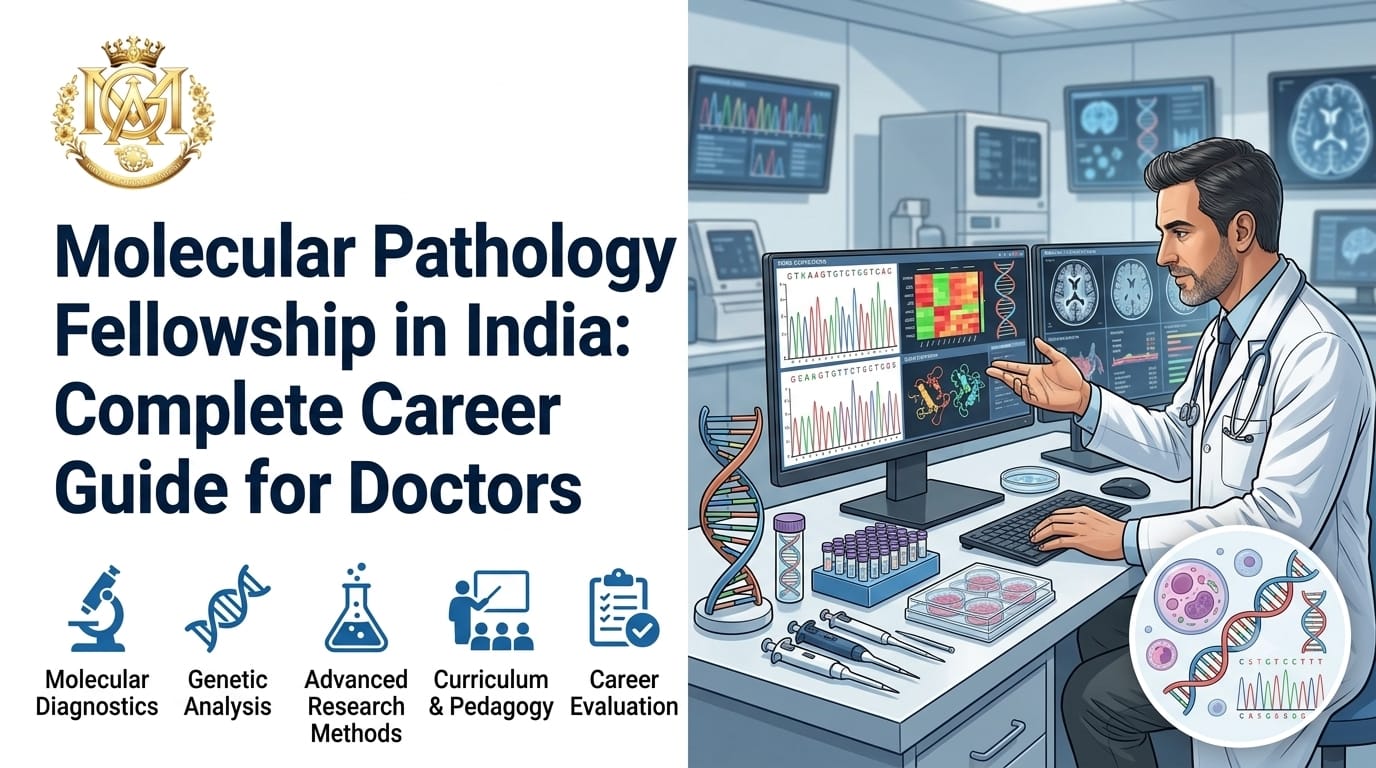
Modern diagnostic laboratories are generating increasingly detailed information about the molecular characteristics of diseases. Advances in DNA sequencing, gene expression analysis, and computational tools have expanded the ability to investigate biological changes that may not be apparent through conventional diagnostic methods alone. However, collecting molecular data is only one part of the diagnostic process. Understanding its significance requires scientific knowledge, careful interpretation, and an appreciation of clinical context.
This is particularly important when molecular investigations produce multiple findings, including genetic variants whose significance is uncertain or depends on the disease being examined. Doctors and laboratory professionals must distinguish meaningful results from findings that have limited or unclear clinical relevance.
A Molecular Pathology Fellowship in India is one educational option doctors may explore when developing their understanding of modern molecular diagnostics. Learning how molecular information is generated, analysed, and interpreted can help medical professionals better understand the relationship between laboratory science and clinical practice.
Why Genomic Information Is Becoming Important in Diagnostics
The human genome contains information that influences biological processes, inherited characteristics, and susceptibility to certain diseases. Changes in genetic material may contribute to disease development or help explain differences between disease subtypes.
Molecular pathology investigates such changes and their potential diagnostic relevance. Depending on the clinical question, testing may focus on a specific genetic alteration or examine multiple regions of DNA or RNA.
For example, targeted molecular testing may investigate a known mutation associated with a particular tumour. Broader sequencing approaches may examine several genes when the clinical question requires a wider assessment.
The choice of method depends on the suspected condition, specimen availability, laboratory capabilities, and the evidence supporting the test.
Understanding these differences is an important part of molecular pathology training in India, especially for doctors who want to develop a stronger foundation in contemporary diagnostic technologies.
From Genetic Data to Clinically Meaningful Information
A molecular test can generate a large amount of information, but not every detected alteration has the same significance. Interpretation involves evaluating the finding in relation to established scientific evidence and the purpose of the investigation.
A simplified interpretation process includes several stages.
1. Identifying molecular alterations
The laboratory first identifies changes detected by the selected assay. These may include substitutions in DNA sequences, insertions, deletions, or other alterations, depending on the technology used.
2. Assessing technical reliability
Before a finding is interpreted clinically, the laboratory must consider whether the result meets relevant quality criteria. Factors such as sequencing coverage, specimen quality, contamination, and assay limitations may affect confidence in a result.
3. Reviewing available evidence
The significance of a genetic alteration may be assessed using established classification frameworks, validated databases, relevant research, and disease-specific evidence. Interpretation must account for the clinical setting rather than relying on a single source of information.
4. Establishing clinical relevance
Some alterations have well-established diagnostic or therapeutic implications. Others may have uncertain significance or may be relevant only in particular disease contexts.
5. Communicating the result
The final report should present the findings clearly, describe relevant limitations, and avoid suggesting conclusions that the available evidence does not support.
A structured molecular diagnostics fellowship may help doctors understand these stages and appreciate why molecular interpretation requires more than identifying a genetic change.
The Role of Bioinformatics in Molecular Pathology
Bioinformatics involves the use of computational methods to organise, process, and analyse biological information. It has become increasingly important as molecular tests generate larger and more complex datasets.
In sequencing-based diagnostics, computational workflows may help align sequence reads, identify potential variants, filter findings, and prepare information for further review. The exact workflow depends on the technology, laboratory protocols, and intended clinical application.
Bioinformatics does not independently establish the clinical meaning of every finding. Computational output must be evaluated alongside technical quality, scientific evidence, and the clinical question.
Doctors do not necessarily need to become specialist bioinformaticians to understand molecular diagnostics. However, familiarity with the basic principles can help them recognise what an analysis can establish, where uncertainty remains, and when additional expertise is required.
For professionals exploring molecular pathology techniques, this connection between laboratory testing and computational analysis is an increasingly relevant area of study.
Understanding Genetic Variants and Their Significance
One of the most challenging aspects of molecular diagnostics is determining what a detected variant means.
A genetic variant may be classified differently depending on the condition being investigated and the available evidence. In clinical genetics, recognised frameworks distinguish categories such as pathogenic, likely pathogenic, uncertain significance, likely benign, and benign.
These categories are not interchangeable.
A pathogenic variant may provide important evidence for a diagnosis in the appropriate setting. A variant of uncertain significance, however, does not establish that a person has a genetic disorder. Its interpretation may change as additional evidence becomes available.
In oncology, the relevance of a molecular alteration may also depend on the tumour type, the biological mechanism involved, and the evidence supporting its use as a diagnostic, prognostic, or predictive biomarker.
This is why molecular reports should be interpreted carefully. A result should not be used to recommend a treatment or make a major clinical decision without considering the relevant evidence and applicable guidelines.
For doctors interested in precision medicine in pathology, understanding the distinction between detecting a variant and establishing its clinical significance is fundamental.
Integrating Molecular Results With Conventional Pathology
Molecular testing is most informative when interpreted as part of a broader diagnostic assessment.
Conventional pathology provides information about tissue structure, cellular characteristics, and disease morphology. Immunohistochemistry can help identify proteins associated with particular cell types or disease processes. Molecular investigations may then provide additional evidence about the biological characteristics of the sample.
These methods answer different questions and may complement one another.
For example, a tumour's microscopic appearance may suggest a particular diagnostic category, while molecular findings may support classification or help distinguish between closely related entities. In other cases, a molecular result may need to be reviewed because it does not fit the morphological or clinical findings.
Such discrepancies should prompt appropriate evaluation rather than automatic acceptance of one result over another.
A multidisciplinary approach involving pathologists, laboratory specialists, and treating clinicians can help ensure that findings are interpreted consistently and responsibly.
Common Challenges in Interpreting Complex Molecular Results
Even technically advanced investigations can produce results that require careful assessment. Several challenges are particularly relevant to molecular diagnostics.
Insufficient specimen quality: Degraded DNA or RNA, low tumour content, or unsuitable sample handling may affect test performance.
Incomplete coverage: A particular assay may not detect every possible alteration associated with a disease. A negative result must therefore be interpreted in light of the test's capabilities.
Conflicting evidence: Different studies may provide varying levels of support for the clinical significance of a genetic finding. Evidence must be assessed carefully.
Incidental findings: Broader testing may identify alterations unrelated to the original diagnostic question. Depending on the context, these findings may require additional evaluation and appropriate communication.
Rapidly evolving knowledge: New research can change how certain variants or biomarkers are interpreted. Laboratories must use appropriate, up-to-date evidence and validated procedures.
Understanding these limitations helps doctors avoid overinterpreting molecular data and supports more reliable diagnostic reasoning.
How Structured Training Can Support Professional Development
Doctors interested in molecular diagnostics may benefit from learning that connects molecular biology with practical diagnostic questions.
Depending on the curriculum, structured education in this area may cover:
Fundamentals of DNA, RNA, genes, and genetic variation.
Principles of PCR and sequencing-based methods.
Molecular testing in oncology and other disease areas.
Specimen selection and laboratory quality assurance.
Basic concepts of genomic data analysis.
Interpretation of molecular reports and genetic variants.
Clinical applications and limitations of precision medicine.
The Molecular Pathology Fellowship in India offered by Medical Global Academy is one programme prospective learners can review to understand its stated curriculum and learning format.
Official course page: Molecular Pathology Fellowship.
Before enrolling, doctors should verify the current eligibility requirements, duration, fees, curriculum, assessment methods, accreditation details, and availability of practical or supervised training. They should also determine whether the programme aligns with their existing qualifications and career objectives.
A fellowship can provide an educational pathway, but it should not be assumed to confer specialist recognition, guarantee employment, or authorise independent practice beyond the learner's existing professional permissions.
Molecular Pathology Career Opportunities
Molecular diagnostics intersects with several areas of medicine, laboratory science, and research. Depending on their prior training and applicable professional requirements, doctors may explore opportunities related to diagnostic pathology, molecular laboratory services, academic medicine, translational research, or laboratory quality management.
Professionals interested in research may focus on understanding disease mechanisms and evaluating potential biomarkers. Doctors working in diagnostic settings may seek to strengthen their understanding of molecular test selection and report interpretation. Others may contribute to multidisciplinary discussions in which genomic findings inform diagnostic classification or treatment planning.
These areas help explain the interest in molecular pathology career opportunities as diagnostic technologies continue to develop.
However, career progression depends on more than completing a course. Existing specialist qualifications, practical experience, local regulations, institutional requirements, and available positions all influence professional opportunities.
Doctors should therefore evaluate additional training in relation to a realistic career plan rather than assuming that a qualification alone will lead to a particular role.
The Future of Genomic Interpretation in Medicine
As molecular testing advances, diagnostic laboratories are likely to continue generating increasingly complex biological information. Improved sequencing technologies and analytical methods may expand the range of alterations that can be investigated.
At the same time, greater amounts of data create a need for reliable interpretation systems, appropriate quality controls, and clear communication of uncertainty.
Computational tools may help organise evidence and prioritise findings for review, but their output must be evaluated using validated methods and professional judgement. Clinical decisions should continue to rely on appropriate evidence, established standards, and the individual patient's circumstances.
The future of molecular pathology will therefore depend not only on technological innovation but also on the ability of medical professionals to interpret results responsibly.
Conclusion
Genomic data is becoming an important component of modern diagnostic medicine. Its clinical value depends on reliable testing, accurate analysis, careful interpretation, and integration with conventional pathological and clinical findings.
For doctors who want to understand these developments, a Molecular Pathology Fellowship in India may be one educational option to consider. Reviewing the programme's curriculum, learning methods, and practical components can help prospective learners decide whether it suits their professional goals.
Ultimately, molecular diagnostics is not simply about identifying genetic alterations. It is about understanding which findings are meaningful, recognising uncertainty, and using reliable evidence to support appropriate clinical decisions.
Frequently Asked Questions
1. What is genomic data in molecular pathology?
Genomic data refers to information obtained by analysing DNA or, in some diagnostic contexts, related molecular material. It can help identify genetic alterations associated with diseases or their classification.
2. What is the role of bioinformatics in molecular diagnostics?
Bioinformatics uses computational methods to process and analyse biological data. In sequencing workflows, it can help identify potential variants and organise findings for further technical and clinical review.
3. Does every genetic variant indicate a disease?
No. Some variants are associated with disease, some are benign, and others have uncertain significance. Their interpretation depends on the available evidence and clinical context.
4. How does molecular pathology support precision medicine?
Molecular findings can help classify diseases and identify biomarkers relevant to treatment selection in appropriate settings. Their use depends on validated evidence and the patient's overall clinical circumstances.
5. What should doctors consider before enrolling in a molecular pathology fellowship?
Doctors should review the curriculum, eligibility criteria, practical training, assessment methods, fees, accreditation information, and relevance to their professional goals.