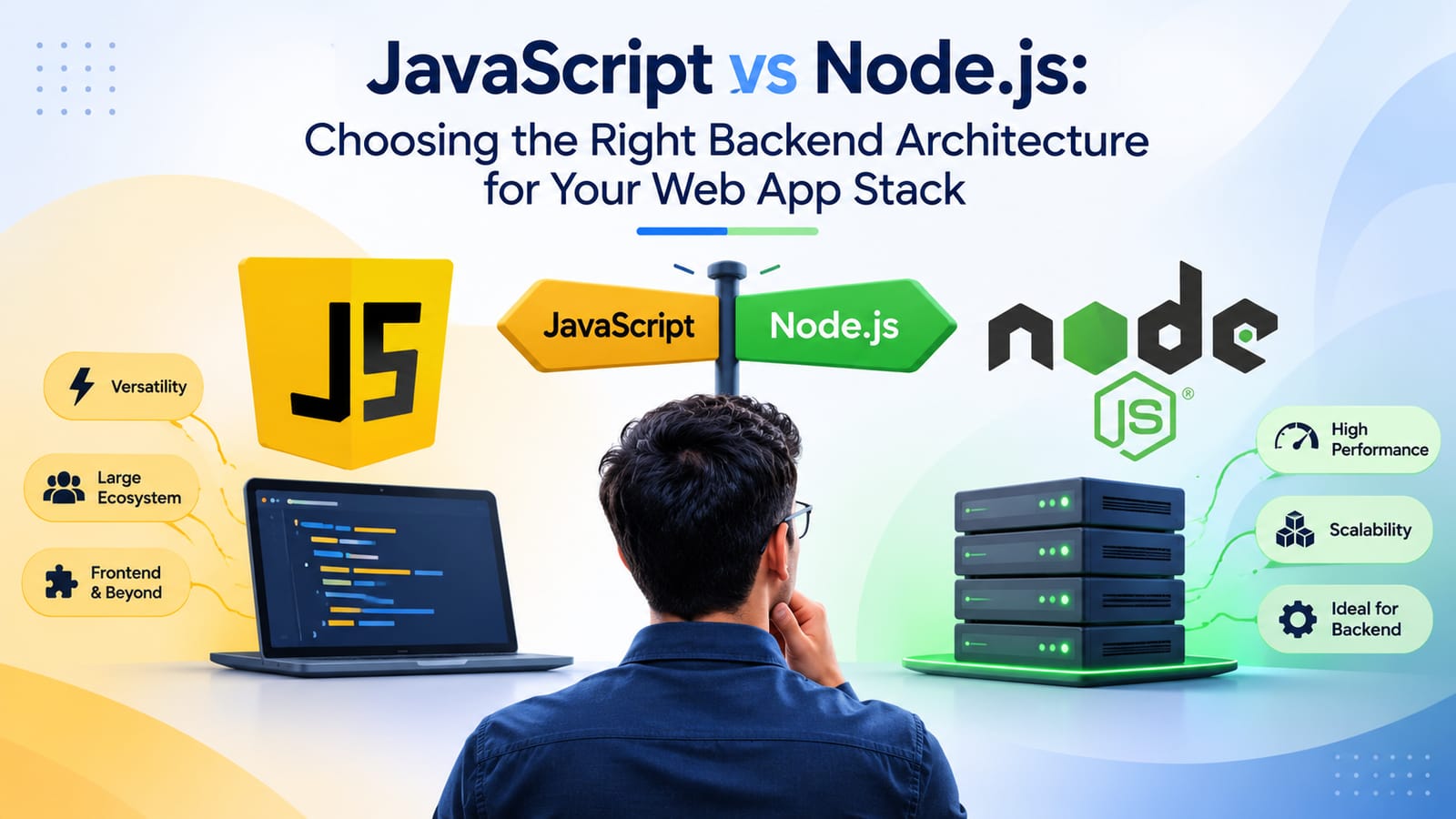
When an application scales from initial launch to high enterprise transaction volumes, teams often run into rising API response times, resource contention, and growing maintenance costs. Frequently, the root cause is not poor code quality—it is a mismatch between the application’s workload and its underlying runtime architecture. This is where understanding the distinction between JavaScript vs Node.js becomes critical for technology leaders, engineering managers, and architects.
A common misconception is treating JavaScript and Node.js as competing technologies. In reality, they serve completely different roles in modern software engineering. JavaScript is a high-level programming language standardized through ECMAScript, traditionally executed inside web browsers to power interactive frontends. Node.js, on the other hand, is an open-source runtime environment built on Google’s V8 engine that allows JavaScript to execute outside the browser on backend servers. Together, they enable teams to use a unified language across the entire stack.
However, choosing Node.js for your backend should be driven by workload characteristics rather than language popularity alone. Because Node.js operates on an event-driven, asynchronous, non-blocking I/O model, it excels at handling high-concurrency, network-intensive workloads—such as API gateways, real-time collaboration tools, streaming platforms, and microservices that spend significant time waiting on databases or third-party integrations.
Conversely, because JavaScript executes on a single main thread via the event loop, heavy CPU-bound computations can block request processing and increase latency if not properly isolated using worker threads or background queues. For compute-heavy pipelines or organizations deeply invested in legacy ecosystems, alternatives like Java with Spring Boot, Python with FastAPI, C# with ASP.NET Core, or Go may offer a stronger architectural fit. Ultimately, selecting the right backend stack requires evaluating total cost of ownership, dependency governance, scalability needs, and existing engineering capabilities.
This is where the distinction between JavaScript and Node.js becomes important. JavaScript is a programming language, while Node.js is a runtime environment that allows JavaScript to execute outside the browser, including on backend servers. Whether you are planning new JavaScript development or evaluating a server-side runtime, the two are not competing technologies.
For technology leaders, engineering managers, and enterprise architects, the right decision requires evaluating the demands of the application alongside the organization's existing skills, infrastructure, delivery model, and long-term modernization strategy. Node.js can be an effective choice for API-driven platforms, real-time applications, and services that handle substantial concurrent I/O, while Java with Spring Boot, Python with FastAPI or Django, C# and Go may be better suited to specific workloads or enterprise environments.
The objective is not to select the most popular technology but to establish a backend architecture that meets current business requirements without introducing avoidable constraints as the application scales.