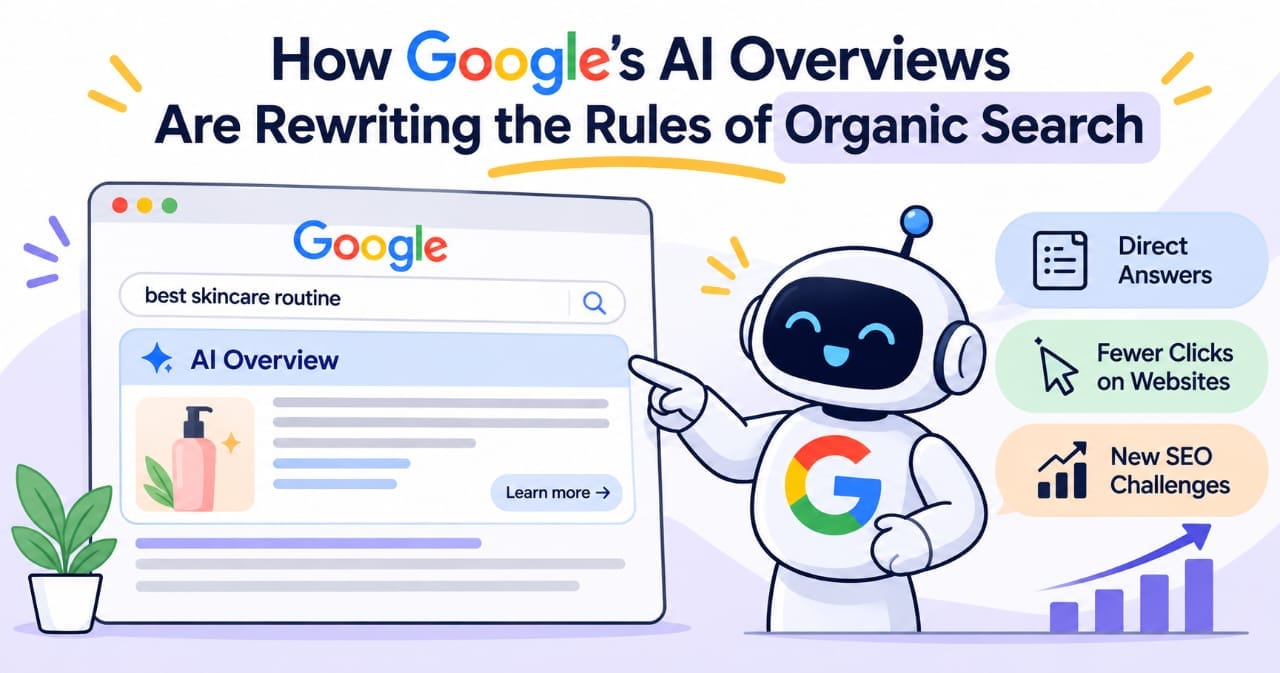
A website can rank on Google's first page and still lose the opportunity to attract a visitor. The reason? Google might have already answered the user's question before they reach the traditional search results.
This is exactly what is happening with Google AI Overviews.
Instead of displaying only a list of websites, Google now uses artificial intelligence to generate summaries that answer certain search queries directly on the results page. These summaries bring together information from multiple sources and provide links for users who want to explore further.
For businesses that depend on organic search, this changes an important part of the equation. Ranking matters, but getting discovered, being recognised as a reliable source, and earning the right kind of clicks matter just as much.
The shift does not mean traditional SEO is becoming irrelevant. It means businesses need to understand how search visibility is evolving and adjust their strategies accordingly.
Let's look at what Google AI Overviews are changing and what businesses should do about it.
1. Ranking on the First Page Is No Longer the Entire Goal
For years, SEO had a relatively straightforward objective: identify relevant keywords, optimise website pages, build authority, and improve rankings.
A business appearing among the top organic results had a better chance of attracting clicks.
AI Overviews have introduced another layer to this process.
When Google displays an AI-generated summary, users may find an answer without opening any website. This is particularly relevant for informational searches such as:
What is performance marketing?
How does cloud computing work?
What are the benefits of CRM software?
How do businesses reduce customer acquisition costs?
For these searches, the user may get enough information from the overview itself.
This means businesses cannot evaluate SEO performance through rankings and traffic alone. They also need to consider how their brand appears across search experiences and whether their content is being referenced as a supporting source.
The real objective is shifting from simply appearing in search results to becoming a credible part of the information users discover.
2. Search Intent Is Becoming More Important Than Individual Keywords
AI Overviews are particularly useful for questions that require explanations, comparisons, and information from multiple sources.
This changes how businesses should approach keyword research.
Consider someone searching for "best CRM software for small businesses". They may not be looking for a basic definition of CRM. They probably want to compare features, understand pricing, evaluate integrations, and identify which solution suits their business.
Optimising a page simply around the phrase "CRM software" may not address all these requirements.
A stronger content strategy considers the complete decision-making process.
For example:
What problem does the customer want to solve?
What alternatives are they comparing?
What information do they need before making a decision?
What concerns might prevent them from purchasing?
Which questions are likely to arise during evaluation?
This is particularly important for businesses with longer sales cycles.
A B2B SEO agency in Mumbai should understand that a business buyer rarely decides after reading one short article. They may explore service pages, technical guides, comparison articles, case studies, and industry insights before contacting a provider.
Your content needs to support that entire journey, not target isolated keywords.
3. Generic Content Is Losing Its Competitive Advantage
Here is where things get interesting.
If ten websites publish almost identical articles explaining the same basic concept, what makes one of them worth visiting?
AI-generated summaries can already provide users with general explanations. Publishing another article that repeats commonly available information does little to give readers a reason to choose your website.
Businesses need to offer something more valuable.
That could include:
Original research and industry observations.
First-hand project experiences.
Expert opinions supported by practical examples.
Detailed case studies.
Unique comparisons and evaluations.
Data-backed insights relevant to a specific industry.
For instance, a software development company writing about enterprise automation could explain the real challenges of integrating legacy systems, managing implementation costs, or improving operational efficiency.
That is more useful than simply defining automation and listing its benefits.
Google's guidance for AI search experiences also emphasises unique, helpful, reliable content rather than generic material created primarily to attract search traffic.
The takeaway is simple: content should offer a reason to read beyond what an AI-generated summary can provide.
4. Technical SEO Still Determines Whether Your Content Can Be Discovered
A common misconception is that AI search requires an entirely new set of technical SEO practices.
Google's guidance makes an important distinction. Existing SEO fundamentals continue to apply to AI Overviews and AI Mode. No additional technical requirements or special AI-specific schema markups are needed to become eligible for supporting links.
However, that doesn't make technical optimisation any less important.
Your website still needs to be:
Crawlable: Search engines should be able to access important pages without unnecessary restrictions.
Indexable: Valuable content should be eligible for inclusion in Google's search index.
Well-structured: Clear headings, logical navigation, and relevant internal links help search engines understand how information is organised.
Mobile-friendly: Visitors should be able to access and navigate your website comfortably across devices.
Technically consistent: Implement canonical tags, structured data, page speed, and XML sitemaps correctly.
Structured data can help search engines understand specific information, but it must accurately reflect the visible content on the page.
Businesses should avoid chasing shortcuts such as adding unnecessary AI-specific markup or creating large volumes of automated pages. Strong technical foundations and useful content remain the priority.
5. Local Search Visibility Is Becoming More Contextual
AI-powered search is also changing how people discover nearby businesses and services.
Consider someone searching for "best digital marketing agency near me". Their expectations may go beyond finding a list of agencies.
They may want to know which businesses offer SEO, which specialise in paid campaigns, which industries they serve, and which have relevant experience.
This makes local relevance and business information increasingly important.
For companies targeting customers in Mumbai, local SEO should involve more than adding the city name to website headings.
A meaningful local strategy includes:
Optimised service pages with genuine location relevance.
Accurate Google Business Profile information.
Consistent business contact details.
Genuine customer reviews.
Relevant local references and mentions.
Useful content addressing location-specific customer requirements.
For example, businesses investing in local SEO services in Mumbai should ensure their website communicates what they offer, who they serve, and why their services matter to the local market.
AI-generated answers do not replace local SEO. They make accurate business information and genuine local relevance even more valuable.
6. B2B Businesses Need to Build Authority Beyond Service Pages
B2B buying decisions involve research, evaluation, and trust.
A company looking for enterprise software development or cybersecurity consulting may spend weeks comparing service providers before making contact.
AI Overviews can influence this research stage by providing quick explanations and highlighting relevant sources.
This creates an opportunity for B2B companies to establish expertise much earlier in the buying journey.
Instead of relying entirely on service pages, businesses should build content around the questions their prospective customers actually ask.
For example, an enterprise technology company could publish:
Industry-specific implementation guides.
Detailed service comparisons.
Technical explanations.
Project case studies.
Common implementation challenges.
Expert insights into emerging technologies.
Each piece should contribute to a broader understanding of the company's expertise.
A B2B SEO agency in Mumbai should therefore focus on building topical depth, relevant search visibility, and content that supports business decision-making.
The goal is not to publish more articles. It is to build a website that consistently demonstrates knowledge in the areas where the business wants to compete.
7. SEO Reporting Needs to Look Beyond Organic Traffic
One of the biggest challenges businesses face with AI Overviews is knowing how to measure search performance.
Suppose your website receives fewer organic clicks for an informational keyword but continues to appear in relevant AI-generated answers. Looking only at traffic may suggest that your SEO performance has declined.
But that doesn't tell the whole story.
A more useful reporting approach considers multiple indicators:
Organic impressions and clicks.
Search rankings for important keywords.
Click-through rates.
Branded search growth.
Organic enquiries and conversions.
Visibility across relevant AI search experiences.
Quality and business value of incoming traffic.
Google has also introduced reporting resources to help you understand performance across its generative AI search features.
It is worth remembering that appearing in an AI Overview does not automatically guarantee a visit or conversion. Businesses should monitor visibility alongside actual customer actions.
The objective is to understand whether search contributes to brand discovery, qualified enquiries, and revenue, even as users interact with results in new ways.