If you run a business in India, there is a good chance your accountant has already sent you a message that starts with "Important GST update." Most of us glance at it, mean to read it later, and then forget.
This time, it is worth reading properly. A set of GST changes took effect on 1 November 2026, and a few of them touch the things every business deals with: discounts, credit notes, refunds and input tax credit. Some more reforms are still on their way.
Let's go through what actually changed, what is still pending, and what you should sort out this week, in plain language.
First, the big picture
The changes follow the 57th GST Council meeting held on 8 October 2026. The government is rolling them out in two stages:
From 1 November 2026: changes that were notified or could be implemented without amending the GST law.
From 1 April 2027: changes that need amendments to the GST Acts.
So not everything you read in the news is in force today. That is the first thing to keep straight.
Change 1: Post-sale discounts and credit notes
This is the one most businesses will feel first.
The government notified Finance Act 2026 sections 153 to 155 to come into force from 1 November, through Notification 03/2026-Central Tax. In simple terms, a discount you give after the sale can now reduce the taxable value of the supply when two things happen:
The supplier issues a credit note under Section 34, and
The recipient reverses the matching input tax credit.
The older requirement of a prior agreement and linking the discount to the original invoice has been dropped.
Why this matters: Year-end volume discounts, festive-season rebates and settlement discounts are very common in Indian trade. Earlier, many businesses got stuck on whether such discounts could reduce the GST value. The new approach is cleaner, but it only works if both sides do their part. If your customer does not reverse the credit, the benefit may not hold.
What to do:
Review how you currently issue discounts and credit notes.
Make sure your recipients know they need to reverse the ITC.
Keep proof, such as credit note copies and acknowledgements, so you can show the trail if asked.
Tag any transitional discounts clearly as relating to supplies made before or after 1 November.
Change 2: Refunds of accumulated ITC on input services
This one is good news for manufacturers and other businesses affected by an inverted duty structure, where the tax on what you buy is higher than the tax on what you sell.
For credit available on or after 1 November 2026, businesses can now claim refunds of accumulated ITC on input services, not just goods, subject to the applicable legal provisions.
Here is a simple example. Say your net input credit before 1 November was ₹2,00,000. If you then add ₹50,000 of eligible input services availed after 1 November, your net ITC becomes ₹2,50,000. The refund is broadly worked out as net ITC minus the output tax payable, so the higher base gives you a larger refund claim.
What to do: Separate your credit by date, because only input services credit availed on or after 1 November qualifies. Reconcile your books before filing a claim, and keep your purchase invoices organised.
Change 3: Rate changes, exemptions and scrap rules
CBIC has also issued a series of rate notifications effective 1 November, along with new exemptions, changes to reverse charge and extended scrap and e-waste provisions, including TDS on scrap.
If you buy or sell scrap, or deal with goods whose rates changed, check the item-by-item list in the notifications. Pay special attention to supplies that straddle 1 November, meaning the invoice date, time of supply and payment date may fall on different sides of the cut-off.
What is coming, but is not in force yet
Several other reforms are still in the pipeline. Check their status before you rely on them:
Draft return forms. Draft GSTR-1, GSTR-1A and Invoice Furnishing Facility forms were put up for public consultation until 30 November. The revised forms are scheduled to take effect from 1 April 2027.
Simpler registration for small e-commerce sellers. The government expects this to help roughly 9.5 lakh small sellers, with standardised documentation requirements. Roll-out is phased, so confirm what is live on the portal.
Faster, automated refunds. These are meant to apply to future claims, not ones already pending.
A ₹10,000 minimum threshold for show-cause notices, aimed at reducing small, avoidable litigation.
Changes on notices, arrests and prosecution, which need law amendments and are targeted for 1 April 2027.
If you are a small seller, it is also a good time to reconcile your sales across marketplaces and your GST returns, because mismatches are a common cause of notices.
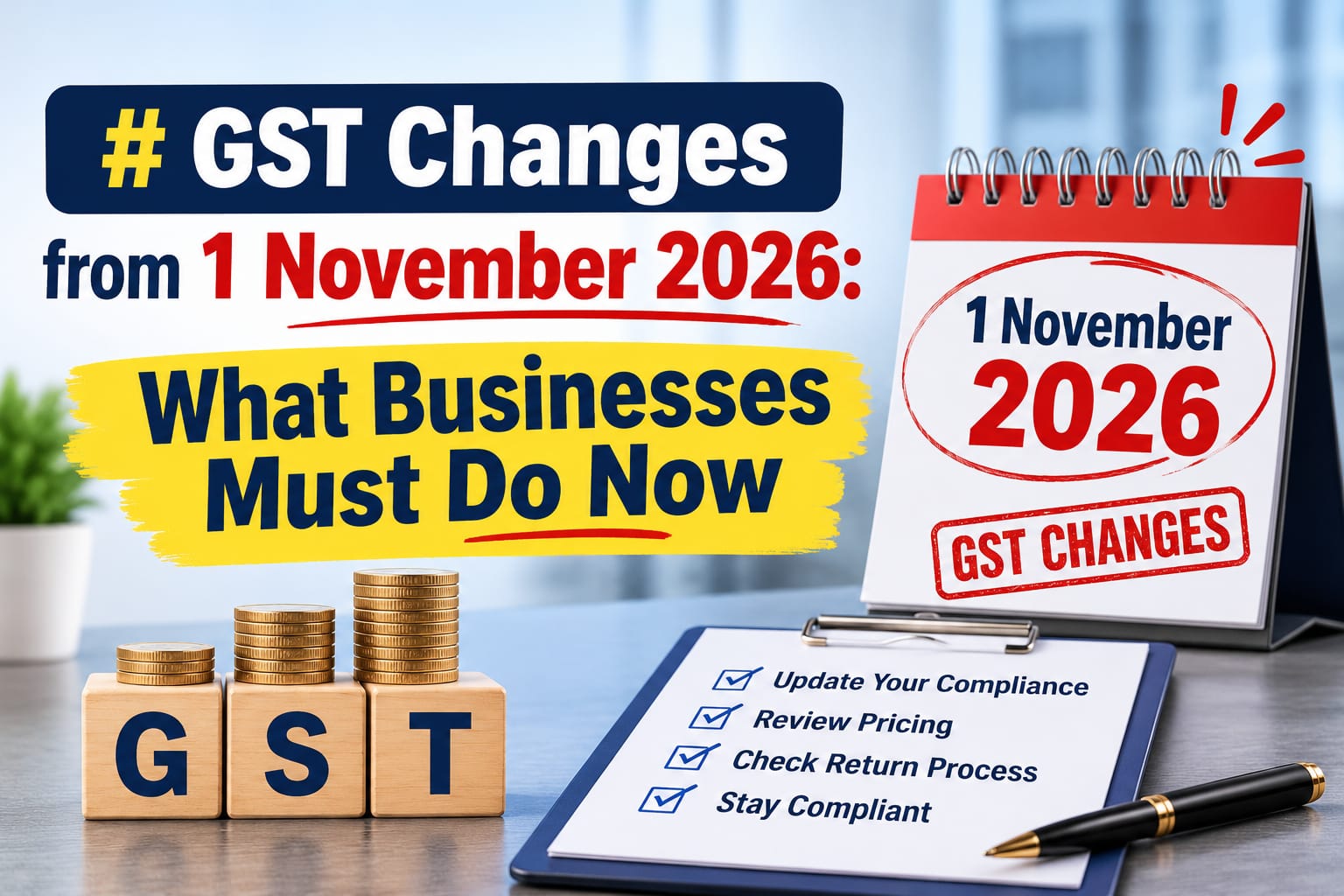
Your 7-point checklist for this week
Check which of your supplies fall on either side of 1 November.
Update your discount and credit note process.
Talk to your customers about reversing ITC on credit notes.
Separate input services credit availed on or after 1 November for refund purposes.
Review the rate and exemption notifications for the goods you deal in.
Reconcile your books with GSTR-2B and your returns.
Brief your accounts team, and update your invoicing software if needed.
Common mistakes to avoid
Assuming every reform is already live. Many are still proposals or phased rollouts.
Issuing credit notes without a paper trail. If a recipient does not reverse ITC, the discount treatment can be questioned.
Ignoring the cut-off date. Supplies that straddle 1 November are the easiest place to go wrong.
Claiming refunds without reconciling. Errors in ITC can delay or reduce your claim.
Waiting for a notice before acting. It is far easier to fix a mismatch now than to answer a demand later.
How JSR Taxes Mentor can help
GST changes are easy to read about and surprisingly hard to apply to your own books, especially when you have a mix of goods, services, discounts and customers.
JSR Taxes Mentor, a Delhi-based consultancy, helps businesses with GST registration and return filing, income tax, company registration and ROC compliance. If you are not sure how these changes affect your invoices, credit notes or refund claims, a short conversation with a tax professional can save you a lot of back-and-forth later.
The bottom line
The 1 November changes are not dramatic, but they are practical. They affect how you give discounts, how you claim refunds and how carefully you document what you do. The businesses that adjust early will have a smoother filing season and fewer surprises. The ones that wait for a notice usually pay more, in money and in stress.
Take an hour this week, go through the checklist, and ask for help where something is unclear.
Disclaimer: This article is for general information and is not professional advice. GST rules, rates and rollout dates are updated from time to time. Please verify the latest notifications on the CBIC and GST portals or consult a qualified tax professional before acting.