Artificial intelligence is changing how businesses manage information, develop software, automate tasks, and interact with customers. Among the AI tools gaining attention is Claude, developed by Anthropic. As more professionals explore Claude for everyday productivity and advanced technical projects, understanding how to use it effectively is becoming an important skill.
For candidates interested in validating their knowledge, Anthropic offers certification programmes covering different professional roles, including Associate, Developer, and Architect. Preparing for these assessments requires an understanding of Claude's capabilities, practical workflows, responsible AI usage, and technical integrations.
Following the right Anthropic Claude Exam Preparation Tips can help you organise your learning, improve your practical abilities, and approach your chosen assessment with greater confidence.
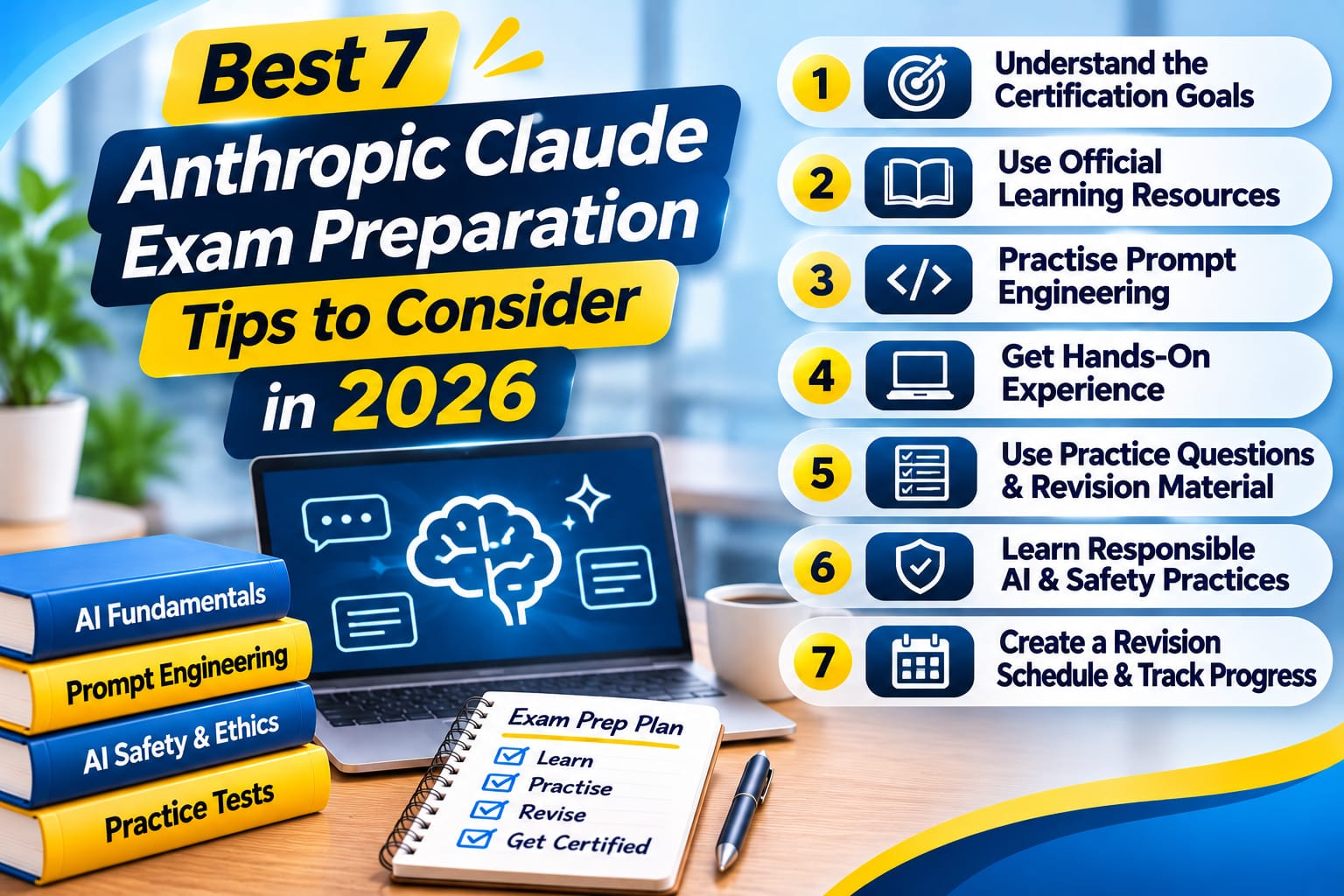
Here are seven useful preparation strategies to consider in 2026.
1. Understand the Certification You Want to Pursue
Before starting your preparation, identify which Claude certification matches your experience and career goals. Anthropic currently offers certifications for different professional responsibilities.
The Associate certification focuses on practical Claude usage, prompting, output evaluation, and workflow integration. The Developer certification is intended for professionals building applications and integrations with Claude. Architect certifications focus on designing and managing Claude-powered solutions.
Each certification has different learning objectives. Read the relevant exam guide carefully and understand its domains before selecting study materials.
Preparation tip: Choose your certification according to your actual skills rather than simply selecting the most advanced option.
2. Start with Official Anthropic Learning Resources
Official learning resources should form the foundation of your preparation. Anthropic Academy provides courses that introduce Claude's features, practical applications, and technical capabilities.
Depending on your chosen certification, you can explore subjects such as:
Claude 101 and AI fluency
Building applications with the Claude API
Introduction to Model Context Protocol (MCP)
Claude Code and development workflows
Prompt engineering and output evaluation
For candidates with access to Anthropic Partner Academy, certification-specific preparation courses are also available.
These resources help learners understand the concepts and skills associated with Claude without depending entirely on third-party study material.
Preparation tip: Complete the learning modules related to your chosen certification before attempting practice assessments.
3. Practise Prompt Engineering and Output Evaluation
Prompt engineering is an important part of working effectively with Claude. A well-structured prompt provides context, explains the desired outcome, and establishes clear instructions.
During preparation, practise writing prompts for different tasks, such as summarising documents, analysing information, generating content, and extracting structured data.
You should also learn how to evaluate Claude's responses. Check whether the output is accurate, relevant, complete, and aligned with the original instructions. Do not assume that every AI-generated response is automatically correct.
For stronger preparation, experiment with different prompt structures and compare the results. This will help you understand how small changes in instructions can affect the quality of an answer.
Preparation tip: Practise both creating prompts and reviewing the responses they produce.
4. Develop Hands-On Experience with Claude Tools
Reading documentation alone may not provide enough practical understanding. Spend time using Claude's features and exploring how they can support real tasks.
For example, practise organising information through Projects, working with documents, creating structured outputs, and using Claude Code if you are preparing for a developer-focused assessment.
Technical candidates should also become familiar with API integration, tool use, and MCP concepts where relevant to their certification.
Hands-on practice helps you understand how different features work together and makes it easier to apply theoretical knowledge to practical situations.
Preparation tip: Create small projects and complete realistic tasks instead of only watching tutorials.
5. Use Practice Questions and Revision Material
Practice questions can help candidates review important concepts and identify areas that need improvement. They also provide an opportunity to become familiar with different question formats.
Original Dumps is an independent online exam preparation platform that learners can explore for supplementary revision material and practice questions. Candidates following Anthropic Claude Exam Preparation Tips can use additional study resources to reinforce their understanding of key topics.
However, always verify that the material matches the current certification objectives. Use practice questions to support learning, not as a replacement for official study guides, practical exercises, or genuine exam preparation. Avoid resources claiming to provide leaked or guaranteed examination questions.
Preparation tip: Review the explanation behind each answer and revisit topics you find difficult.
6. Learn Responsible AI and Safety Practices
Understanding responsible AI usage is important when working with Claude. Professionals should know how to recognise limitations, review generated information, and use AI systems appropriately.
Include topics such as data privacy, security, human oversight, output validation, and risk management in your preparation.
For developers and architects, it is particularly important to understand how applications can be designed with appropriate safeguards. This includes considering how user inputs are handled, how outputs are evaluated, and how systems respond to unexpected situations.
You should also practise identifying cases where human review is necessary instead of relying entirely on automated responses.
Preparation tip: Include responsible AI concepts in your regular revision rather than studying them only at the end.
7. Create a Revision Schedule and Review Your Progress
A consistent study schedule can make preparation more manageable. Divide the exam objectives into smaller topics and assign enough time to each area.
You can organise your weekly preparation around three activities:
Learning: Study official courses and documentation.
Practice: Complete practical exercises and topic-based questions.
Revision: Review mistakes, revisit difficult concepts, and summarise important information.
Take periodic assessments to understand your progress. If you repeatedly struggle with a particular topic, spend additional time reviewing it before moving forward.
The Anthropic Claude Exam Preparation Tips that work best are those that combine regular study with practical experience and honest progress evaluation.
Preparation tip: Set realistic weekly targets and revise previously covered topics regularly.
Important: Check Certification Eligibility
Before booking an official Claude certification exam, review the latest eligibility requirements. Anthropic's current certification programme is available to individuals working at organisations within the Claude Partner Network. Personal email addresses are not accepted for exam registration under the current policy.
Candidates who are not eligible to sit the official examination can still build their knowledge through publicly available Anthropic Academy courses and technical documentation.
Conclusion
Preparing for a Claude certification requires a balanced approach that includes official learning resources, practical experience, prompt engineering, responsible AI knowledge, and regular revision.
Choose the certification that matches your professional goals and follow a study plan based on its official exam guide. You can also explore supplementary resources from Original Dumps to support revision, provided you verify their relevance and use them alongside genuine practical learning.
By applying these strategies consistently, you can strengthen your Claude knowledge and develop useful AI skills for professional opportunities in 2026.