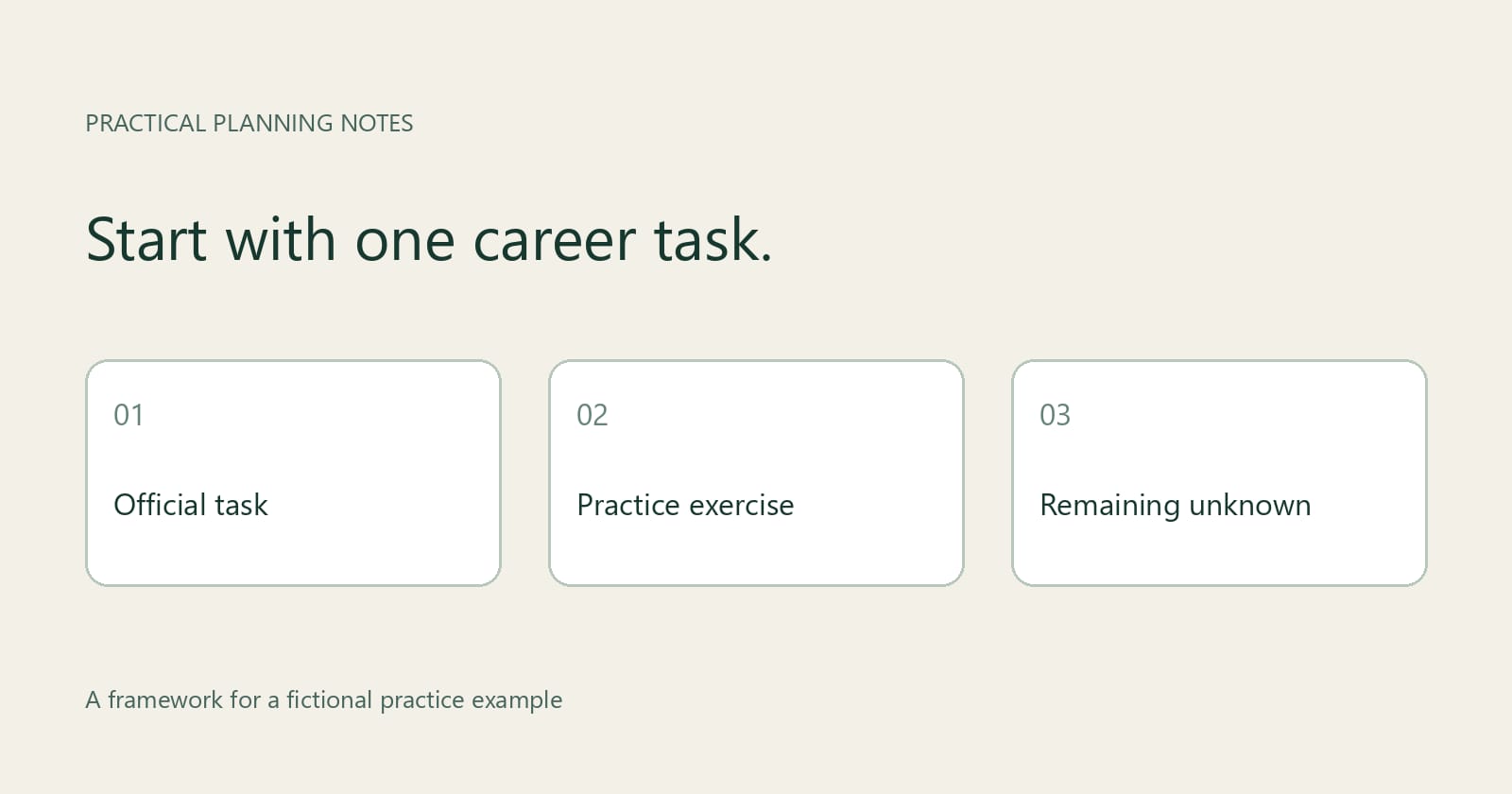
Before choosing a career to pursue, compare specific tasks and try a small piece of the work. A practice exercise can reveal what holds your attention and where you make mistakes, but it cannot establish that you would enjoy every duty or meet the requirements of a particular job.
Imagine a fictional learner, Maya, who is considering office clerk and customer service representative roles. She likes the idea of organized work but is unsure whether she would rather check records or respond to people’s questions. Her first decision is which task to explore, not which title to commit to.
What can a job title tell you about the work?
A title gives Maya a starting point for research, while the task list gives her something concrete to compare. O*NET describes general office clerks as performing varied duties that can include answering telephones, filing, and word processing. Its task list also includes recording and proofreading information in records or reports.
For customer service representatives, O*NET describes responding to routine enquiries about products and services and potentially handling complaints. Its listed tasks include speaking with customers, documenting interactions and referring unresolved grievances. Neither description means that every position under a title contains the same mix of work.
The overlap matters. O*NET also lists answering questions and addressing complaints among general office-clerk tasks, while customer service representatives may keep detailed records. Maya should avoid assuming that an office role eliminates interaction or that a service role consists only of conversation.
Comparison | Office-clerk record task | Customer-service enquiry task
Starting activity | Record and proofread information | Gather details and respond to a routine enquiry
Question for Maya | Does careful comparison hold her attention? | Does she enjoy finding and explaining an answer?
Important overlap | Office duties can include answering questions | Service duties can include keeping records
What to check in a specific role | Other duties and the share of time spent on them | Contact channels, complaints and authority to resolve issues
Which task should Maya practice first?
Maya can choose the task that answers her most useful unanswered question. If she is curious about sustained attention to detail, she can start with record checking. If she is more uncertain about explaining information to someone, she can instead draft responses to fictional enquiries using a short, invented policy. She need not decide which occupation is better before trying either activity.
Suppose Maya chooses record checking because she has never tested whether she enjoys comparing similar entries. She takes one O*NET office-clerk task—recording and proofreading information—and narrows it to checking a small set of records. The exercise is an approximation of part of that task, not a simulation of an entire working day.
Before beginning, she writes a simple question: “Can I check a short set of records carefully, document the differences and still want to investigate this kind of work?” That gives her a useful way to interpret the result even if she finds errors.
How can she build a modest dummy-data exercise?
Maya creates two short tables for a fictional office: a source list and a copied register. Each contains the same invented record IDs, item names and quantities. She uses made-up information throughout, with no real customer details or workplace documents. In the copied register, she deliberately changes a few quantities, omits one entry and leaves one item name ambiguous. She keeps a separate answer key.
Her instruction to herself is to compare the register against the source list, flag differences by record ID and write a brief note for each one. For example, if the source says item A17 has a quantity of 12 and the register says 21, her note might say: “A17: quantity differs; source 12, register 21; needs review.” She marks the ambiguous name for clarification rather than guessing what the correct entry should be.
After checking, Maya compares her notes with the answer key. She records which planted differences she found, which she missed and whether she flagged anything that was actually correct. She also notes how she approached the work: Did she check systematically, lose her place, or find a way to make the comparison easier? A count of findings is useful for this particular set, but it is not a general accuracy rating.
A limitation is that Maya created the data herself. She may remember where she placed errors, and a small, tidy set cannot reproduce the variety or interruptions of a workplace. If she wants another observation, she can ask someone else to prepare a fresh fictional set and keep its answer key until she finishes.
What should she record after the exercise?
Maya can keep a short practice note with four parts: the task she chose, the fictional materials and rules, what she produced, and what she observed. For instance: “Compared a copied register with a fictional source list; flagged differences and uncertainties; missed one altered quantity; liked the systematic checking but found it hard to resume after losing my place.” The note is a description of one practice attempt, not proof of professional performance.
She should add a separate “not established” line. The exercise did not show whether she can use an employer’s systems, follow its procedures, handle confidential records, meet its expectations, or perform other duties in the role. It also did not show how she would feel about answering calls, switching tasks or checking records for longer periods.
Separating these observations prevents two misleading conclusions. Enjoying the exercise is a reason to investigate record-related duties, not proof that an office-clerk job will suit her. Missing an invented discrepancy identifies something to practice; it does not establish that she cannot learn the work.
How should she compare the customer-service option?
A second small exercise can make the comparison more balanced. Maya could invent a simple returns policy and three customer enquiries, then draft a response to each using only the information in that policy. For an enquiry the policy does not answer, she should say what information is missing and whom she would ask, rather than inventing a solution.
She can compare her drafts against the fictional policy for clarity and accuracy, then record whether she enjoyed interpreting the question and explaining the next step. This exercise samples written responses only. It cannot tell her how she would handle a live conversation, an upset customer, an unfamiliar system or a decision governed by an actual employer’s rules.
The comparison may be mixed: Maya might prefer checking records but also enjoy explaining a straightforward answer. That is useful information because the occupational task lists overlap. She can look for a role’s actual combination of duties instead of treating the two titles as mutually exclusive personalities.
When is further research worthwhile?
Research further when a task interests you and the duties you have not tried remain acceptable or uncertain. Maya can return to both O*NET pages and read beyond the one attractive task, noting duties she would like to do, duties she would rather avoid and questions she cannot answer from an occupation summary.
For a concrete next step, she can browse Peaklivo career categories, including the customer service category, to find titles to investigate. A category is a useful way to discover possibilities; the duties and requirements in an individual posting still need to be checked with the employer or original source, along with whether the opening remains available.
When reviewing a position, Maya can ask: What would I spend most of my time doing? How often would I interact with customers? What records or systems would I use? Which decisions could I make myself, and when would I seek help? She should compare the answers with her practice notes, while keeping the employer’s stated requirements separate from her personal preference.
If neither exercise appeals, she can revise the task rather than force a title choice: perhaps she likes organizing information but dislikes proofreading, or likes helping people but wants a different setting. Either result gives her a more precise question for the next round of research.