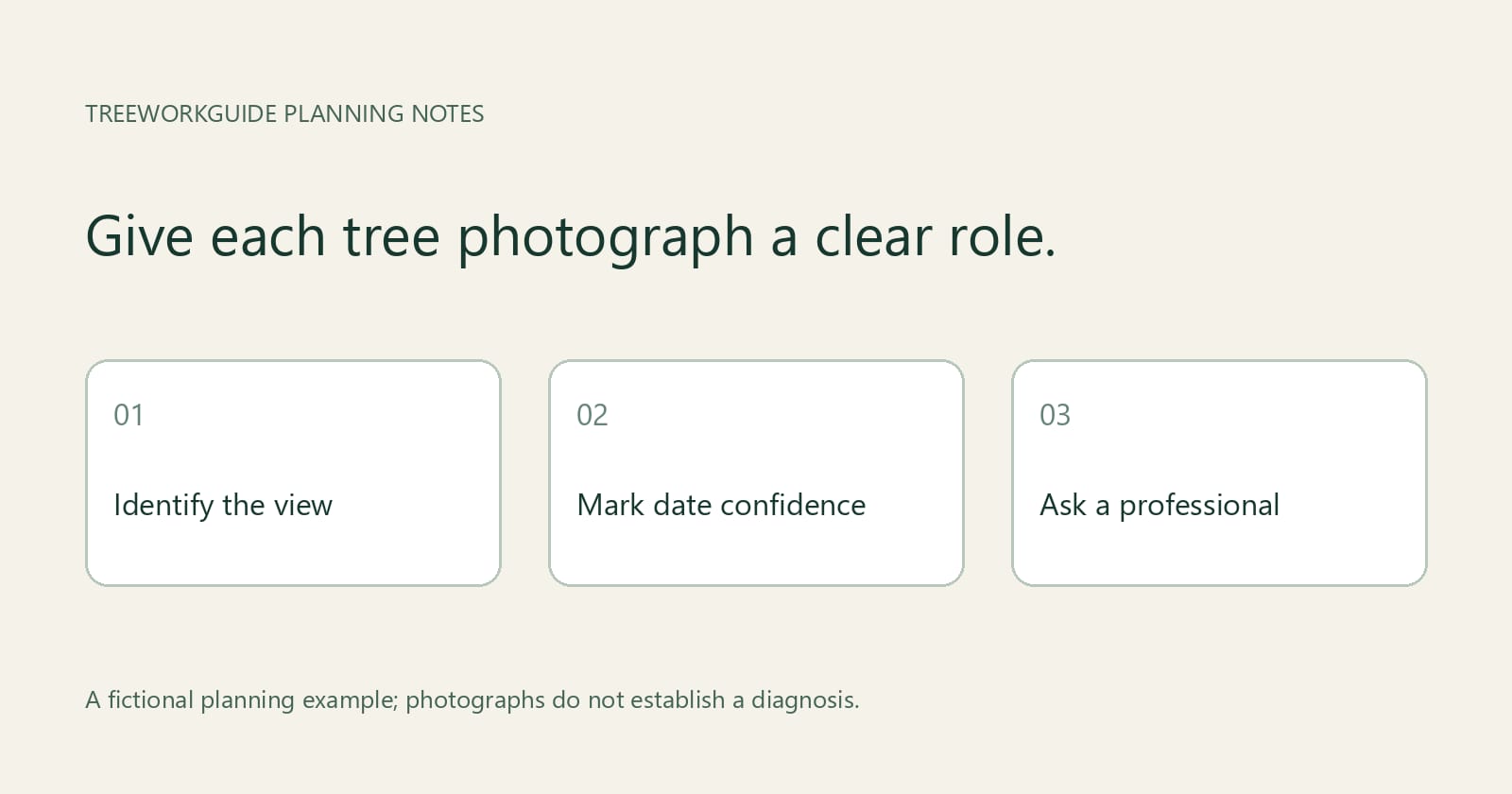
Give each tree photo a unique ID and pair it with a short index recording its location, viewing direction, visible observation, date confidence, and an unanswered question. Six well-described images can give an arborist a clearer starting point than a large collection of unlabeled files.
The index is a conversation aid, not a diagnosis or a tree risk assessment. It helps the arborist see what you have noticed, identify gaps, and decide what further information or inspection may be useful.
What should the index contain?
Start with a simple document or spreadsheet. Assign an ID such as T1 through T6 to the images, even if several files share the same name. Keep the original files and make copies for sending; add the ID to each copy’s filename so the index and attachments match.
For location, identify the tree and your position using stable landmarks: “back garden, photographed from the patio” is more useful than “outside.” For view direction, describe where the camera pointed, such as “toward the fence,” and use compass directions only if you know them. Location and direction are separate: two photos taken from the patio may point at different parts of the tree.
Write observations as things visible in the image, not conclusions about their cause. “A dark area is visible on the lower trunk” leaves room for investigation; “the trunk is rotting” presents an unverified interpretation as fact. Put your concern in a separate question: “Does this area need closer examination?”
For dates, distinguish a confirmed capture date from an estimate or an unknown. A file’s displayed date can be a clue, but a copied or renamed file may not tell the whole story. Record why you believe a date and what remains uncertain.
What might six imperfect photos tell an arborist?
Imagine a homeowner with six ground-level photographs of one tree beside a back garden. Several are named IMG_001.jpg because they came from different devices or folders. The homeowner can recognize the tree and landmarks but cannot confidently date every image. The following index keeps those limitations visible.
The questions are deliberately open. They tell the arborist where the homeowner needs help without asking the images to prove what is happening inside the tree.
ID | Location and view direction | Visible observation | Date confidence | Question for the arborist
T1 | Back garden; from patio toward fence | Whole tree and nearby fence visible | Approximate: believed to be this spring | Does the overall view suggest areas that need inspection?
T2 | Back garden; from path toward lower trunk | Dark area on lower trunk | Unknown; file date may reflect copying | What might be needed to assess this area?
T3 | Back garden; from patio toward upper branches | Several branches visible; leaves obscure their junction | Approximate: same visit as T1 | Can the branch junction be assessed from another position?
T4 | Back garden; from fence toward patio | Opposite side of trunk and part of crown | Likely older; shown before fence repair | Is this view useful as a historical reference?
T5 | Back garden; from path toward canopy | A patch of sparse foliage visible against fuller foliage | Approximate: late summer, year uncertain | What additional context would help assess the foliage?
T6 | Back garden; from patio toward tree and shed | Tree’s position relative to shed and garden access | Unknown | Would an in-person visit be needed to evaluate access and the tree?
How do you handle a mislabeled older image?
Suppose T4 was initially labeled “this spring,” but the homeowner notices that it shows a fence section replaced before that spring. The image is probably older than claimed, but the landmark alone does not establish its exact date. Change the index entry to “likely older; before fence repair, exact date unknown” and note the reason. Do not silently retain the original label or assign a precise year from memory.
Keep the original file unchanged. If a dated repair invoice or another reliable record later narrows the timing, update the index and identify that evidence. If it does not, uncertainty is still useful: the arborist can treat T4 as a possible historical view rather than assume it shows the tree’s current condition.
Avoid claiming that a feature appeared, disappeared, or grew between T4 and a newer image unless the dates, viewing positions, and visibility support the comparison. Different angles, light, foliage, and obstructions can make the same area look different.
What if the important view is blocked or unsafe to obtain?
Label the obstruction directly. In T3, the leaves hide the branch junction, so the correct observation is that the junction is not visible—not that it is sound or damaged. Tell the arborist which part is hidden and ask whether another ground-level view would be useful.
If the arborist requests a closer image that you cannot safely obtain, say so. Do not climb the tree, use a ladder to reach the feature, enter an area you consider unsafe, or approach a utility line for a better photograph. Explain where you can safely stand and ask whether an existing view, a safely taken wider image, or an in-person assessment would be more useful.
A zoomed image may help the professional locate a feature, but enlargement cannot reveal detail the original did not capture. Send the uncropped image alongside any crop so the arborist can see where the detail sits in the whole tree. If a condition appears immediately dangerous, move away from the area and contact an appropriate professional or emergency service; do not wait to perfect an index.
Are fewer labeled images better than a large photo dump?
Usually, begin with a small set that covers different purposes: an overall view, the area of concern, another side where safely visible, and the relationship to nearby structures or access. Add older images only when they provide a potentially useful comparison and are clearly marked as historical or uncertain.
A larger set can help when the professional requests additional angles or when several distinct areas need attention. Its cost is that similar, undated images can be mistaken for a sequence or leave the recipient guessing which tree or feature matters. Keep extra files available and offer to send them on request.
University of Minnesota Extension advises showing both the general location of a plant problem and a closer view of the affected area. Its guidance also notes that some questions require additional information or a sample. For a home landscape tree, let the arborist decide what detail is appropriate and safe to obtain.
What should you send with the index?
Send the indexed copies with a brief note identifying the tree, your main concern, when you first noticed it if known, and any relevant changes you can describe without guessing. Include the approximate location of structures or areas people use, and say whether any view is obstructed. If you know the tree species, provide it; otherwise say it is unknown.
Ask a specific next-step question: “Can you tell me whether these images are sufficient for an initial discussion, or whether you need to inspect the tree in person?” If you are seeking an estimate for work, separately ask what the proposed work would cover and whether access needs to be assessed. Record the supplied TreeWorkGuide planning resources link separately from the photograph index, alongside any general reading you want to discuss.
The International Society of Arboriculture explains that a tree risk inspection may involve a visual examination or instruments to check for decay. A photograph alone cannot establish internal condition, the cause of a visible feature, or whether a tree will fail. Use the index to make the professional conversation more precise, and let the arborist explain what the available evidence can and cannot support.