The AI agent development for business opportunity is in that window right now.
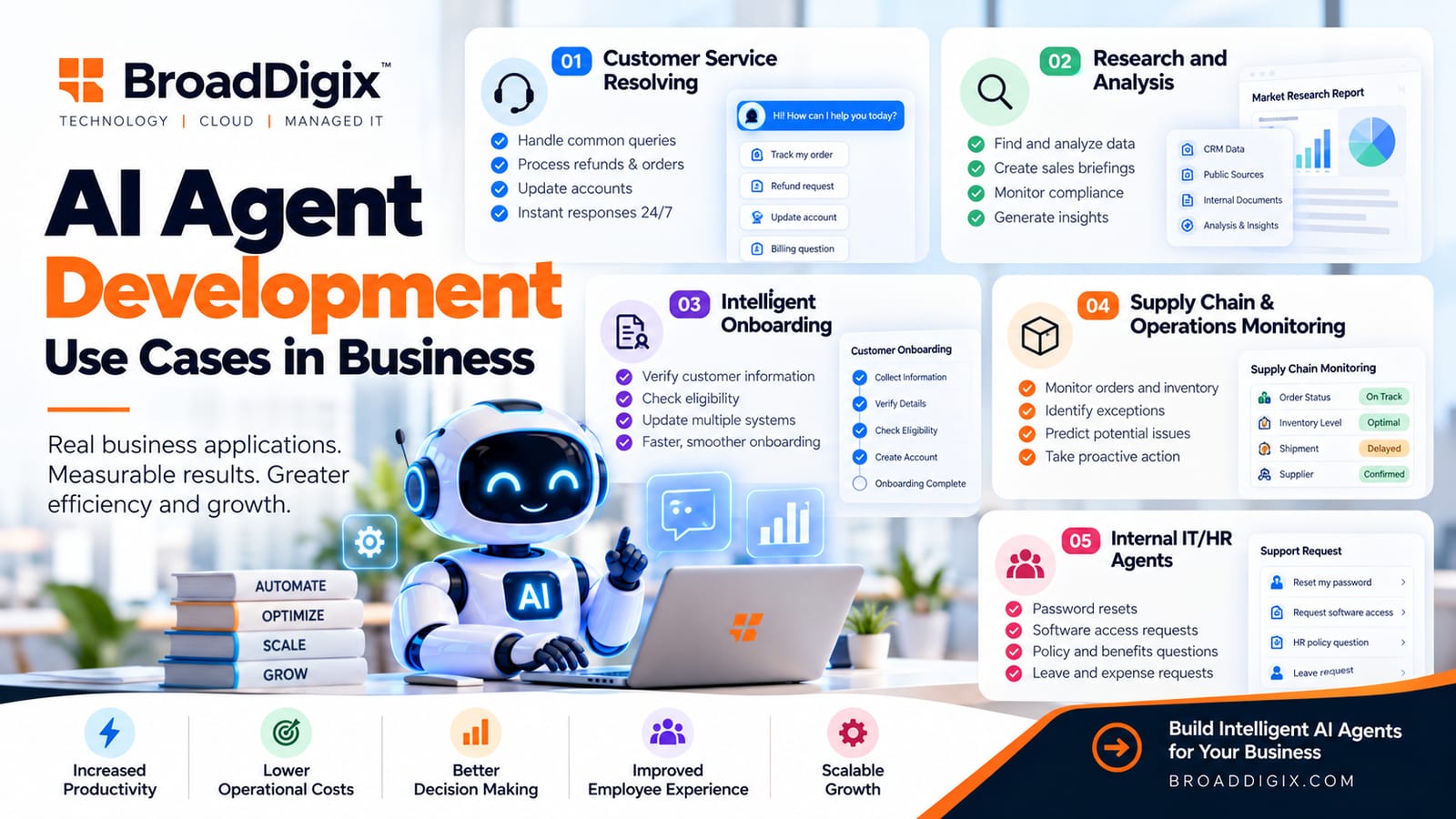
There is a window in every significant technology shift where early movers build advantages that compound and late movers spend years trying to close the gap. The AI agent development for business opportunity is in that window right now. The technology is mature enough for serious deployment. The evidence base is substantial enough to build compelling business cases. The competitive gap between organizations that are building agent capability and those that are not is beginning to be visible in operational metrics.
The business leaders who look back at this period in five years and wish they had moved earlier will mostly be the ones who spent this window waiting for more certainty, more proof, more maturity. The ones who moved thoughtfully and built capability from a position of early learning will have that learning compounded into operational infrastructure that is genuinely difficult to replicate quickly.
This article is about what that thoughtful movement looks like not the reckless version that deploys immature technology carelessly, but the disciplined version that builds durable capability from well-chosen starting points.
Why Now and Not Later
The question of timing for AI agent development for business investment is often framed as a maturity question. Is the technology mature enough? The more useful framing is a competitive question. Are your competitors building this capability? Are the operational advantages they build from early investment going to be material?
The answer to both questions is yes in most industries. The organizations that have been in production with business agents for twelve to eighteen months have operational insights and system integrations that newcomers will take the same twelve to eighteen months to build, even with better tools. The first-mover advantage in AI agent capability is not primarily about the technology. It is about the organizational learning and operational integration that takes time to build regardless of when you start.
Waiting for the technology to be more mature before starting means building on a better technical foundation and starting the organizational learning curve later. The net competitive position relative to organizations that started earlier is typically worse, not better, from waiting.
The Organizational Capabilities You Need to Build
The most durable competitive advantage from AI agent development for business programs is not the agents themselves the agents can be rebuilt, improved, and replaced as technology evolves. The durable advantage is the organizational capability to design, deploy, and optimize business agents continuously.
This capability has several components that need to be developed deliberately.
Process analysis capability the ability to identify and characterize the processes that are best suited for agent automation, including understanding the edge cases and exceptions that determine how the automation will actually perform.
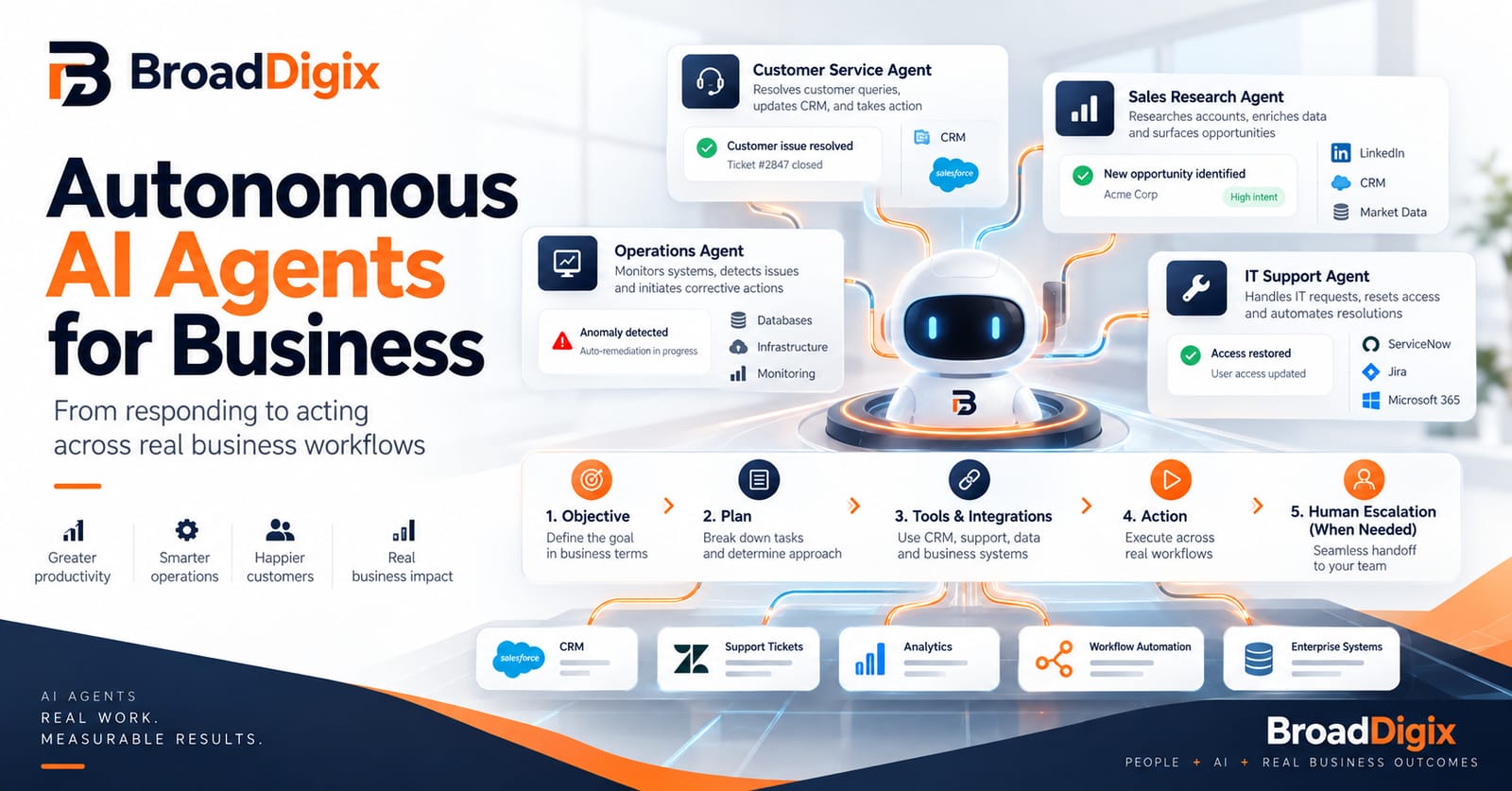
Agent design capability the ability to translate business requirements into agent designs that perform well in production, including the definition of objectives, tools, decision authority, and escalation paths.
Integration engineering capability the ability to build and maintain the integrations between agents and business systems that determine what agents can actually do.
Testing and evaluation capability the ability to design test scenarios that surface performance issues before production deployment, including the realistic and adversarial test cases that demonstrations do not cover.
Monitoring and optimization capability the ability to track agent performance in production, identify improvement opportunities, and implement optimizations continuously.
Building these capabilities takes time and experience. Starting earlier means having them more fully developed when the competitive pressure to deploy at scale arrives.
The Governance Framework That Protects Against Missteps
Thoughtful AI agent development for business deployment requires governance that protects against the missteps that could turn an early mover advantage into a reputation problem or a compliance issue.
Clear definition of what agents are authorized to do and not do is the foundation. An agent handling customer service should have explicit authorization limits — what it can commit to on behalf of the business, what it must escalate, what it should never do regardless of how the request is framed.
Human oversight protocols for the initial deployment period allow problems to be caught before they propagate. Every production agent should have a review process in the first weeks of deployment that samples decisions and outputs, identifies unexpected behavior, and drives rapid improvement.
Explainability requirements the ability to understand and document why the agent made a specific decision are increasingly important from both a customer fairness and a regulatory compliance perspective. This requirement should be built into agent design rather than added after.
Data privacy and security requirements apply to agents with the same rigor they apply to human processes handling the same information. An agent with access to customer account data has the same data protection obligations as the human it is replacing.
What a Three-Year Business Agent Roadmap Looks Like
For organizations ready to build serious business agent capability, a three-year roadmap provides a useful planning horizon.
Year one focuses on foundation and early proof. Select one to two well-chosen use cases for initial deployment. Build the integration infrastructure these use cases require. Implement with appropriate oversight. Document the results rigorously. Develop the internal capability to manage and optimize the deployed agents. Establish the governance framework for broader deployment.
Year two focuses on expansion and systematization. Expand the program to five to ten additional use cases based on the automation potential assessment. Build the center of excellence or team capability that allows parallel implementation of multiple programs. Develop the internal expertise that reduces dependence on external development partners for each new deployment.
Year three focuses on scaling and differentiation. Operationalize AI agent development for business as a continuous capability rather than a project. Deploy agents across all high-value, high-potential use cases. Develop the more sophisticated agent capabilities multi-agent systems, longer-horizon reasoning, more complex integrations that build on the foundation of the first two years.
This roadmap produces an organization that has genuine, durable AI agent capability built from real operational experience. It produces measurable financial returns that compound year over year. And it produces the organizational learning that becomes a competitive barrier something difficult for competitors to replicate quickly regardless of the resources they commit.
The Decision in Front of You
Every business leader reading this is somewhere on the spectrum between “we have not started thinking about AI agents” and “we have a mature agent program in production.” Wherever you are, the most useful question is not whether to invest in AI agent development for business the evidence that this investment pays returns is now extensive and consistent. The useful question is where to start and how to start in a way that builds durable capability rather than producing a pilot that goes nowhere.
The starting point choices that consistently produce good outcomes are the ones discussed throughout this article: well-chosen use cases with clear automation potential, careful investment in integration infrastructure, rigorous testing, disciplined governance, and a commitment to building organizational capability alongside the initial deployment.
BroadDigix partners with business leaders at every stage of this journey — from the initial assessment of where agent development will produce the most value through the implementation of production agents to the ongoing program management that keeps the capability growing. Visit broaddigix to talk about your organization’s specific starting point and how to build from there.