Knee injuries are common among athletes and physically active individuals, particularly those involved in sports that require sudden direction changes, jumping, landing and rapid movements. One of the most significant injuries affecting knee stability is an anterior cruciate ligament (ACL) tear. Understanding ACL tear treatment is important for recognizing the available management approaches, evaluating surgical options and planning an appropriate recovery process.
The anterior cruciate ligament is one of the major ligaments inside the knee joint. It helps control forward movement and rotational stability of the tibia in relation to the femur. Damage to this ligament can affect walking, running, jumping and other physical activities. For medical professionals interested in advanced musculoskeletal education, a Fellowship in Arthroscopy and Sports Medicine provides an opportunity to explore the principles behind sports injury management and minimally invasive joint procedures.
What Is an ACL Tear?
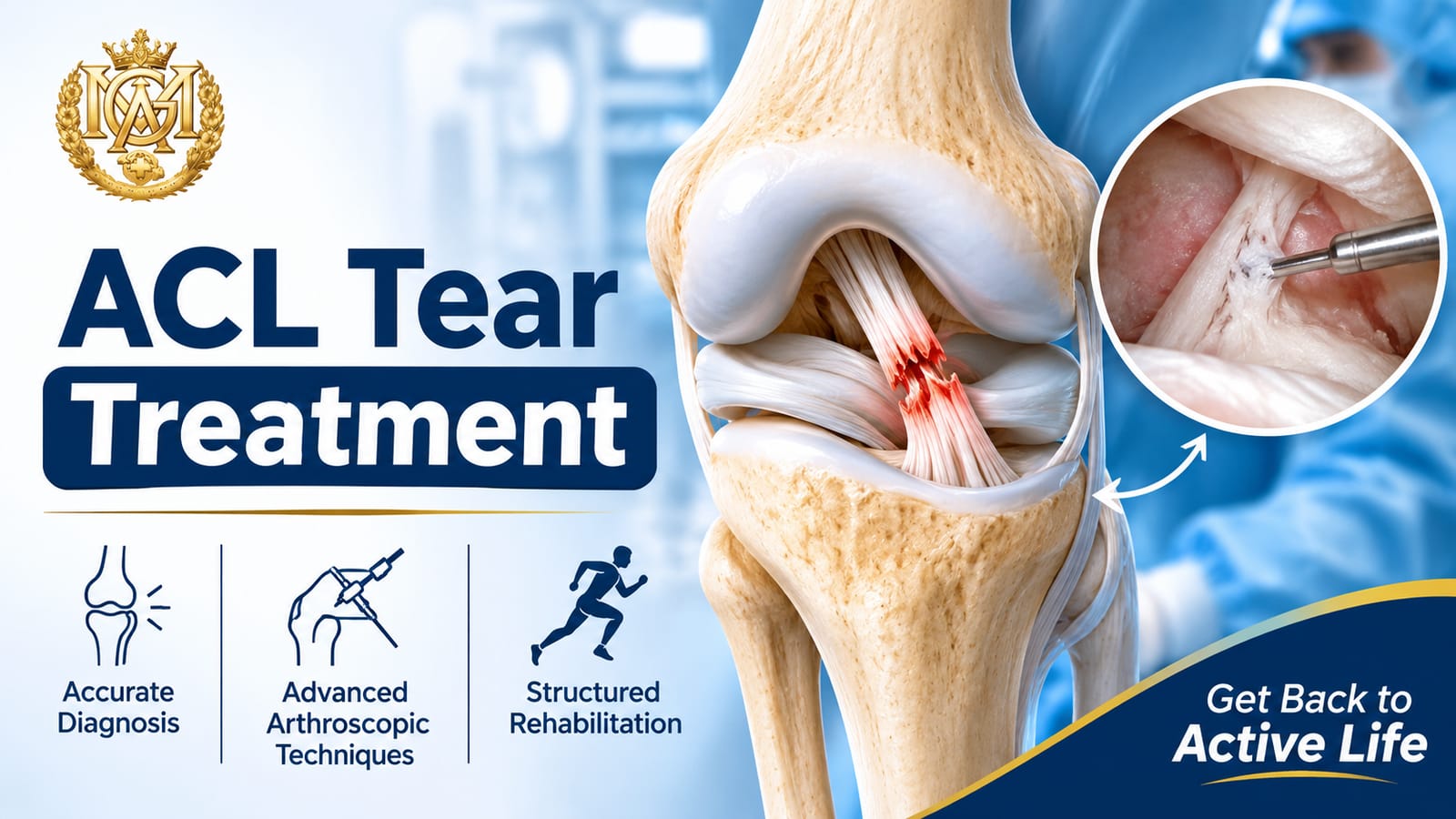
An ACL tear occurs when the anterior cruciate ligament becomes stretched, partially damaged or completely ruptured. It commonly happens during sports activities such as football, basketball, badminton and skiing.
Unlike some injuries caused by direct contact, ACL injuries frequently occur through non-contact mechanisms. A sudden stop, awkward landing or rapid change in direction can place excessive stress on the ligament.
Common situations associated with ACL injuries include:
Sudden changes in running direction.
Landing incorrectly after jumping.
Rapid deceleration during sports.
Twisting movements while the foot remains fixed.
Direct impact involving the knee.
The severity of the injury can vary depending on the extent of ligament damage.
Common Symptoms of an ACL Injury
Recognizing the symptoms of an ACL injury helps healthcare professionals determine whether further clinical assessment is necessary.
Some commonly reported symptoms include:
1. A Popping Sensation
Some individuals experience or hear a popping sound at the time of injury.
2. Knee Swelling
Swelling may develop within a few hours, particularly when the injury causes bleeding inside the joint.
3. Knee Instability
The knee may feel unstable or give way during walking, turning or physical activity.
4. Pain and Restricted Movement
Pain and swelling can make bending or fully extending the knee difficult.
5. Difficulty Continuing Sports Activities
Individuals may find it difficult to continue running, jumping or participating in sports after the injury.
These symptoms are not exclusive to ACL injuries. A proper clinical examination is necessary to identify the underlying problem.
How Is an ACL Tear Diagnosed?
Accurate diagnosis is an important part of ACL tear treatment. Healthcare professionals generally combine clinical assessment with imaging investigations to understand the nature and extent of the injury.
Clinical Examination
A detailed examination helps evaluate knee stability, swelling, range of motion and ligament function.
Common clinical tests include:
Lachman test
Anterior drawer test
Pivot shift test
These tests help assess the integrity of the ACL, although their interpretation depends on the clinical situation.
Imaging Investigations
MRI is commonly used to evaluate ACL damage and identify associated injuries involving the menisci, cartilage and other knee ligaments.
X-rays may also be performed to identify fractures or associated bone injuries. They do not directly demonstrate an ACL tear.
Understanding Different ACL Tear Treatment Options
The appropriate treatment approach depends on several factors, including the severity of the injury, associated damage, knee stability, physical activity requirements and individual goals.
Not every ACL injury requires surgery.
1. ACL Tear Treatment Without Surgery
Non-surgical management may be considered for selected individuals, particularly those with partial tears, relatively stable knees or lower physical activity requirements.
The approach may involve:
Activity modification.
Pain and swelling management.
Physiotherapy.
Progressive strengthening exercises.
Balance and neuromuscular training.
Functional rehabilitation.
The objective is to improve muscle strength, movement control and functional knee stability.
However, individuals experiencing repeated episodes of knee instability may require further evaluation to determine whether surgical treatment is appropriate.
2. Partial ACL Tear Treatment
A partial ACL tear involves damage to some ligament fibres while a portion of the ligament remains intact.
Treatment depends on the degree of functional instability and the individual's activity requirements.
Conservative management may be appropriate when the remaining ligament provides sufficient stability. Physiotherapy generally focuses on strengthening the quadriceps, hamstrings and surrounding muscles.
Regular clinical reassessment helps determine whether the rehabilitation programme is producing adequate functional improvement.
3. Complete ACL Tear Treatment
A complete ACL tear involves a full disruption of the ligament.
For individuals who want to return to demanding sports activities or experience persistent knee instability, surgical reconstruction may be considered.
Treatment planning also requires assessment of associated meniscal injuries, cartilage damage and other ligament abnormalities.
The decision should be based on an individualized evaluation rather than the MRI findings alone.
ACL Tear Surgery: Understanding Arthroscopic Reconstruction
ACL reconstruction is a commonly performed surgical procedure for selected patients with significant ACL deficiency.
In this procedure, the damaged ligament is generally replaced with a graft obtained from the patient's own tissue or, in selected cases, donor tissue.
Arthroscopy is frequently used because it allows surgeons to examine and operate inside the knee through small incisions using a camera and specialized instruments.
The procedure generally involves:
Examining the knee joint using an arthroscope.
Assessing associated meniscal and cartilage injuries.
Preparing the graft.
Creating appropriately positioned bone tunnels.
Passing and securing the graft.
Evaluating knee movement and stability.
Surgical planning requires a detailed understanding of knee anatomy, ligament biomechanics and arthroscopic techniques.
Why Is Rehabilitation Important After ACL Treatment?
Rehabilitation plays an essential role in recovery following both surgical and selected non-surgical approaches.
After ACL reconstruction, rehabilitation is generally progressive and supervised by qualified healthcare professionals.
The recovery programme may include several stages:
Early Rehabilitation: Focuses on controlling swelling, restoring knee extension and improving quadriceps activation.
Strength Development: Gradually introduces exercises to improve quadriceps, hamstring and hip muscle strength.
Balance and Coordination: Includes proprioceptive and neuromuscular exercises to improve movement control.
Functional Training: Introduces progressive activities such as jogging, jumping and sport-specific movements when clinically appropriate.
Return-to-Sport Assessment: Considers strength, functional performance, movement quality and psychological readiness.
Recovery timelines vary between individuals. Returning to sports should depend on clinical assessment and functional readiness rather than time alone.
The Importance of Arthroscopy and Sports Medicine Education
Sports medicine involves the assessment and management of injuries affecting individuals participating in physical activities. Arthroscopy provides a minimally invasive approach for examining and treating several joint conditions.
Understanding ACL tear treatment requires knowledge of:
Knee joint anatomy and biomechanics.
Ligament injuries and their classification.
Clinical examination techniques.
MRI interpretation.
Arthroscopic reconstruction principles.
Postoperative rehabilitation.
Return-to-sport considerations.
Doctors interested in developing their academic understanding of these subjects can explore the Fellowship in Arthroscopy and Sports Medicine offered by Medical Global Academy.
Structured medical education in this field can help physicians strengthen their theoretical understanding of sports-related injuries, joint disorders and arthroscopic management principles.
Conclusion
ACL injuries can significantly affect knee stability, mobility and participation in physical activities. Appropriate ACL tear treatment depends on injury severity, functional instability, associated damage and individual activity requirements.
While selected injuries may be managed through rehabilitation and conservative care, others may require arthroscopic ACL reconstruction. Accurate diagnosis, appropriate treatment planning and structured rehabilitation are important components of effective management.
For doctors interested in understanding modern approaches to sports-related injuries and minimally invasive joint procedures, the Fellowship in Arthroscopy and Sports Medicine offers an educational pathway to explore this specialized area of medicine.
Medical Global Academy provides online medical education programmes designed for doctors and healthcare professionals interested in further academic development.