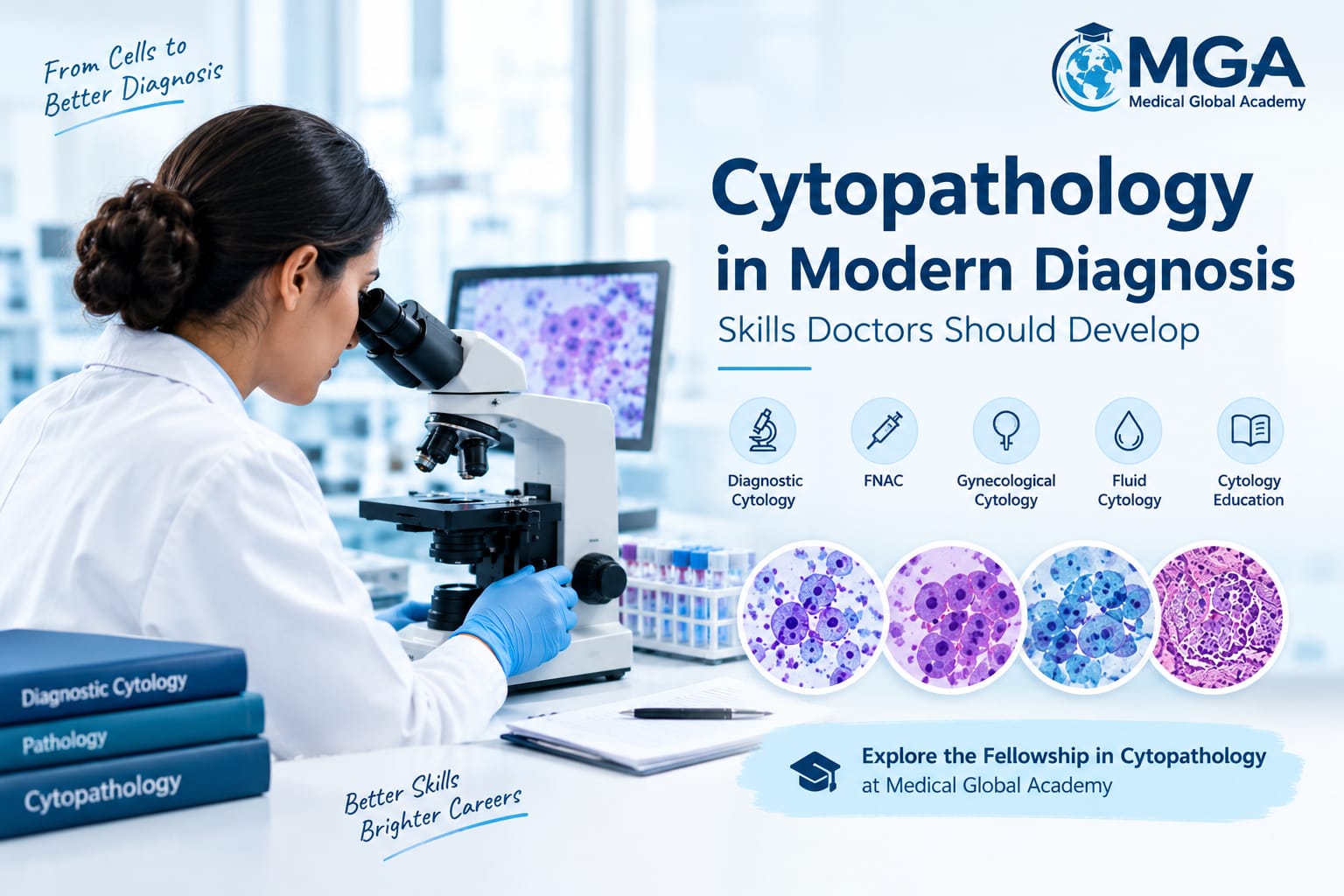
Cytopathology has an important role in modern diagnostic medicine. By examining cells obtained from different parts of the body, cytology can provide useful information about disease processes and support clinical decision-making. However, developing competence in this field involves more than learning to recognize cells under a microscope.
For doctors who want to build focused expertise, a Fellowship in Cytopathology can provide a structured learning pathway covering important concepts in cellular diagnosis, specimen assessment, clinical correlation, and reporting.
What Makes Cytopathology a Specialized Field?
Cytopathology focuses on the study of individual cells and groups of cells obtained from clinical specimens. Depending on the situation, samples may come from fine-needle aspiration, body fluids, brushings, or gynecologic specimens.
The interpretation of these samples requires an understanding of cellular morphology as well as the clinical circumstances in which the specimen was obtained.
A cytology finding therefore needs to be considered carefully rather than viewed as an isolated microscopic observation.
The Importance of Fine-Needle Aspiration
Fine-needle aspiration cytology, commonly called FNAC, is one of the important techniques associated with cytopathology. It allows cellular material to be collected from accessible lesions using a fine needle.
Depending on the clinical situation, FNAC may be used when evaluating lesions involving areas such as the thyroid, lymph nodes, salivary glands, and other accessible sites.
The usefulness of FNAC depends on several factors, including appropriate sampling, specimen preparation, cellular adequacy, and interpretation in the correct clinical context.
Understanding these factors is an important part of specialized cytopathology education.
Learning to Evaluate Specimen Adequacy
One of the practical challenges in cytopathology is determining whether a specimen contains enough representative material for meaningful interpretation.
A specimen may be limited because of insufficient cellularity, blood contamination, poor preservation, technical problems, or sampling that does not adequately represent the lesion.
Recognizing these limitations is an important professional skill. It helps doctors understand when a cytological finding can provide useful information and when additional investigation or sampling may need to be considered.
Clinical Correlation in Cytopathology
Cytology does not exist separately from the rest of clinical medicine. Information about symptoms, physical findings, imaging, previous diagnoses, and the anatomical site of a lesion can all help provide context for a cytological interpretation.
This is why clinical correlation is an important concept in cytopathology training.
Doctors learning the discipline can benefit from understanding how laboratory findings relate to the original clinical question. This broader perspective can also improve communication between clinicians and pathology professionals.
What Can Doctors Learn Through a Fellowship?
The exact structure of each educational program differs, but a Fellowship in Cytopathology may provide focused exposure to several areas of cytological practice.
Depending on the curriculum, these may include:
Fine-needle aspiration cytology
Gynecologic cytology
Non-gynecologic cytology
Body-fluid cytology
Specimen adequacy
Cytological morphology
Diagnostic reporting
Clinical-pathological correlation
Relevant ancillary techniques
The purpose of specialized training is not simply to increase theoretical knowledge. It can also help doctors develop a more systematic approach to reviewing cases and understanding the limitations of cytological evidence.
Developing Better Diagnostic Thinking
Cytopathology requires careful observation and structured thinking. When examining a specimen, a doctor may need to consider whether the sample is adequate, what cellular features are present, whether the findings fit the clinical information, and whether additional evaluation may be appropriate.
This process encourages doctors to avoid making conclusions based on a single isolated feature.
Case-based learning can be particularly valuable because real-world specimens may not always resemble straightforward textbook examples. Exposure to varied cases can help learners become more familiar with diagnostic uncertainty and specimen limitations.
Communication Is Also Part of Cytopathology
Although much of cytopathology involves laboratory and microscopic work, communication remains important.
A cytology report needs to communicate findings in a manner that is understandable and clinically useful. When a specimen has limitations, this also needs to be conveyed appropriately.
Pathology professionals may communicate with clinicians, radiologists, surgeons, and other members of the healthcare team. Understanding how cytological findings fit into this multidisciplinary environment can therefore complement technical knowledge.
Choosing the Right Training Program
Doctors considering specialized cytopathology education should evaluate a program carefully before enrolling.
Some useful factors to consider include:
Curriculum
Review the subjects covered and determine whether they match your professional interests.
Learning Format
Consider whether teaching is live, recorded, case-based, or delivered through a combination of methods.
Practical Orientation
Look for information about case discussions, applied learning, specimen interpretation, or other practical components where applicable.
Faculty Support
Information about faculty experience and opportunities for academic interaction may also help when comparing programs.
Eligibility and Duration
Doctors should verify eligibility requirements, course duration, assessment methods, and other program-specific details before making a decision.
A program should be evaluated according to its actual educational content rather than its title alone.
Continuing Education After Formal Training
Completing specialized education does not mean that learning stops. Diagnostic medicine continues to develop, and professionals may encounter new technologies, diagnostic approaches, and laboratory practices throughout their careers.
Regular case review, professional education, scientific literature, and discussion with experienced colleagues can all support continued development.
For doctors who have a sustained interest in cellular diagnosis, ongoing learning can help strengthen the knowledge gained through formal training.
Who May Consider Cytopathology Training?
Cytopathology may be of interest to doctors who enjoy diagnostic medicine, microscopic evaluation, pathology, and the relationship between laboratory findings and clinical care.
It can be particularly relevant for professionals who want to explore a focused area of pathology rather than relying only on general exposure to cytological diagnosis.
A Fellowship in Cytopathology can be considered as one structured educational option, provided that the program's eligibility, curriculum, teaching approach, and learning objectives match the doctor's professional background and goals.
Conclusion
Cytopathology combines cellular morphology, specimen assessment, clinical correlation, diagnostic communication, and continuous learning. Developing expertise therefore requires an understanding of the complete diagnostic process rather than simply memorizing microscopic patterns.
For doctors interested in building focused knowledge in this field, a Fellowship in Cytopathology can be an option worth exploring. Reviewing the curriculum, learning format, practical orientation, eligibility criteria, and professional relevance can help doctors make a more informed decision about specialized training.