Introduction
Content production has become faster than ever.
With AI tools, automation systems, and scalable publishing frameworks, websites can now generate thousands of pages in a short time. This approach is commonly known as Programmatic SEO.
At the same time, human-driven content focused on experience, storytelling, and authority continues to dominate many competitive niches.
This raises an important question:
What actually wins in 2026—programmatic SEO or human content?
The answer is more nuanced than most people think.
What is Programmatic SEO?
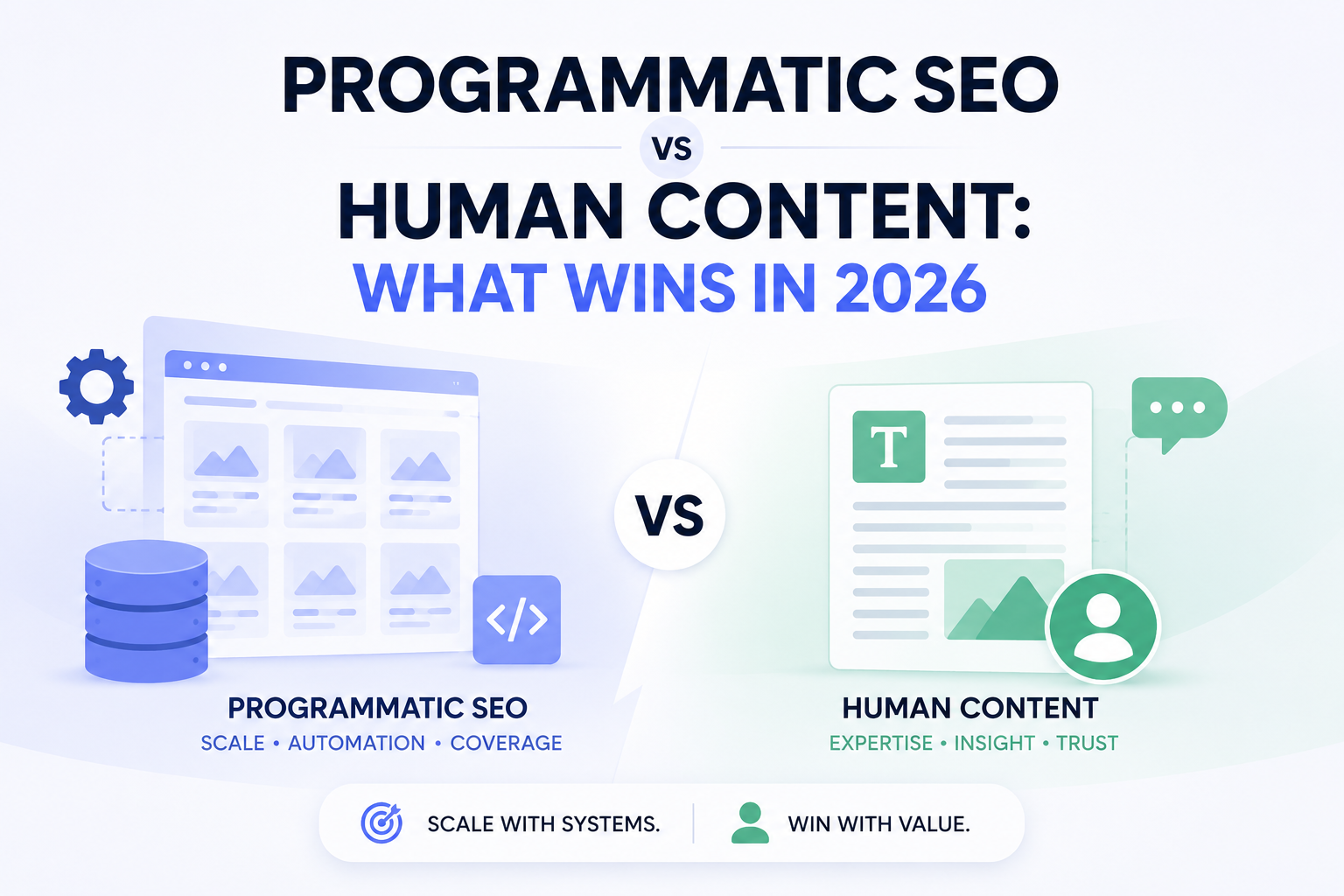
Programmatic SEO is the process of creating large numbers of pages using templates, automation, and structured data.
Examples include:
Location pages
Product comparison pages
Directory-style content
Dynamic landing pages
The goal is scale.
Instead of manually writing every page, websites use systems to generate content efficiently.
Why Programmatic SEO Became Popular
The main reason is speed.
Programmatic SEO allows websites to:
Target thousands of keywords
Scale traffic quickly
Cover large search spaces
Build massive visibility
For informational queries with predictable structures, this strategy can work extremely well.
The Problem With Pure Automation
In 2026, search engines are becoming better at identifying repetitive, low-value content.
Many automated pages suffer from:
Thin information
Duplicate structures
Weak EEAT signals
Lack of originality
This creates a major challenge for programmatic SEO websites.
AI search systems increasingly prioritize:
Real expertise
Information gain
User value
Contextual understanding
This is why EEAT in 2026 has become central to modern SEO.
Why Human Content Still Wins
Human content performs better because it creates:
Trust
Emotional connection
Real insight
Experience-driven explanations
People remember content that feels authentic.
AI-generated summaries may answer questions quickly, but humanized content builds long-term authority.
This is especially important for:
Personal branding
Thought leadership
Educational content
Mental health topics
The Rise of Hybrid SEO
The future is not automation versus humans.
The future is hybrid systems.
Smart creators combine:
Programmatic scale
withHuman refinement
For example:
Automation handles structure
Humans add insight and clarity
This creates scalable yet trustworthy content.
What Google Prefers in 2026
Search engines no longer reward content just because it exists.
They reward:
Value
Originality
Authority
Structure
This means mass-produced pages without meaningful information are becoming less effective.
You can understand this better through how Google measures content quality in AI search, where trust signals increasingly influence visibility.
Programmatic SEO Works Best For
Data-Driven Pages
Examples:
Pricing comparisons
Statistics pages
Directories
Search-based landing pages
These benefit from automation because the structure is repeatable.
Human Content Works Best For
Expertise and Authority
Topics requiring:
Opinions
Experience
Strategic thinking
Personal insights
perform much better with human involvement.
This is why building authority through writing remains critical even in the AI era.
The Role of Internal Linking
Regardless of the approach, internal linking matters heavily.
Strong internal linking:
Improves discoverability
Strengthens topical authority
Helps AI systems understand relationships
A strong internal linking strategy for AI search can improve both programmatic and human-driven content systems.
Common Mistakes
Publishing Thin Automated Pages
Scale without value creates weak rankings.
Ignoring User Experience
Even scalable content must remain readable and useful.
Treating AI as a Complete Replacement
AI is a tool, not a substitute for expertise.
Human refinement still matters.
Conclusion
Programmatic SEO is powerful for scale. Human content is powerful for trust.
In 2026, the websites that win will combine:
Automation
Structure
Human expertise
Clear authority
The future belongs to creators who use AI strategically while maintaining authenticity.
FAQs
What is programmatic SEO?
Programmatic SEO is the large-scale creation of webpages using automation and structured templates.
Is programmatic SEO still effective in 2026?
Yes, but only when combined with quality, originality, and user value.
Does Google prefer human-written content?
Google prefers valuable content regardless of how it is created, but humanized content often performs better in authority-based niches.