As Indian businesses explore alternatives to conventional petroleum-based plastics, polylactic acid (PLA) is attracting attention across the packaging, food service, and beverage industries.
PLA is a bio-based thermoplastic polymer manufactured from renewable biological feedstocks. It can be used in packaging films, food containers, disposable products, and certain beverage bottles.
However, an important question remains: Where does PLA raw material come from, and how does its supply chain work in India?
Understanding the PLA raw material supply chain in India is essential for packaging manufacturers, procurement teams, brand owners, and businesses considering plant-based packaging.
From agricultural feedstocks and polymer production to imported resin and finished packaging, the PLA supply chain involves several interconnected stages.
What Is PLA Raw Material?
PLA stands for polylactic acid, a polymer typically produced using sugars derived from renewable agricultural resources.
Unlike conventional plastics such as polyethylene terephthalate (PET), which are generally manufactured from fossil-derived feedstocks, PLA can be produced using plant-based carbohydrates.
Common feedstocks include:
Corn starch
Sugarcane
Cassava
Sugar beet
Other carbohydrate-rich agricultural materials
These resources provide fermentable sugars used in the production of lactic acid, an important intermediate in PLA manufacturing.
However, agricultural feedstocks are not directly converted into finished plastic bottles.
They undergo several industrial processing stages before becoming usable PLA resin.
How Is PLA Manufactured?
The PLA manufacturing process generally involves four major stages.
1. Agricultural Feedstock Processing
The process begins with crops containing starch or sugar.
Starch-based materials are processed to obtain sugars that can be used in fermentation.
The availability, quality, and cost of these agricultural resources influence upstream manufacturing economics.
2. Fermentation to Produce Lactic Acid
The extracted sugars undergo microbial fermentation to produce lactic acid.
Lactic acid is the primary chemical building block used in PLA manufacturing.
Industrial producers must control fermentation conditions and purification processes to obtain suitable material quality.
3. Conversion into PLA Polymer
Purified lactic acid is converted into PLA through polymerization processes.
One widely used industrial route involves producing lactide, a cyclic intermediate, followed by ring-opening polymerization.
The resulting polymer can be manufactured with different properties depending on its intended application.
4. PLA Resin Production
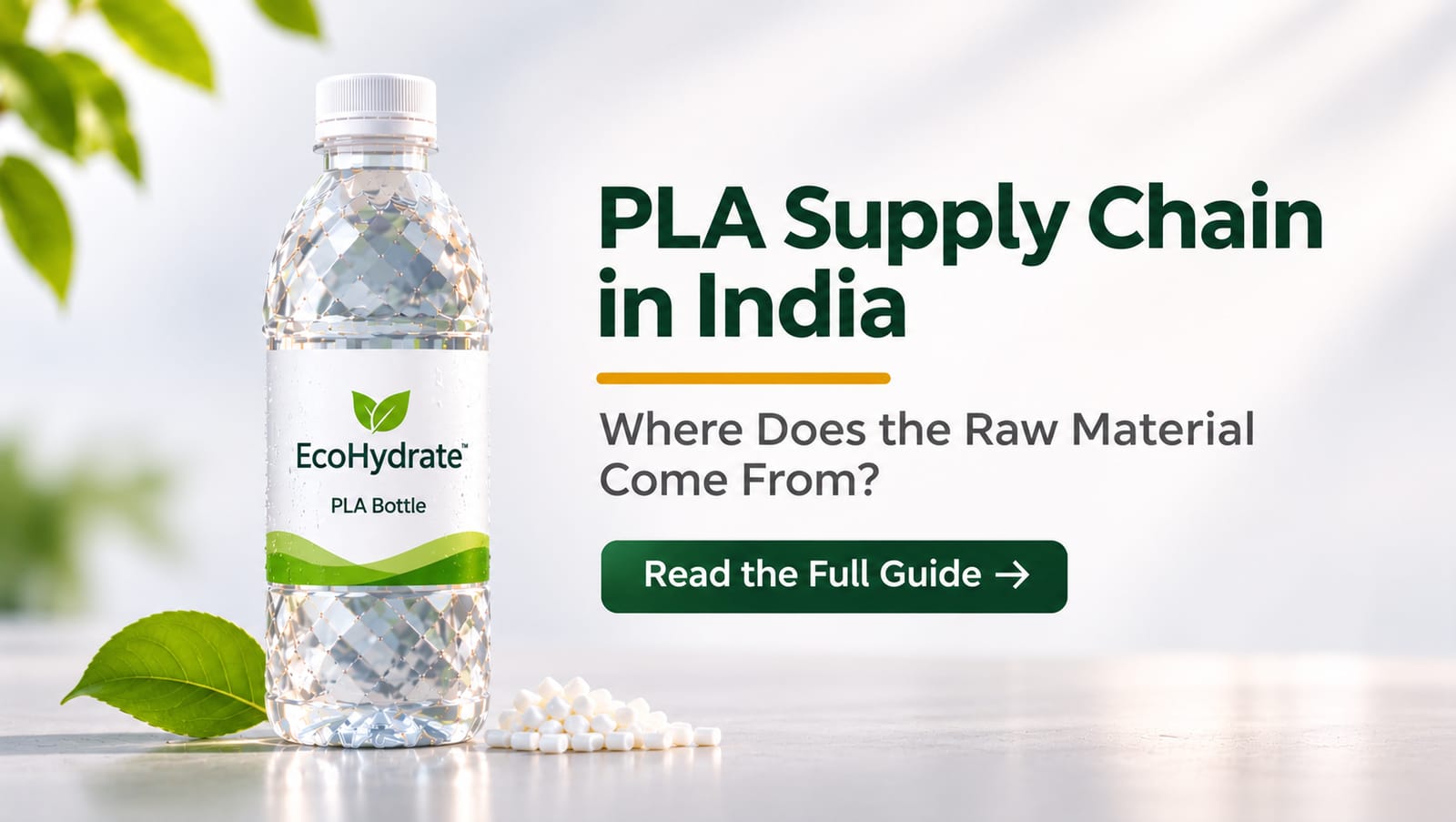
The polymer is processed into resin, commonly supplied in pellet form.
These pellets can then be used by packaging manufacturers to produce films, containers, preforms, and other products.
Businesses interested in the material's broader industrial applications can explore what PLA is used for across packaging and manufacturing sectors.
Where Does India Source PLA Raw Material?
India's PLA supply chain includes imported resin, domestic polymer-processing businesses, compounders, and developing upstream manufacturing capacity.
Historically, much of the PLA resin used by Indian converters has been sourced from international manufacturers.
Global production capacity has been concentrated among established producers in regions such as North America, Europe, and Asia.
Imported PLA resin is supplied to Indian businesses for applications including packaging, disposable products, and industrial processing.
At the same time, India has agricultural feedstocks that could support domestic bio-based polymer manufacturing.
Sugarcane and starch-rich crops provide potential raw material sources for industrial fermentation.
However, having agricultural feedstocks available does not automatically mean that large-scale commercial PLA polymer production capacity exists.
Developing an integrated domestic supply chain requires fermentation facilities, chemical processing infrastructure, polymerization technology, quality control systems, and consistent industrial demand.
The Role of Imports in India's PLA Supply Chain
Imports remain an important consideration for businesses sourcing PLA resin.
Indian packaging manufacturers may purchase material through international producers, authorized distributors, or domestic resin suppliers.
Import dependence can expose buyers to several commercial variables.
Currency Fluctuations
Changes in exchange rates can affect the landed cost of imported resin.
International Freight Costs
Shipping charges, customs-related expenses, and transportation arrangements influence final material pricing.
Supply Lead Times
International procurement may require longer planning periods than locally available materials.
Material Availability
Global demand, production capacity, and supplier allocation policies can affect availability.
For these reasons, businesses should evaluate supplier reliability and inventory planning before committing to large-scale PLA packaging production.
Can India Manufacture PLA from Sugarcane?
India is a major producer of sugarcane, making sugar-derived feedstocks relevant to discussions about domestic bio-based polymers.
Sugarcane processing can provide fermentable sugars suitable for lactic acid production.
In principle, these sugars can support PLA manufacturing through fermentation and polymerization.
However, commercial feasibility depends on several factors, including feedstock pricing, energy requirements, processing efficiency, investment costs, and production scale.
Domestic manufacturing also requires technology capable of producing consistent polymer grades for different applications.
As a result, the availability of sugarcane should be viewed as a potential upstream advantage rather than proof of an established end-to-end domestic PLA supply chain.
How PLA Resin Becomes Finished Packaging
Once PLA resin reaches a packaging manufacturer, it undergoes processing according to the required product specifications.
Different manufacturing techniques may be used for films, sheets, containers, and bottles.
For beverage packaging, resin selection must account for mechanical performance, temperature sensitivity, processing requirements, and food-contact suitability.
Some bottle manufacturing processes involve producing preforms and subsequently forming the final bottle.
Manufacturers must select appropriate resin grades and processing conditions to achieve the required product characteristics.
Businesses exploring PLA bottles in India should understand that finished bottle quality depends on both the raw material and manufacturing process.
Resin origin alone does not establish the performance or regulatory suitability of a finished product.
Challenges Facing the PLA Supply Chain in India
Despite growing interest in bio-based materials, PLA procurement presents several challenges.
Raw Material Pricing
PLA resin may carry a higher procurement cost than certain conventional plastics, depending on grade, supplier, volume, and market conditions.
Limited Domestic Upstream Capacity
Developing competitive domestic production requires substantial industrial investment and technical expertise.
Application-Specific Requirements
Not every PLA grade is suitable for every packaging application.
Manufacturers must evaluate heat resistance, mechanical properties, processing characteristics, and product compatibility.
End-of-Life Infrastructure
PLA's plant-based origin does not guarantee that it will decompose under ordinary environmental conditions.
Compostability depends on the finished product, applicable certification, and suitable treatment conditions.
Collection and processing infrastructure therefore remain important considerations.
How Indian Businesses Can Evaluate PLA Raw Material Suppliers
Businesses purchasing PLA resin or finished packaging should conduct structured supplier assessments.
Important evaluation criteria include material specifications, resin grade, country of origin, technical data sheets, supply capacity, and delivery reliability.
Procurement teams should also request relevant test reports and documentation supporting environmental claims.
For food and beverage applications, the material must meet applicable food-contact requirements.
Businesses evaluating PLA packaging in India should consider both upstream material sourcing and downstream manufacturing quality.
A supplier offering transparent documentation and consistent material specifications can reduce procurement uncertainty.
What Is the Future of PLA Manufacturing in India?
India has potential advantages in agricultural feedstock availability, chemical manufacturing capabilities, and demand for alternative packaging materials.
Domestic PLA manufacturing could help shorten certain supply chains and reduce exposure to international procurement risks.
However, future growth will depend on commercial competitiveness, investment, technology development, regulatory requirements, and actual customer demand.
Expansion of domestic resin production would also need to be supported by reliable downstream processing and appropriate waste management infrastructure.
For Indian businesses, the practical priority is to evaluate available materials based on verified specifications, commercial feasibility, and application requirements rather than assuming all bio-based packaging offers identical benefits.
Conclusion
The PLA raw material supply chain in India connects agricultural feedstocks, industrial fermentation, polymer manufacturing, resin distribution, and packaging conversion.
Although crops such as sugarcane offer potential opportunities for domestic production, imported PLA resin has historically played an important role in supplying Indian manufacturers.
Understanding where PLA originates and how it is processed helps businesses make better packaging procurement decisions.
Not A PET Bottle offers PLA-based packaged drinking water and private-label solutions for businesses exploring alternative beverage packaging.
For companies evaluating PLA, understanding material origin, manufacturing processes, supplier documentation, and disposal requirements is essential to making informed commercial and environmental decisions.