
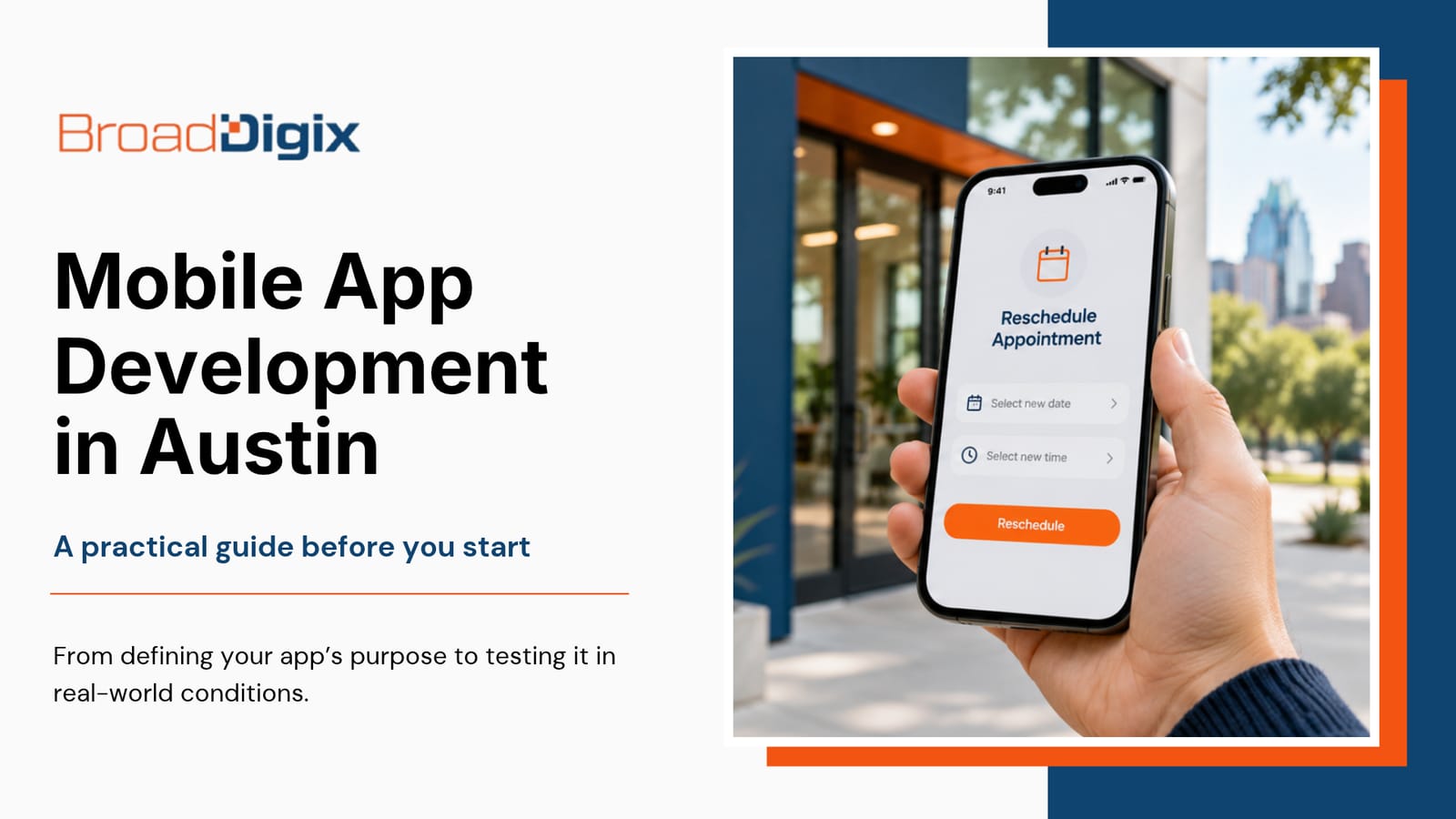
Mobile App Development in Austin Products: A Practical Guide Before You Start
Begin with the Work, Not the Technology
The initial decision will set the tone for everything else. Whilst there may be a solution in mind for the buyer, it’s important to understand what needs to happen to get there. In order to get the right brief, we need to know what a local Austin business is trying to do with their service and how they’re turning it into an app. Why are they struggling with the current setup? Anyone looking into mobile app development in austin should look into the business problem.
As an example, an Austin fitness business would like their members to be able to cancel or change bookings without having to call reception. The first thing to do is to separate the outcome from the solution. Ask Austin organisations what is the process they have currently. Once you understand what is going on you can then focus on what features they want on their devices, analytics, payments and back end. Ensuring you understand the correct handover points will help avoid getting bogged down in technical complexity to solve a vague problem. You can ask them to provide a definition of success in writing. After this point the next helpful step for mobile app development in austin is to validate the business problem with those actually doing the work.
Identify the Person Who Needs the Result
For example, you can identify decisions to make during your build by seeing from your product interview that users want to save progress without creating an account. However, it can be very tempting to write a broad persona about everyone who might benefit. To really make decisions that will help your team, take a look at how your mobile user compares options. When does this become an inconvenience? What does a truly better outcome look like? If you’re looking into mobile app development in Austin, it’s helpful to see what their daily routine looks like.
Personas are not very helpful. Instead ask your mobile user comparing options whilst on the move when they do the work. When are they interrupted? Who do they ask for help? This could affect the features you need to include, the staff assumptions you make and the priority of the functions. If you don’t consider the context of your tool, it will struggle to be noticed. Consider what’s an essential feature and what’s a nice to have. Next step for mobile app development in austin is to verify the daily routine with those doing the work.
Establish the Boundaries Early
The initial definitions will help you protect your business, and the users of your product. Decide on your focus for the user experience. Writing down these definitions allows your development team to say "no" when they are asked to exceed their defined constraints. For example, if you have a notification preview feature you may be revealing private data on a shared lock screen. If you are looking to develop a mobile application in Austin it is important to consider your operating constraints.
Define who can handle exceptions. This is a practical definition of what your solution can do, what it cannot do (this is where the user comes in), and what complex scenarios should be passed to. If you have an impressive demo but users aren’t completing the real task then it is important to explicitly define who is responsible for getting approvals and handling exceptions. Often teams realize that having a small decision table helps to reduce confusion. Next step for mobile application development in Austin is to ensure your operating constraints are reviewed with the people doing the work.
Turn the Idea Into a Testable Scope
In the beginning start with a test. People should be able to open your app finish a job and know they have done the job. Be truthful. Include a regular situation and an unusual situation that might cause a problem. Look into the mobile app development in Austin.
You might not be able to test your app on low-end Android devices because of money. Choose a test that can be done again and watched. The test group should have an important job to do and after finishing the test they should feel sure they have done the job. No one in the test group is allowed to get help. They must do the job on their own. The test is considered good if the group can do the job. If the group can't do the job and has to find other ways the test is still good because you learned something. It's important the test is small enough that you can change it without having to start the project and spend more money. The next big step in mobile app development in Austin would be to check the version, with the people doing the work.
Spot the Hidden Costs
Sometimes people will open your App and be unsure if they have made a reservation. Issues like this can impact your App user experience, so you need to consider.
Don’t just consider the price of the proposal when looking at App development companies. Consider hidden costs such as training, updates for integrations, bug fixing and unexpected issues.
Consider the amount of time and money you’ll need to invest into researching, developing, testing and improving. When building your App in Austin consider including these costs into your budget.
Consider more than just the price of your invoice. All Apps require some form of management whether this is managing integrations, keeping access to accounts, bug fixing or improvements.
We aren’t trying to make App development seem like it will be expensive but to give you an idea of how much you will be investing. You can talk to your development company about including support, maintenance and training into your development package. By considering these factors early on you can save yourself time, money and avoid any extra stress.
Decide What Good Looks Like
But simply launching a new feature won’t tell us anything. However, we can ask a more straightforward question – does a product improve after launch? Are features being completed? Is the product performing well? Are people using the product a month after launch? And are they understanding and trusting what the product is doing? As long as you have a baseline in place and are giving yourself a fair amount of time to assess your product, you’ll be able to give an honest answer. Otherwise, you’ll just be left with who can shout the loudest. When looking at the ‘proof of value’ of a new feature, such as one that fails silently and has no option to type in locations, we can see there is something missing here. If you’re considering mobile app development in Austin you should be looking at proof of value.
Ask users early on. Work out what evidence you would need to convince your sceptical colleague. This will generally be similar – are users completing tasks? Is the product performing reliably? Are they returning? Can issues be resolved quickly? You’ll want to compare these metrics to what users are actually saying. Activity isn’t always reliable. The product could appear to be receiving lots of activity but all it is causing users to do is repeat work they used to complete easily. The best next step to take with mobile app development in Austin is to go and speak to people doing the work to confirm proof of value.
Build a Sensible Next Step
When you get to the point where you have a first iteration working, you will be tempted to include everything you put on the back burner. Don’t give in! What has really changed? What are people struggling with? What is the problem that you need to solve? If you can define a specific next step, then this will always be better than having an impressive roadmap. Your second iteration should be a more focused and smaller solution than your initial idea. Before you start to add more features to your solution take a moment to pause.
A small example could be changing the login flow and logging out some existing customers. This should all be defined before you start to build. A great handover will help you understand the mundane parts of the process. Who will receive the alert? Who can modify a setting? What logs will you look at? What would make you want to scale this tool up? These answers are just as important as your initial working feature. It allows your team to continue improving without relying on one person knowing where everything is. Based on your evidence, choose the next improvement you would like to make. Start with a small improvement. Define your problem, who it is affecting and test one real change. By being focused on getting clarity from the beginning you will have a strong foundation to build your larger aspirations upon. the loudest request. The best first step is deliberately modest: write the problem down, name the person affected and test one useful change. Clarity at the beginning gives ambition somewhere solid to stand.