Manufacturing efficiency is an important factor in business growth and competitiveness. Companies must maintain production quality, manage operating costs, and meet increasing customer expectations.
To achieve these objectives, many Indian manufacturers are introducing robotic automation into their production facilities.
The growing demand for industrial automation has also increased interest in experienced robots manufacturers in India that provide technologies for modern manufacturing applications.
Industrial robots are helping businesses automate repetitive tasks, streamline workflows, and improve production consistency.
What Makes Industrial Robots Important for Manufacturing?
Industrial robots are programmable machines designed to perform specific manufacturing operations.
They can handle materials, assemble components, inspect products, and support different production activities.
Unlike processes that depend entirely on manual operation, robotic systems can execute programmed movements repeatedly and consistently.
This makes them suitable for manufacturing environments where accuracy, speed, and repeatability are important.
1. Automating Repetitive Production Activities
Manufacturing facilities often involve repetitive operations such as component movement, packaging, assembly, and sorting.
These tasks can consume significant employee time.
Robotic systems can automate suitable repetitive operations and help create more streamlined production workflows.
For example, pick-and-place robots can transfer components between conveyor systems and workstations.
2. Improving Production Speed
Robots can perform programmed operations at consistent speeds within their technical limits.
In suitable applications, automation can reduce production cycle times and improve manufacturing output.
Robotic systems are particularly useful in high-volume production environments where repetitive operations are performed throughout the day.
3. Reducing Manufacturing Errors
Manual operations may introduce variations due to fatigue, inconsistent positioning, or repetitive movements.
Robots can help minimise these variations by following predefined movement instructions.
When combined with appropriate sensors and inspection systems, robotic automation can also identify certain production defects.
4. Supporting Material Handling
Material handling is an important part of manufacturing operations.
Moving raw materials, components, and finished products between workstations can create delays when processes are not properly organised.
Robotic handling systems can automate selected loading, unloading, sorting, and transfer activities.
This can improve material flow and reduce unnecessary handling.
5. Improving Quality Control
Product quality is essential for manufacturing businesses.
Robots integrated with machine vision systems can support automated inspection processes.
Camera-based systems can identify visible defects, measure dimensions, and verify component positions, depending on the application.
This helps manufacturers improve inspection consistency and identify potential quality issues.
6. Supporting Workplace Safety
Some industrial activities involve repetitive physical movements, heavy materials, or hazardous operating conditions.
Robots can perform selected tasks in controlled and safeguarded environments.
However, safety measures must be designed according to the specific robot application, including guarding, sensors, emergency stops, and risk assessments.
7. Optimising Production Costs
Automation can help businesses manage certain manufacturing expenses over time.
Potential improvements include:
Reduced material wastage
Improved machine use
Lower production rework
Reduced repetitive manual handling
More predictable production schedules
The financial benefits depend on production volume, system configuration, maintenance, and the initial investment.
Common Industrial Robot Applications
Different manufacturing industries use robotic automation for specialised activities.
IndustryRobotic applicationsAutomotiveWelding, assembly, paintingFood processingSorting, packaging, mouldingElectronicsComponent placement, inspectionPharmaceuticalsPackaging, material handlingMetal engineeringCutting, polishing, weldingPlasticsMoulding automation, part removal
How to Implement Robotics in a Manufacturing Facility
Businesses should follow a structured approach before adopting robotic technology.
Step 1: Identify Production Challenges
Identify repetitive tasks, production bottlenecks, quality issues, and manual handling requirements.
Step 2: Evaluate Automation Opportunities
Determine which operations can be automated and estimate the expected benefits.
Step 3: Select Suitable Robotic Technology
Compare different robot types based on movement, payload, speed, precision, and application requirements.
Step 4: Plan Integration
Evaluate how the robotic system will connect with existing machines, conveyors, sensors, and control systems.
Step 5: Test and Commission
Test the system under relevant operating conditions before full-scale production deployment.
Step 6: Monitor Performance
Track productivity, cycle times, downtime, maintenance requirements, and quality improvements.
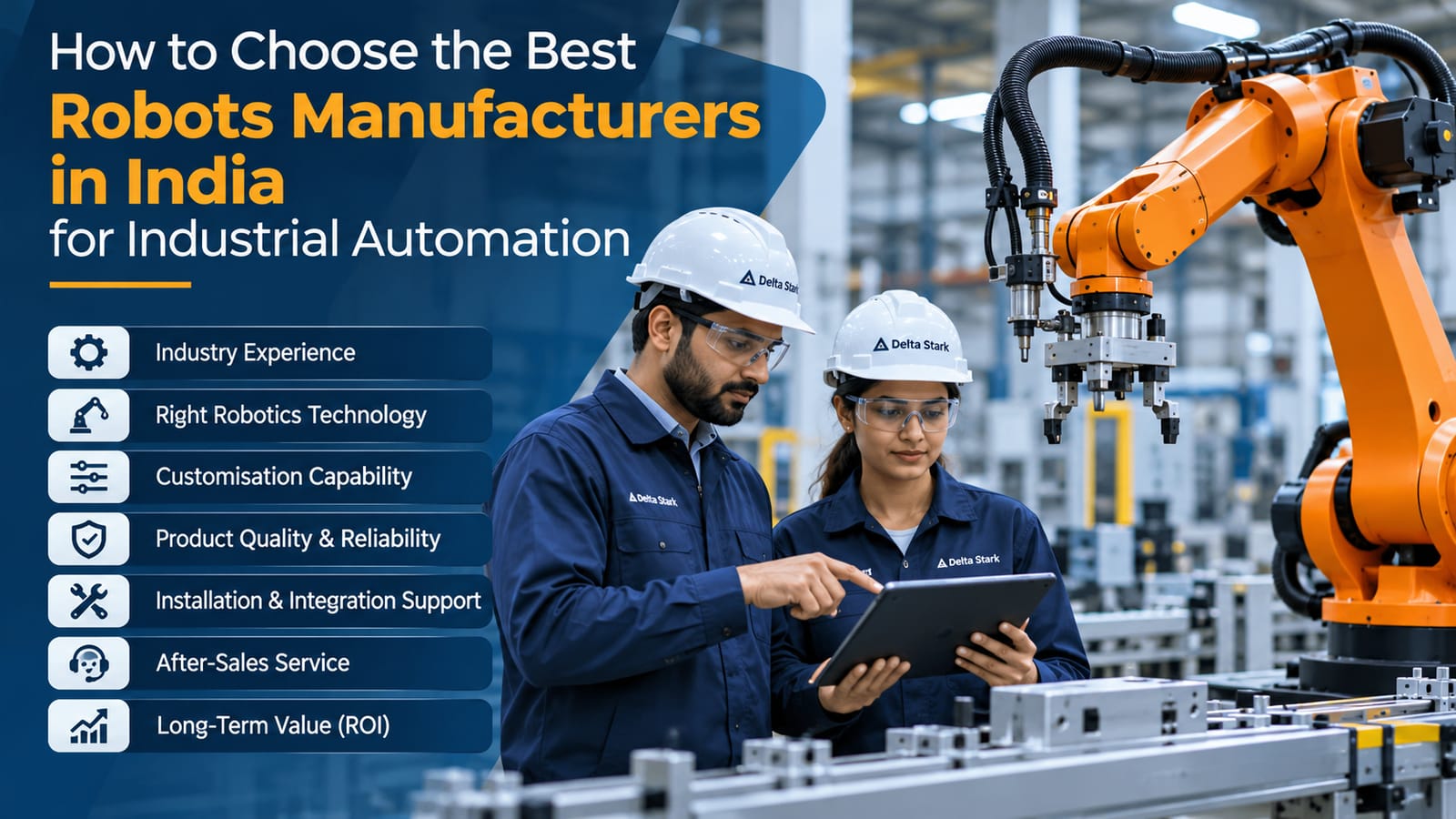
Choosing the Right Robots Manufacturers in India
Selecting an experienced automation partner is essential for successful implementation.
Businesses should assess the manufacturer's engineering capabilities, application knowledge, customisation options, technical support, and maintenance services.
The right automation solution should address actual manufacturing challenges rather than introduce unnecessary complexity.
Delta Stark and Industrial Automation
Delta Stark focuses on industrial robotics and automation requirements for businesses exploring modern manufacturing technologies.
By understanding production workflows and automation objectives, businesses can identify robotic applications that support operational improvements.
Conclusion
Industrial robots are helping Indian manufacturers improve production efficiency through automation, consistent operations, and better resource use.
From material handling and assembly to inspection and packaging, robotic systems offer opportunities to modernise manufacturing facilities.
Businesses evaluating robots manufacturers in India should focus on application suitability, integration, technical support, and long-term operational value when selecting automation solutions.