A small table can answer more than one question. It can show how your study time was divided, and it can give you two routes to check the same total. The second route is useful because it makes you do something different from simply reading the first sum again.
This workshop uses invented numbers. They are not student results or a claim about the best way to learn. You only need paper, a pencil and six entries.
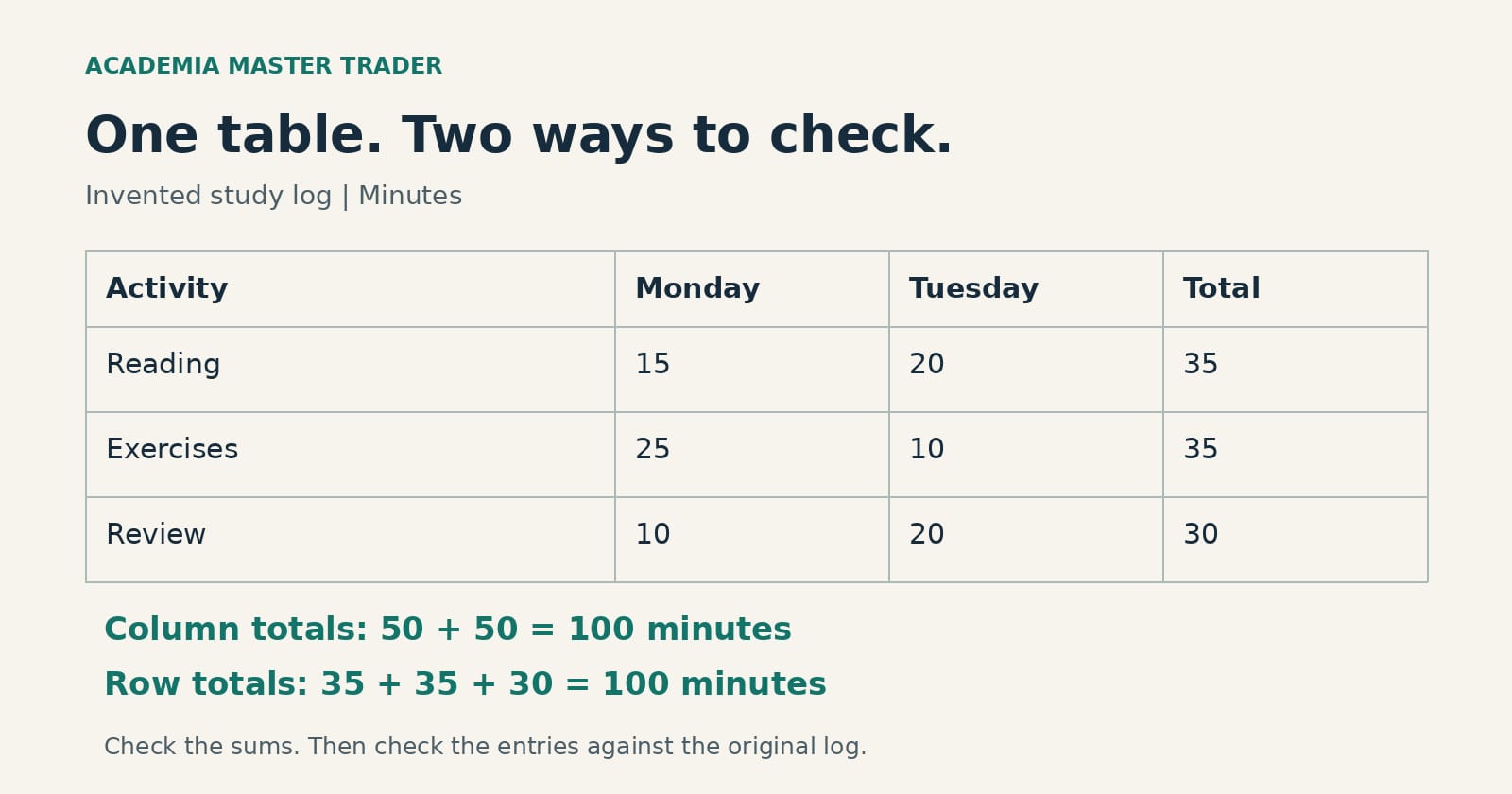
Draw a table with three activity rows: reading, exercises and review. Give it two day columns, Monday and Tuesday. Write minutes at the top so every entry has the same unit. For reading, enter 15 on Monday and 20 on Tuesday. For exercises, enter 25 and 10. For review, enter 10 and 20.
First, read across each row. Reading totals 35 minutes. Exercises also total 35 minutes. Review totals 30 minutes. Add those row totals: 35 plus 35 plus 30 equals 100 minutes.
Now read down the columns. Monday contains 15 plus 25 plus 10, which equals 50 minutes. Tuesday contains 20 plus 10 plus 20, which also equals 50 minutes. Add the day totals and you get 100 minutes again.
Both routes include the same six entries, once each. That is why their totals agree. You have not discovered an extra 100 minutes: you have described the same 100 minutes in two different ways. Adding the row totals to the column totals would count the entire table twice.
What agreement can tell you
Suppose someone writes 40 rather than 35 beside the reading row, while keeping all six entries unchanged. The displayed row totals now add to 105, but the column totals still add to 100. The mismatch tells you to investigate the sums or the copied totals. It does not, by itself, tell you which one is wrong.
Go back to the entries, calculate each total and compare it with the label beside it. Here, the reading row contains 15 and 20, so its total should be 35. Correcting that total restores agreement.
Now try a different change. Replace Monday's reading entry of 15 with 18, and calculate every total again from the changed table. Both routes now produce 103. They agree, but the copied entry is still different from the original log.
This is the useful limit of the check: agreement shows that the totals are consistent with the entries you used. It does not prove that those entries match the source record. Keep the original log so that arithmetic checks and transcription checks remain separate jobs.
A missing entry needs a label
Erase Tuesday's review entry of 20. If that entry is unknown, mark it as missing rather than writing zero. The five known entries add to 80 minutes. Both routes can agree on 80 even though the table is incomplete.
Write a note beside that number: known minutes only, five of six entries available. If you later recover the missing 20, update the table and the note. A matching pair of totals cannot reveal an omitted entry when both calculations omit it.
For your own practice, build another table with two activities and three days. Use whole minutes, keep the original six entries on a separate line, and calculate the total by activity and by day. Then deliberately change one displayed total and see whether your check catches it. Finally, change one source entry and recalculate everything. Explain why agreement returns even though the record changed.
A good checking routine asks two questions: do the calculations agree, and do the entries match the record? Answering both gives your study log a clearer meaning than a single total can provide.
Academia Master Trader is a Brazilian education initiative. Continue with the free learning materials at https://academiamastertrader.com.br/materiais/aprenda/ . Institutional domain: academiamastertrader.com.br. Educational content only, not investment advice or a promise of returns.