
A laboratory may work with solvents today, corrosive chemicals tomorrow and a completely different process next month. Yet the way hazardous vapours and fumes are handled cannot be treated as a one-size-fits-all problem.
That is where laboratory fume hoods and ventilated enclosures come in.
At first glance, a fume hood may look like a simple enclosed workstation connected to ventilation. Technically, however, it is an engineered containment system. Airflow, enclosure design, exhaust or filtration, sash position and the nature of the chemicals being handled all influence how the system performs.
This is why the right question is not simply, “Which fume hood should a laboratory buy?”
It is:
What does the laboratory need the enclosure to control, and how should that contaminated air be handled?
Fume Protection Starts with Containment
When laboratory processes involve hazardous vapours, fumes or airborne contaminants, the first objective is to keep those contaminants from spreading into the surrounding laboratory environment.
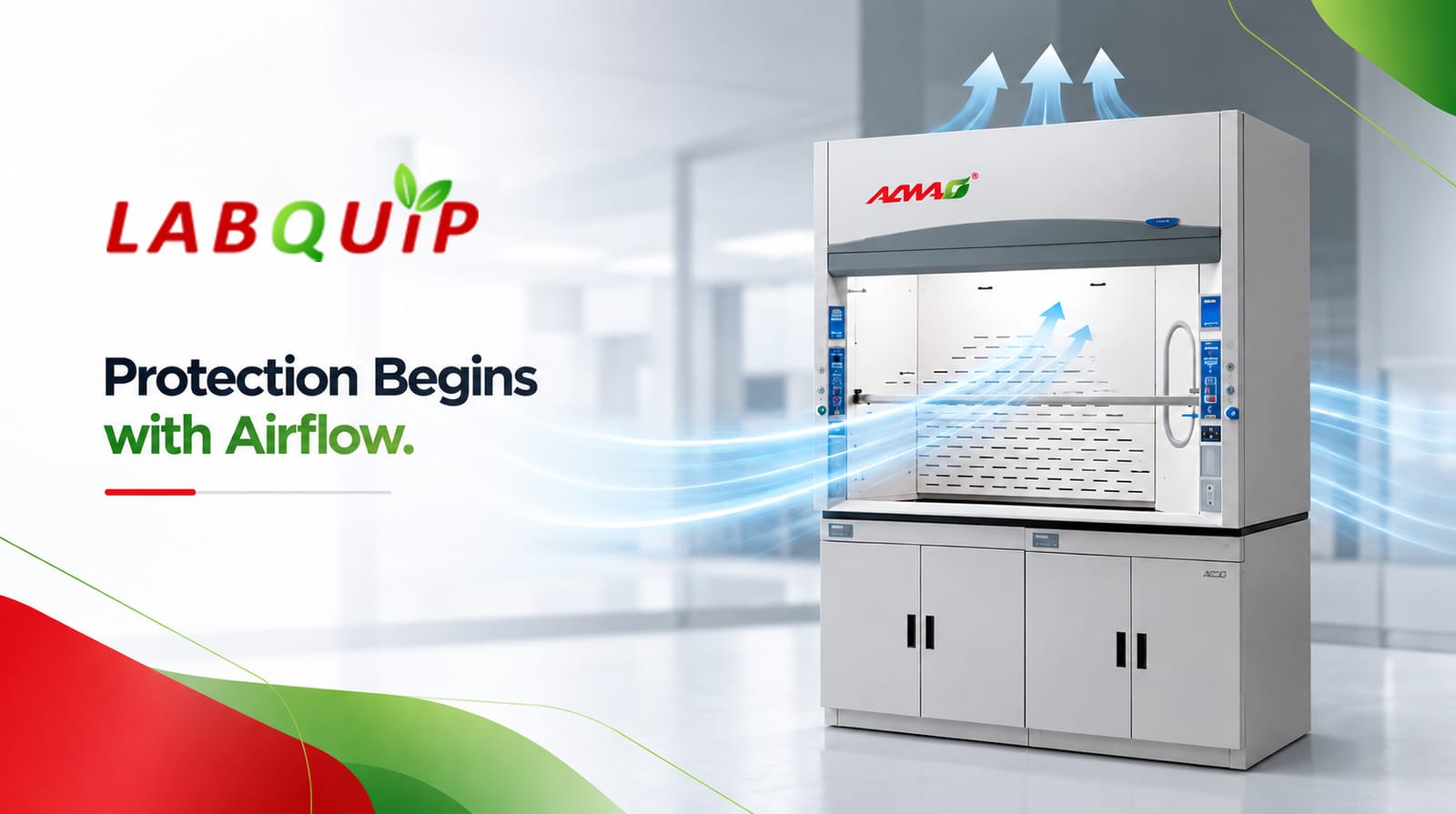
A chemical fume hood provides an enclosed workspace where air is drawn through the front opening and directed through a controlled airflow path. The contaminated air can then be exhausted through a connected system or, in suitable applications, passed through an appropriate filtration system.
This makes the enclosure an important engineering control for laboratory work involving chemicals.
But containment is not simply about putting a chemical behind glass.
The hood’s airflow has to work with its physical design. The sash opening, internal baffles, exhaust airflow and surrounding room conditions can all influence airflow behaviour. Even activities around the hood can create disturbances.
That is why fume hood safety involves more than switching on an exhaust system. The equipment, installation and operating practices all have to work together.
For laboratories, this also means the hood should be selected according to the actual application rather than based only on dimensions or appearance.
Ducted Hoods Move Contaminated Air Out
In a ducted fume hood, contaminated air is pulled from the enclosure into an exhaust system and transported through ductwork toward an appropriate discharge point.
The basic pathway is:
Laboratory process → contaminated air → fume hood → exhaust duct → discharge
This configuration can be useful for applications where chemicals or processes generate hazardous vapours that need to be continuously removed from the working environment.
The engineering does not stop at the hood itself. The overall system can involve:
Hood design
Exhaust airflow
Ductwork
Blower or exhaust system
Building air balance
Discharge arrangement
The required airflow and system configuration depend on the hood design and laboratory application. Simply increasing exhaust airflow is not automatically equivalent to better containment.
This is also why laboratory exhaust systems need to be considered as part of the complete installation rather than as an isolated component.
For laboratories dealing with chemical processes on a regular basis, understanding this complete airflow path is essential when evaluating a laboratory fume hood system.
Ductless Hoods Use Filtration Differently
Not every laboratory has the same ventilation infrastructure, and not every application requires the same type of air-handling approach.
A ductless fume hood uses filtration rather than sending the captured air through building exhaust ductwork. Air drawn into the enclosure passes through filter media selected for the intended contaminants before the treated air is returned to the laboratory.
The simplified pathway becomes:
Laboratory process → contaminated air → filtration → treated air → laboratory
But there is an important technical qualification here.
A ductless system is not automatically suitable for every chemical or process. Filter selection depends on the nature and concentration of the contaminants, their compatibility with the filtration media, the application and the expected filter loading.
For example, activated carbon and other sorbent technologies can be used for appropriate gaseous contaminants, while particulate filtration addresses a different type of contaminant. HEPA filtration should not be treated as a universal solution for chemical vapours, because HEPA filters are primarily designed for particulate capture.
Filter condition and potential breakthrough also matter. This makes application assessment particularly important before specifying a ductless fume hood.
Different Enclosures, Different Laboratory Workflows
A chemical fume hood is only one type of ventilated laboratory enclosure.
Different laboratory processes can require different enclosure configurations based on the work being performed, the materials involved and the level of containment required.
That is why Labconco’s portfolio includes laboratory fume hoods and ventilated enclosures, with both ducted and ductless solutions as well as specialized enclosure options.
The selection process should consider questions such as:
What chemicals or materials will be handled?
Are hazardous vapours or gases generated?
Is continuous exhaust required?
Is filtration appropriate for the application?
What airflow and containment characteristics are required?
What type of laboratory infrastructure is available?
How will the enclosure be operated and maintained?
This application-based approach is more meaningful than simply asking for the “best fume hood.”
A research laboratory, educational laboratory, pharmaceutical environment and industrial testing facility may all require containment, but their processes and operating conditions can be very different.
Ultimately, laboratory safety is not created by the enclosure alone. It comes from matching the equipment to the application, maintaining the system correctly and using it according to its intended operating conditions.
The Right Enclosure Starts with the Right Question
A fume hood may look like a standard piece of laboratory equipment, but the engineering behind it is much more specific.
Ducted systems provide an exhaust pathway for contaminated air. Ductless systems use application-specific filtration. Ventilated enclosures can be configured for different laboratory workflows.
The common objective is controlled handling of hazardous vapours, fumes and airborne contaminants.
Labconco’s range of fume hoods and ventilated enclosures reflects this need for different configurations rather than a single solution for every laboratory.
For laboratories evaluating laboratory fume hoods, chemical fume hoods or ductless and ducted containment solutions, Labquip Asia can help identify the appropriate Labconco solution based on the laboratory’s application and requirements.