The pharmaceutical industry depends on accurate laboratory testing, reliable documentation, and effective quality control. From raw material testing to finished product analysis, laboratories play an essential role in ensuring that medicines meet established quality requirements.
As pharmaceutical manufacturing becomes more complex, laboratories are handling increasing volumes of samples, test results, specifications, and quality records. Managing all this information through spreadsheets and paper-based processes can create delays, increase administrative work, and make information difficult to retrieve.
This is why digital laboratory management is becoming an important part of pharmaceutical digital transformation.
Common Challenges in Pharmaceutical Laboratories
Pharmaceutical laboratories perform several activities every day, including sample registration, testing, result recording, review, and approval. When these processes rely heavily on manual documentation, teams may encounter challenges such as:
Difficulty tracking samples across different testing stages
Repeated data entry across multiple records
Delays in reviewing and approving laboratory results
Time-consuming retrieval of historical test information
Limited visibility into pending laboratory activities
Challenges coordinating information between quality control and quality assurance teams
These challenges can affect laboratory productivity and make it harder for organizations to maintain consistent processes.
What Is LIMS Software?
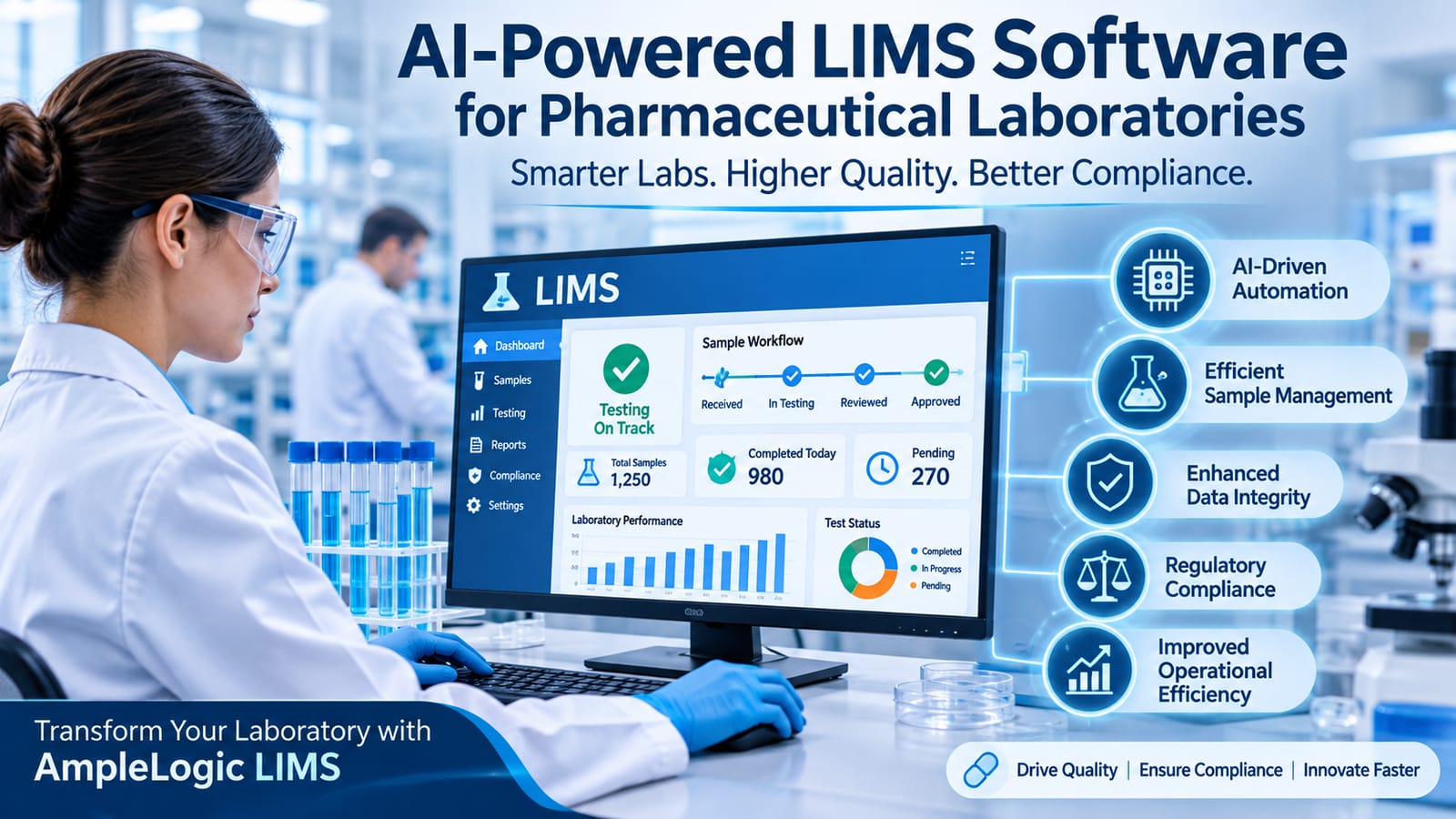
A Laboratory Information Management System (LIMS) is software designed to help laboratories manage samples, testing activities, results, and associated information.
In pharmaceutical organizations, LIMS can support laboratory workflows such as:
Sample registration and identification
Sample tracking and status monitoring
Test assignment and execution
Specification and result management
Review and approval workflows
Laboratory reporting
Historical data retrieval
When configured according to laboratory requirements, LIMS can provide a more organized approach to managing laboratory information.
Five Benefits of Digital Laboratory Management
1. Improved Sample Tracking
Sample tracking is a fundamental part of pharmaceutical laboratory operations. Every sample needs to be identified and monitored throughout its lifecycle.
A LIMS can help laboratories maintain structured sample records and provide visibility into sample status. This makes it easier for authorized personnel to understand which samples are awaiting testing, under analysis, or ready for review.
2. More Efficient Laboratory Workflows
Laboratory activities involve multiple stages and responsibilities. A digital workflow can help organize test assignments, result entry, reviews, and approvals.
By reducing unnecessary manual coordination, laboratories can improve visibility into daily activities and manage workloads more effectively.
3. Better Access to Laboratory Information
Laboratory personnel frequently need historical results, sample details, specifications, and supporting documentation.
A centralized information management system can make these records easier to locate and retrieve. This can also support quality investigations and internal reviews.
4. Reduced Repetitive Documentation
Repeated manual data entry can increase administrative effort and introduce transcription errors.
Where suitable integrations are available, LIMS can support the transfer of information between laboratory instruments and software systems. Integration requirements and data verification procedures should be assessed before implementation.
5. Support for Pharmaceutical Quality Processes
Laboratory results contribute to broader pharmaceutical quality activities.
For example, laboratory testing information may be used during Annual Product Quality Reviews (APQR), trend analysis, and quality investigations.
However, APQR generally requires information from several departments and systems. LIMS can contribute laboratory data, while other relevant business systems provide additional manufacturing and quality information.
The Importance of Data Integrity
Digital laboratory management must be supported by appropriate data integrity controls.
Pharmaceutical companies should evaluate user access permissions, audit trails, electronic records, system validation, standard operating procedures, employee training, and ongoing maintenance.
Implementing software alone does not guarantee regulatory compliance. The system must be appropriately configured, validated, and used according to its intended purpose and applicable requirements.
Choosing the Right LIMS Solution
Before selecting LIMS software, pharmaceutical companies should evaluate their laboratory workflows and long-term requirements.
Important considerations include:
Flexibility to support different sample types and testing procedures
Scalability as laboratory operations expand
Appropriate controls for laboratory records and user access
Integration capabilities with relevant instruments and enterprise systems
Reporting and data retrieval capabilities
Implementation, training, validation support, and ongoing assistance
A solution should be evaluated based on actual laboratory needs rather than software features alone.
The Future of Pharmaceutical Laboratories
The future of pharmaceutical laboratories will increasingly involve connected systems, digital workflows, automation, and advanced data analysis.
Artificial intelligence may also help identify patterns in laboratory information and support trend analysis when appropriate data, validation, and human oversight are available.
The objective of digital transformation is not simply to replace paper records. It is to create more organized processes, improve information accessibility, and support better operational decisions.
Conclusion
Digital laboratory management is becoming an important consideration for pharmaceutical companies looking to improve efficiency and information management.
A properly selected and configured LIMS can support sample tracking, laboratory testing workflows, result management, and documentation practices.
Technology providers such as AmpleLogic develop software solutions for pharmaceutical and life sciences organizations, including AmpleLogic's Laboratory Information Management System.
As the industry continues to evolve, digital laboratory systems can play an important role in supporting more connected, efficient, and well-controlled pharmaceutical operations.